


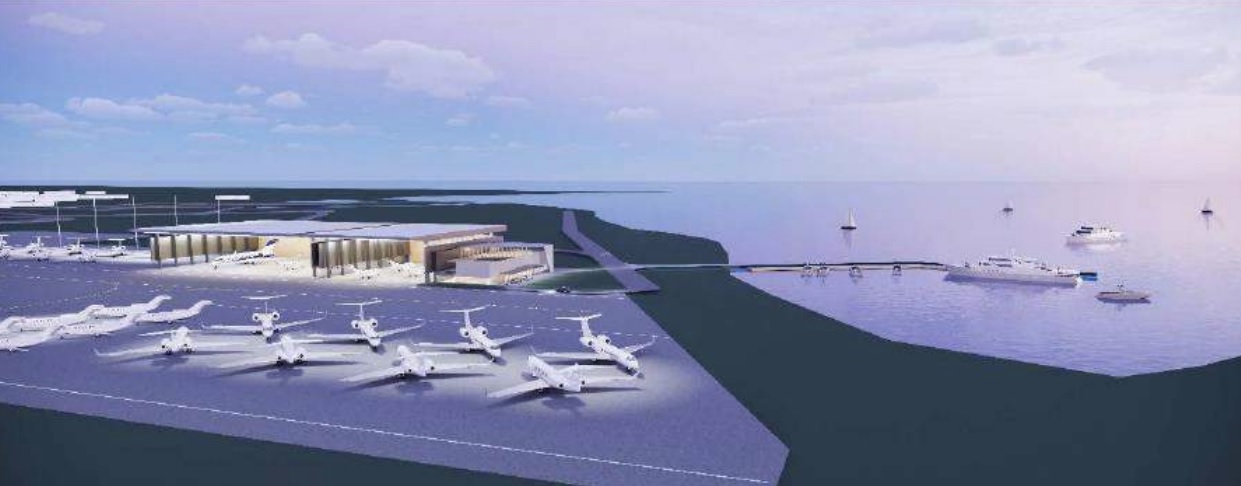
The Central Planning Authority has approved an application to extend the apron at the Owen Roberts International Airport in preparation for the development of a terminal for private aircraft.
AMR Consulting Engineers has been granted permission to expand the apron by 682,127 square feet, as part of the work relating to the construction of a new $42 million general aviation terminal for private jets at the airport.
The planning board, at its 30 April meeting, considered the $1.2 million application to extend the apron pavement as well as the existing service road, and add a generator and a utility building. The minutes of that meeting, released recently, confirm that planning permission was received.
The matter had been scheduled to be heard in March, but adjourned when an objector to the project failed to attend the meeting. The objector, who had raised concerns about the environmental impact the project may have on the adjacent North Sound, also did not attend the 30 April meeting, so the hearing went ahead.
Central Planning Authority chairman Ian Pairaudeau excused himself from the hearing, citing a conflict of interest, and that part of the meeting was chaired by Charles Russell.
The $1.2 million project is part of a wide-ranging, multi-year, $660 million proposal for all three of Cayman’s airports, set out in a master plan published in 2023.
Elements of that master plan – including an extension of the Owen Roberts runway 2,100 feet into the North Sound, the addition of runway-end safety areas to the Charles Kirkconnell International Airport on Cayman Brac, and the relocation of Little Cayman’s Edward Bodden Airfield – are currently subject to environmental impact assessments, and a public consultation exercise is under way.
A spokesperson for the Cayman Islands Airports Authority told the Compass this week that, now planning permission has been granted, the next steps “are simply to continue with the project approval process in accordance with the Section 3 of the Procurement Regulations“.
Section 3 involves project appraisal and business case requirements.
The planning board outlined a series of conditions while granting permission to the project, including that AMR must submit a detailed mitigation plan for the review and approval of the Department of Environment. That plan “needs to outline measures to help offset the related impacts to the mangrove habitat, including but not limited to, replanting, habitat restoration or other compensatory actions”, the board noted.
Other conditions stipulate that, if insulating concrete forms or polystyrene are used during construction, all shavings, foam waste or polystyrene debris must be completely captured on site and not impact the surrounding area.
The Central Planning Authority, outlining the reasons for granting planning permission, said it had determined that it complied with the Development and Planning Regulations, and that the objector had not raised sufficient grounds for refusing permission.
“The objector provided no evidence that the proposal would cause environmental degradation and the Department of Environment did not oppose the application and recommended that a condition be imposed requiring the submission of a mitigations plan. The Authority included this condition in its approval of the application,” the authority noted in the meeting minutes.
.