


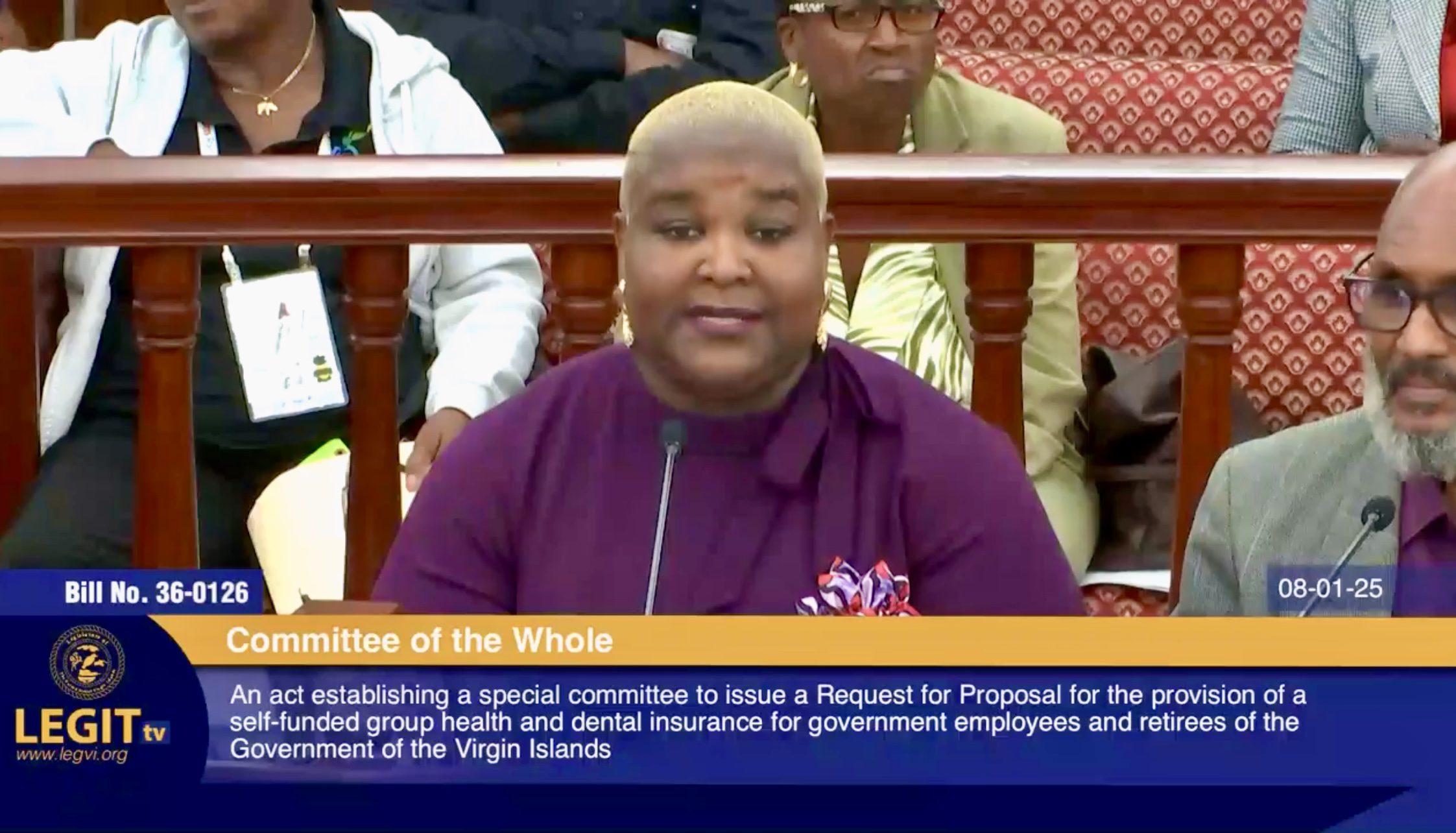
Tensions ran high during Friday’s special session as members of the Government Employees Service Commission Board and governor’s financial team clashed over a bill to establish a special committee tasked with issuing a Request for Proposal to evaluate the merits of a self-funded group health and dental insurance plan — prompting senators to question not just the proposal, but the governor’s intent in excluding the board from the process.
“We’re not getting along and we’re not working together — otherwise we wouldn’t be having this conversation today if we were,” said Sen. Carla Joseph about an hour into the back and forth.
At the center of the discussion was Bill No. 36-0126, which would create a five-member special legislative committee responsible for soliciting proposals from third-party vendors capable of designing and managing a self-funded health plan. The committee would be required to compile a comprehensive report outlining the advantages, disadvantages, projected cost savings, and potential risks and submit it to the Legislature within 180 days. The measure would also allocate up to $500,000 for the process.
The most controversial section — Section 6 — included language stating that the GESC board “shall have no role in the implementation of any contract resulting from this act,” while elsewhere empowering the board to adopt rules and regulations. Several senators pointed to the inconsistency, saying it appeared to undercut the board’s statutory authority, while others questioned the rationale behind forming a new committee to carry out work the board is already empowered to do.
Testimony: Administration vs. GESC Board

Personnel Director Cindy Richardson testified that the administration is not seeking to immediately implement a self-funded insurance model, but rather to explore its viability. She, along with Office of Management and Budget Director Julio Rhymer, pointed to potential savings on administrative fees and pharmaceutical rebates, adding that Cigna, the government’s current insurance carrier, has already indicated a willingness to participate in a self-funded arrangement. Still, they said, expert analysis is required to determine whether such a shift is feasible.
In his testimony Friday, Rhymer said health care costs have increased significantly, from $116 million in 2018 to a projected $226 million in fiscal year 2026 and added that self-funding could allow for greater customization of benefits and better cost control. Finance Commissioner Kevin McCurdy echoed those sentiments, noting that over $1.2 billion has been paid in premiums over the past six years. He said redirecting even a portion of those funds into local health care infrastructure could be transformative.
Meanwhile, in her testimony, GESC Board Chair Beverly Joseph said the board had tasked its consultant, the Gehring Group, with conducting a detailed comparison between the fully insured plan currently offered by Cigna and a potential self-funded model using the government’s existing benefits and claims data. According to Joseph, the results showed that while the self-funded option might save approximately 2.5% — about $4.3 million — the cost exposure and unpredictability presented significant risks.
“Under the fully insured model, we do not have to pay for the claims that exceed our premium — that is the insurance company’s obligation,” Joseph explained. “But under the self-insured model, we would need a fallback strategy to pay the claims and would have had to absorb those excess claims costs or risk loss of coverage.”
Joseph said the plan is currently in a $32 million deficit due to rising claim costs over the last three years, a gap that would have put the government on the hook had it already moved to a self-funded model. “Without the right expertise, infrastructure, and contingency planning, these plans can jeopardize not just fiscal health, but the well-being of the public workforce and the reputation of the government body itself,” she said.
She added that while the self-funded model offers greater flexibility and cost control, it also exposes the government to substantial risks — particularly in the absence of robust reserve funds, experienced third-party administrators, and a reliable payment structure for high-cost claims.
Reactions: Oversight, Conflicts, and Data Concerns
Once testimony concluded, senators quickly took issue with the administration’s decision to exclude the board from the process.
Sen. Kenneth Gittens asked Richardson directly whether she, as a nonvoting member of the GESC board, had supported the board’s statutory obligations. Richardson said she could not, as the Division of Personnel does not have that authority. When pressed by Gittens about whether the board had discussed issuing an RFP, Richardson said, “In my time there, there has been no discussion about them issuing an RFP to be able to go this route.”
Richardson also said that the GESC Board was created by statute to oversee the government’s health insurance plan, but said that Section 6 of the bill was included to allow for a separate process.
“If Section 6 is asking for them to not have a role in this, there has to be a reason,” she said, adding that the board had been presented with the self-funding option multiple times and that their own consultant had also been encouraged exploring cost-saving alternatives. “I do feel there may be a little bit of conflict of interest as well, and the separation needs to be there,” Richardson said. “That’s why Section 6 was included in the bill — so that a separate committee can be formed to go and get the information needed and then present it back to them. It’s not eliminating them fully — it’s just presenting it for this RFP process.”
In response, Senate President Milton Potter called the exclusion of the board “off-kilter,” given its statutory mandate. “It’s clear that the GESC health insurance board was developed by statute to do what the governor is asking this other committee to do,” he said. “Almost like you’re saying the governor is in disagreement with the posture of the board — so this is now a way around to achieve the ends that the governor may be seeking.”

Meanwhile, Joseph challenged Richardson’s characterization of the board’s effectiveness. “It is in the Virgin Islands Code: it is the responsibility of the board, if we want to go out to RFP,” she said. “If anyone is going to be a conflict of interest, it’s going to be the director. She is a member on the plan, the Director of Personnel that administers the plan, an advisory member to the governor, and sits in every meeting – including our executive sessions. She hears the data.”
“For her to say that we don’t get the data is false,” Joseph said. “We sit with all the carriers and our consultant and ask them how we can cut costs,” adding that cost increases are being driven by the health status of the plan’s members — not inefficiencies in board oversight. “When Cigna last reported to the board — and the director was there — they said our cancer rate has gone through the roof,” she said. “You’ve got to pay for the treatment, you’ve got to pay for the medications. We have 12 members with claims over $2 million, and 234 more that are driving costs even higher.”
“We’re not opposed to self-funding,” she concluded. “We’re just asking: can we assume the cost? Can we sustain the risk?”
Later, Joseph also argued that much of the analysis the administration is requesting has already been started by the board’s consultant, the Gehring Group.
“This doesn’t need an RFP. It needs an RFI,” she continued, referring to a request for information. “This is why we engage our consultant. They understand the size of our plan. They’ve already begun this work.”
That back-and-forth prompted Sen. Alma Francis Heyliger to call out the session’s purpose and tone. “I just want to put on the record – I think today is a waste of government funds,” she said. “If we’ve gotten to the point that you’re coming to me as a senator to circumvent the law, we have a problem.”
She added, “This was not an emergency. This was an individual that was upset that the Legislature took away his $50,000 raise, and he was looking for something to throw back at us.” She questioned why a new committee would be formed when the board had already undertaken the assessments being requested.
Potter also pressed officials on the administration’s claim that transitioning to a self-funded model could save the government between $25 to $30 million. “It seems very arbitrary —the numbers that were just put out there,” Potter said. “With no real analytics, with no real data, it has a way of skewing the whole conversation. Instinctively, you just say $25 to $30 million — wow — but those numbers are not based on any real, live information.”
Rhymer acknowledged that the estimate was preliminary, but said potential savings could come from several areas, including pharmaceutical rebates and a more customized benefits structure. “Currently, insurance companies benefit from rebates,” Rhymer said. “In a self-funded model, the government could capture those – about $10 to $15 million a year. That’s one thing.” He added that moving away from a standard plan to tiered coverage based on employee demographics could also reduce costs.
Later, Sen. Marise James focused on what she described as inconsistencies in the bill itself. “Words matter,” she said, pointing to Section 6, which bars the GESC Board from participating in any contract implementation resulting from the act. She contrasted that with another section of the bill that empowers the board to adopt rules and regulations related to third-party contracting. “It’s inconsistent,” she said.
James later engaged in a brief exchange with McCurdy, who questioned whether $1.2 billion in government insurance spending had led to better health outcomes. McCurdy suggested that the territory might benefit more by investing directly in local hospitals. “What we need to do is maybe put that money into things like the hospital — things that maybe help us to get to a healthier workforce and community,” he said.
James responded, “When we cut out a lot of waste, fraud, and abuse and start to see that investment in our hospitals in the Virgin Islands — yes.”
It was after James’s last sentence — and hours of unresolved questions about process, authority, and motive — that the power went out in the Senate chambers on St. Thomas, the result of a scheduled outage on St. Thomas. With six senators still waiting to speak, the body voted to waive the remainder of the debate. Instead, all of the 13 members present voted against the measure.
