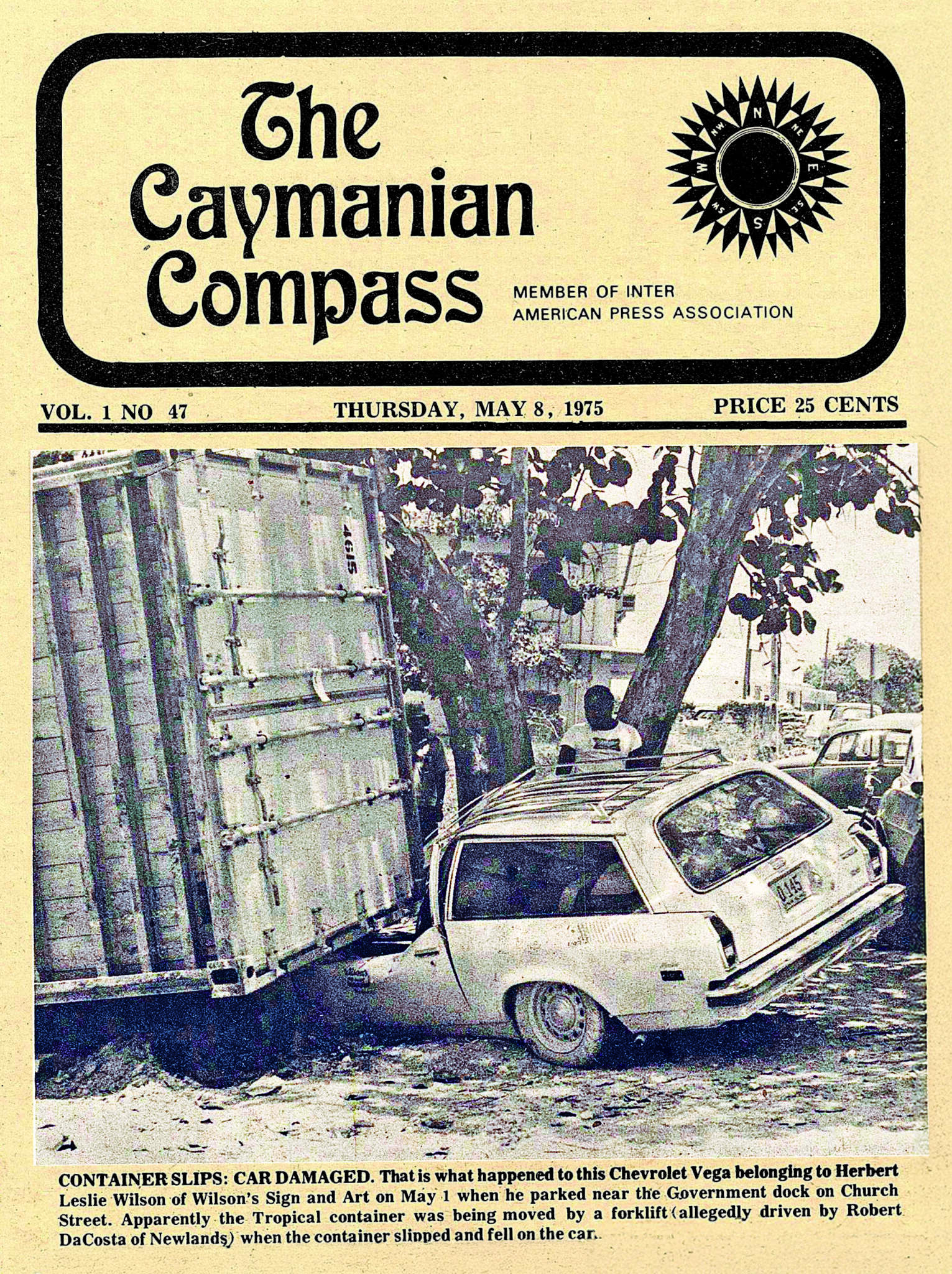
The good news was that no one was hurt; the bad news was that someone’s car got flattened, as shown in a front-page photo in the 8 May 1975 edition of The Caymanian Compass. A container being moved by a forklift had slipped and fallen onto the parked Chevrolet Vega belonging to Herbert Leslie Wilson of Wilson’s Sign and Art.
And, yet again, the proposed Development Plan was in the news. This time, a group of businessmen called for the draft of the plan to be scrapped, warning that the proposed restrictions would “force the Cayman Islands into bankruptcy”.
In a letter to the Compass, the businessmen said, “This Plan, together with recent actions of the Planning Board, is destroying the economy of these islands, The havoc has ALREADY BEGUN.” They criticised the “arbitrary” zoning of private land as “undemocratic”. Among the people signing the letter were Theo Bodden, president of the Chamber of Commerce; R. E McTaggart, former politician and businessman; Capt. E. K. Kirkconnell, former legislator and Executive Council member; and Mrs. Veta Bodden, chairman and managing director of HO Merren and Co. Ltd.

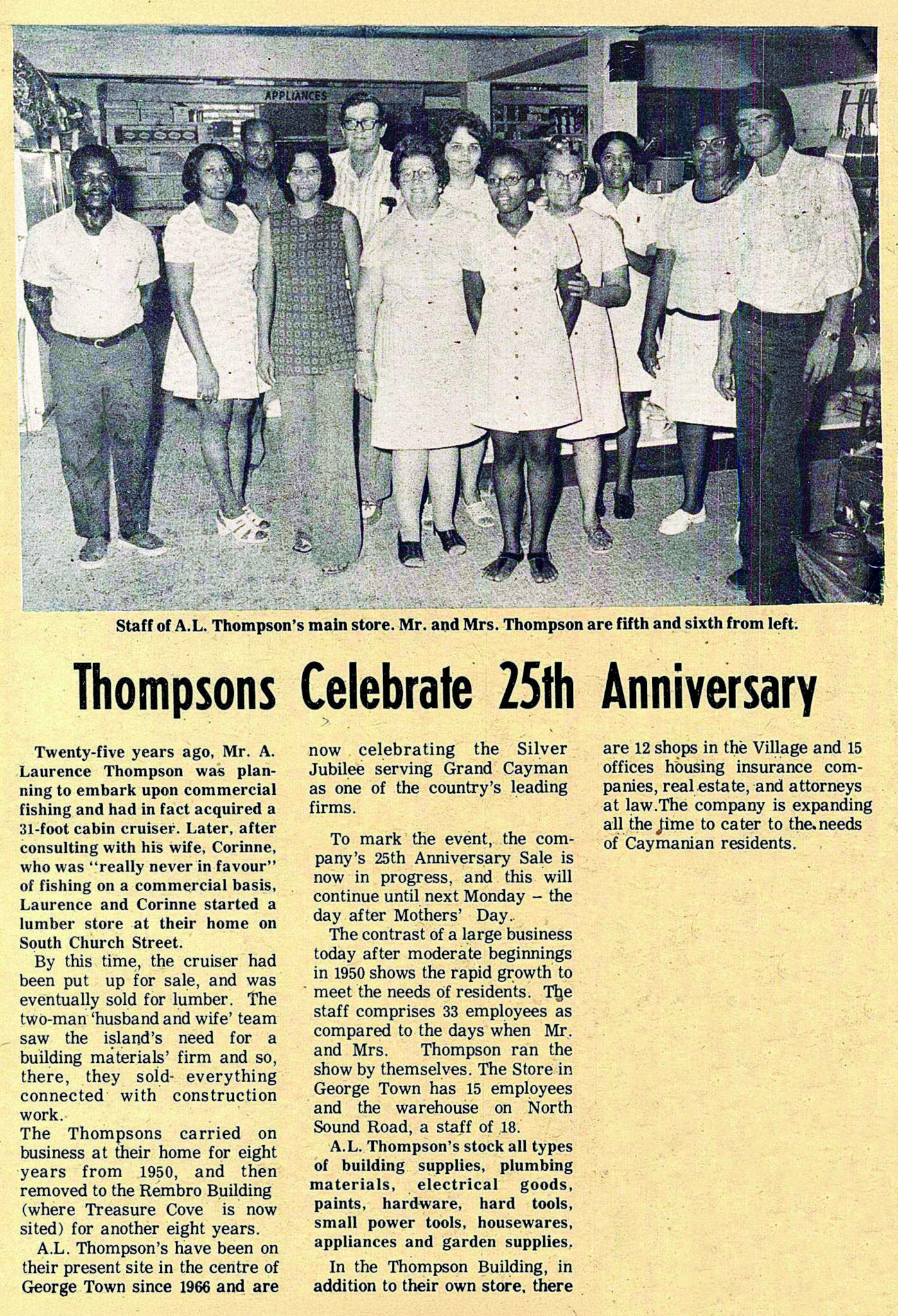
The editorial noted that police have “made a grand effort” to improve traffic by putting up a stop sign and traffic island at the four-way junction by Shedden Road, Schoolhouse Road, North Sound and Crewe Road. However, it was noted that the island “takes up too much of the road”, making it “difficult” for heavy-duty vehicles, and called on the traffic department to “reconsider the situation in the interest of greater road safety”.
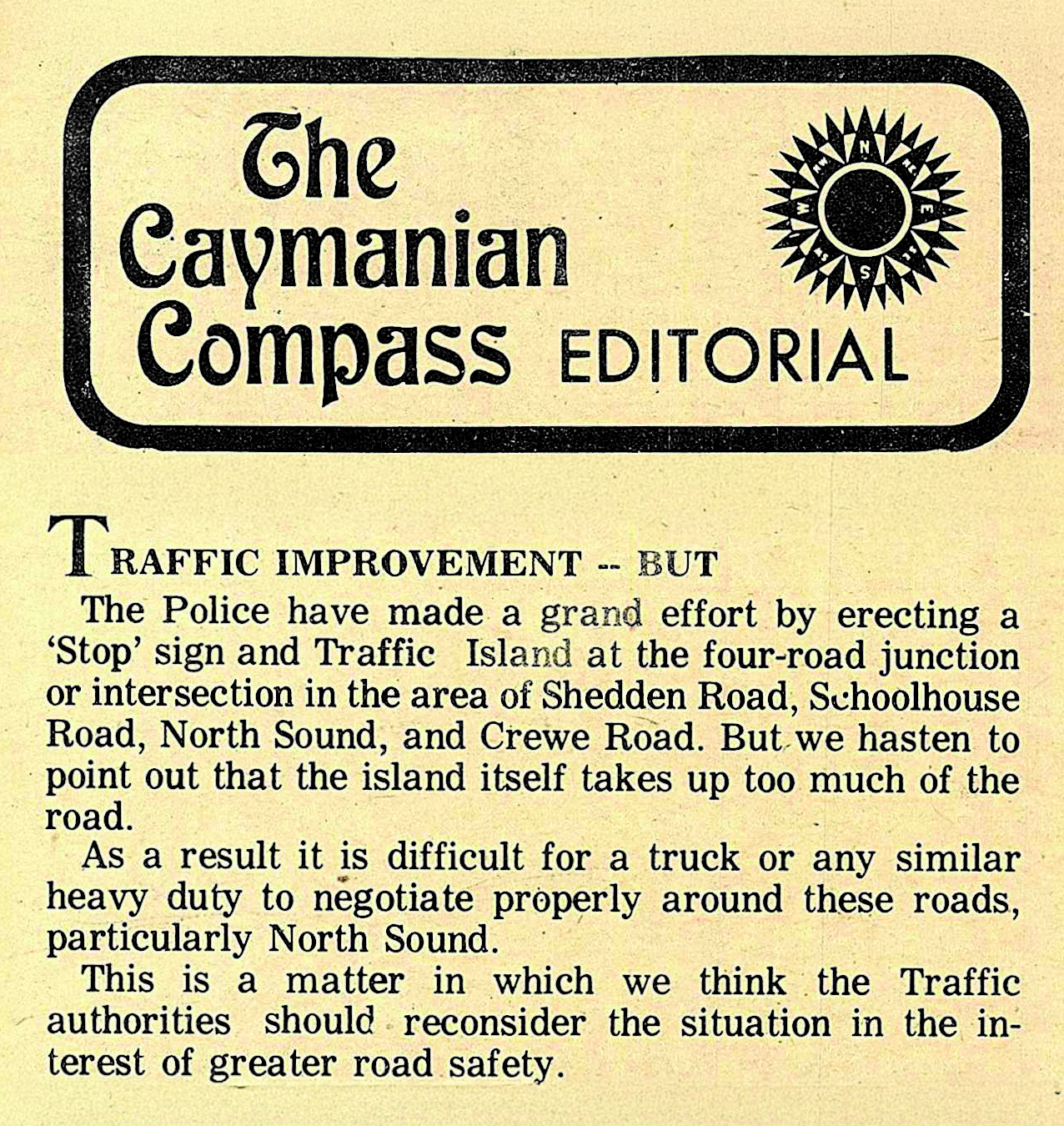
A. L. Thompson’s celebrated its 25th anniversary, with an article chronicling how Laurence and Corinne Thompson first started a lumber store at their South Church Street home, which they ran from 1950-1958 before moving into the Rembro Building. The store had been at their present site in the centre of George Town since 1966.