


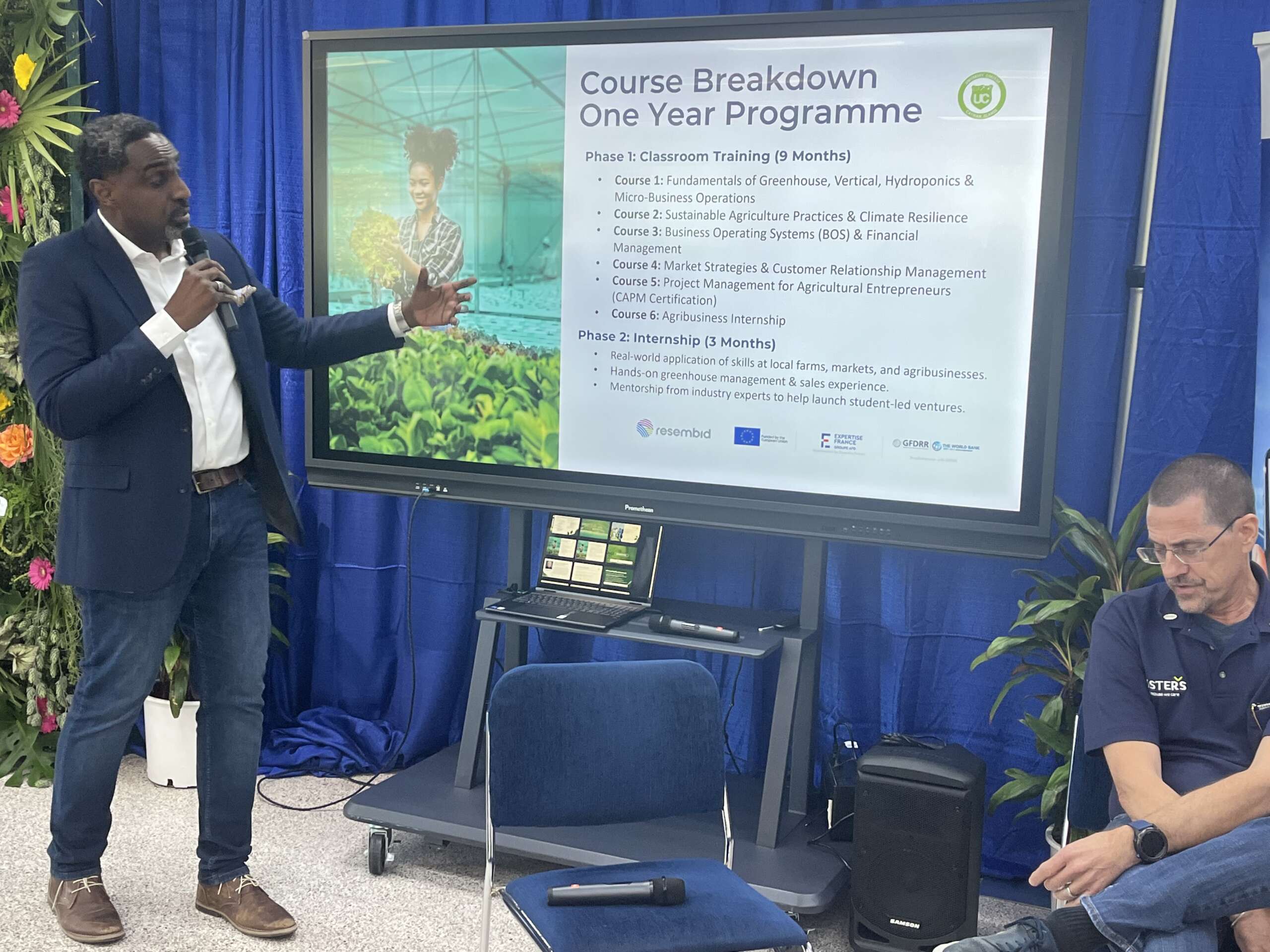
With Cayman importing more than 90% of its food, and most of that coming from the US, a recent panel discussion looked at how to create a sustainable path to growing the local agriculture sector and reducing dependence on overseas production.
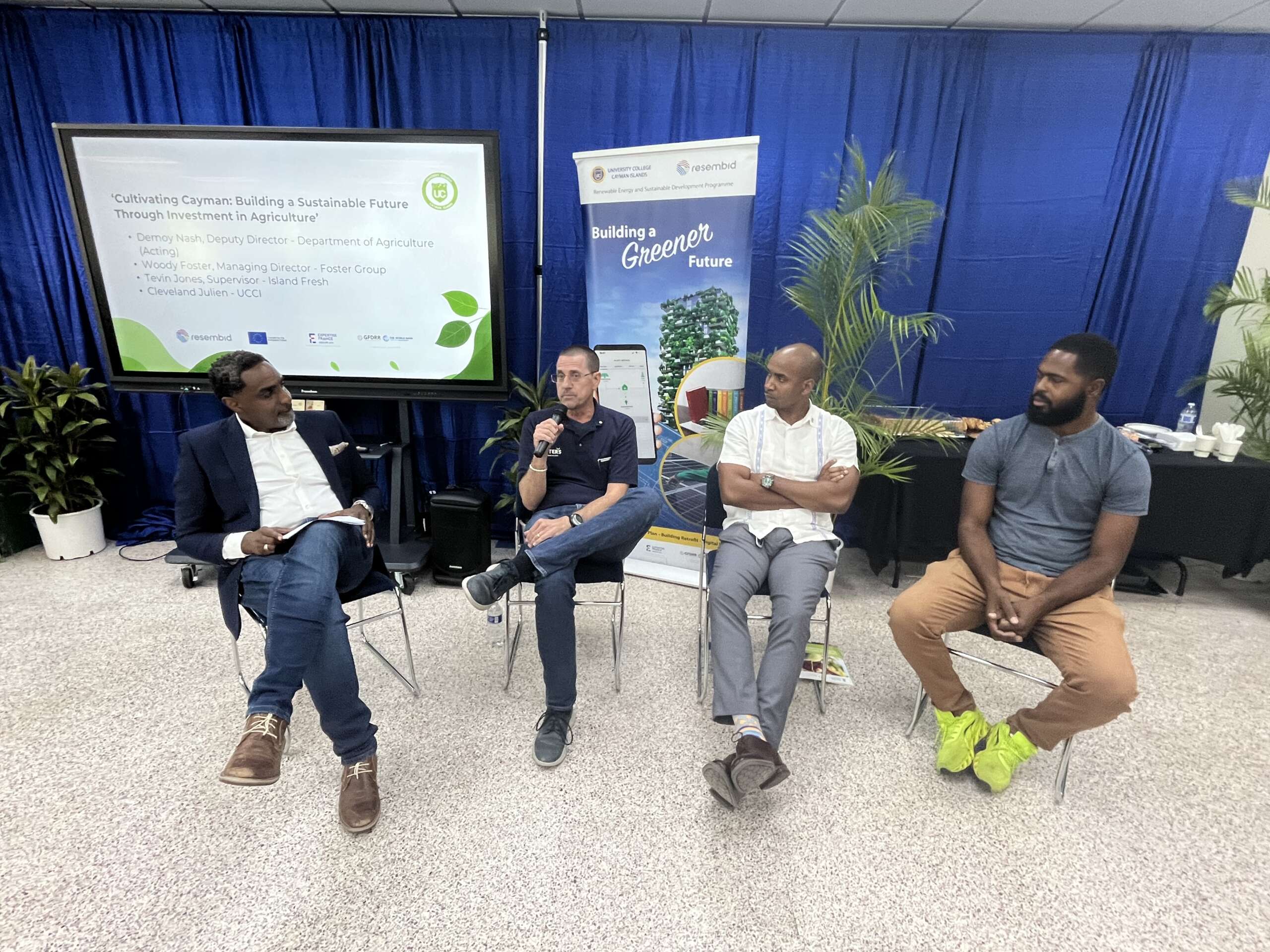
The panel, ‘Cultivating Cayman, Building a Sustainable Future Through Investment in Agriculture’, was held as part of the University College of the Cayman Islands Sustainability Symposium on 20 March.
“Right now, over 90% of our food is imported and 82% of that food comes from a single source: the United States,” explained Demoy Nash, acting deputy director of the Department of Agriculture, who asked the audience, “What if the ships stop coming? More than likely, we only have a couple weeks of food left on the island. How do we begin to mitigate that level of risk?”
In addition to Nash, the discussion included Woody Foster, managing director of Foster Group, and Tevin Jones, supervisor of Island Fresh Produce Ltd., with moderation by UCCI’s STEM and health programme manager Cleveland Julien.
The challenges
Significant headwinds exist for successful and profitable farming in the Cayman Islands, including high costs associated with land, fresh water and electricity, along with a lack of soil in many locations, and difficulties accessing loans and financing.
“We are a tiny island with poor soil, so to say that we’re going to take on the world in terms of producing cheaply, I don’t know that we can get to that. We can have elements that can, but I think we also need to be very clear in terms of what it is that we want,” Foster said.
Nash noted that currently “less than five Caymanians have a degree in agriculture”, with Julien adding that “the average age of farmers here on island is above 65”.
Island Fresh Produce is an operation that has managed to succeed despite the challenges. They have a state-of-the-art greenhouse facility with a 2-acre growing area and they are producing a variety of leafy greens, tomatoes and cucumbers, as well as eggplants, melons and sweet peppers.
“Less than 2% of the land is farmable, so that’s one of the challenges we face as farmers, hence why we have to propose things like hydroponics, aeroponics and alternative farming methods,” Jones explained.
“From the Island Fresh perspective, we have the only commercial hydroponic farm here on the island, and we’re thankful for the Foster’s family, who are our main buyers.”
Demand for fresh foods
Foster believes there is a strong demand for local produce, and if done right, it can be profitable.
“You cannot compare local mangoes to … [what] we bring in from Peru, because at the end of the day, they pick them green, and then they simply cannot taste the same if they’re not grown on the tree for a longer period of time,” he said.
According to the panellists, many of the products that come from the US are picked at least two weeks before they hit the shelves in local supermarkets, which is where Island Fresh has a big advantage, Jones explained.
“Our vegetables and all our produce is delivered fresh every morning. We pick, we package and deliver to the stores every single day,” he said.
The difference in freshness is clear, according to Foster.
“When he brings it to me same day, how does a US tomato compete with that? It is impossible from a taste perspective,” he said.
“There is really no comparison in the quality of product in these items, but for a lot of products, the issue is scale and timing.”
The success of Island Fresh Produce shows that there is a viable path forward for agriculture in the Cayman Islands, and panellists agreed there is also a new determination across multiple sectors to make it happen.
The company uses a small parcel of land to grow produce by hydroponics, vertical farming, greenhouses and containers.
“You get higher yields,” Jones said. “The plants grow three to four times faster than traditional farming. The higher yields come from the direct injection of nutrients to the roots of the plants, as opposed to the plants having to extract that from the soil itself.”
All manner of vegetables and fruits can be grown through hydroponics, he added.
“The largest indoor farm right now is just over 100,000 square feet and that’s the equivalent of about the size of 1,000 acres producing two-and-a-half million pounds of vegetables every year,” he said.
“It takes 99% less land and it’s 95% more efficient in terms of water use, and all of that can be done today.”
Training and the path forward
In 2022, the government, under Minister for Agriculture Jay Ebanks, launched the Cayman Islands Food and Nutrition Security Policy, 2022 to 2036, which provided a framework of how to increase food production sustainably in the Cayman Islands, especially using farming practices tailored to local conditions and climate realities.
UCCI has also developed a food security and agriculture strategy with the goal of increasing local food production, reducing dependence on imports, and promoting sustainable, attainable and even profitable agriculture in the Cayman Islands.
Some of the key strategies include introducing a training course to teach sustainable farming techniques such as crop rotation, organic farming and integrated pest management.
“Our food security and agriculture strategy aims to fortify the resilience of local food systems, reduce dependency on imports, and promote sustainable agriculture to ensure reliable access to nutritious food for all community members,” Julien said.
UCCI is currently pulling together the private sector, the agriculture department and community stakeholders to advance research in sustainable agricultural practices.
“We have public, and government and industry support, and from what we can see, there is a valid business case for increasing initiatives in the agricultural sector,” he said.
“Consumers clearly want the local products, and our conversations with local businesses have been extremely encouraging.”
UCCI also hopes to establish an agriculture incubator so people can train with existing farmers and then go out and partner with real businesses.
Nash agrees on the need for education and improving the technical knowledge base to maximise production.
“You can bring the finest of systems here, but who is going to work in it? Who is going to drive the production?” Nash asked.
“I believe UCCI’s programme is bound to add value: it is novel, there is nothing like it at any level in the education system and we need a multi-pronged approach, having institutions come together.”
With UCCI’s vision and hydroponic farming techniques, Nash said, “Cayman can reach the point where we stop importing leafy vegetables and certain other produce that we can produce here with the right investment in capital both from private entities and government.”
Foster said one of the challenges they face is not knowing what and how much produce is available, acknowledging, “There is very little communication between ourselves and the farmers, which is a chronic problem for us.”
To address that issue, Nash said the ministry is developing a Cayman Islands agricultural business information system to register farmers, and their production data will be publicly available.
“We have a contract already partly paid, and it will include geospatial information so you can actually see where the farms are located,” he said.
The agriculture department is also planning to launch a redesigned backyard farming initiative next year, Nash said, where 210 people “can apply to get registered as a non-commercial farmer, and they will receive a backyard farmers kit, which includes a grow box, soil, seed and fertiliser, and they can then subscribe to a [free] backyard garden training programme.”