


Date: Tuesday, 8 April 2025
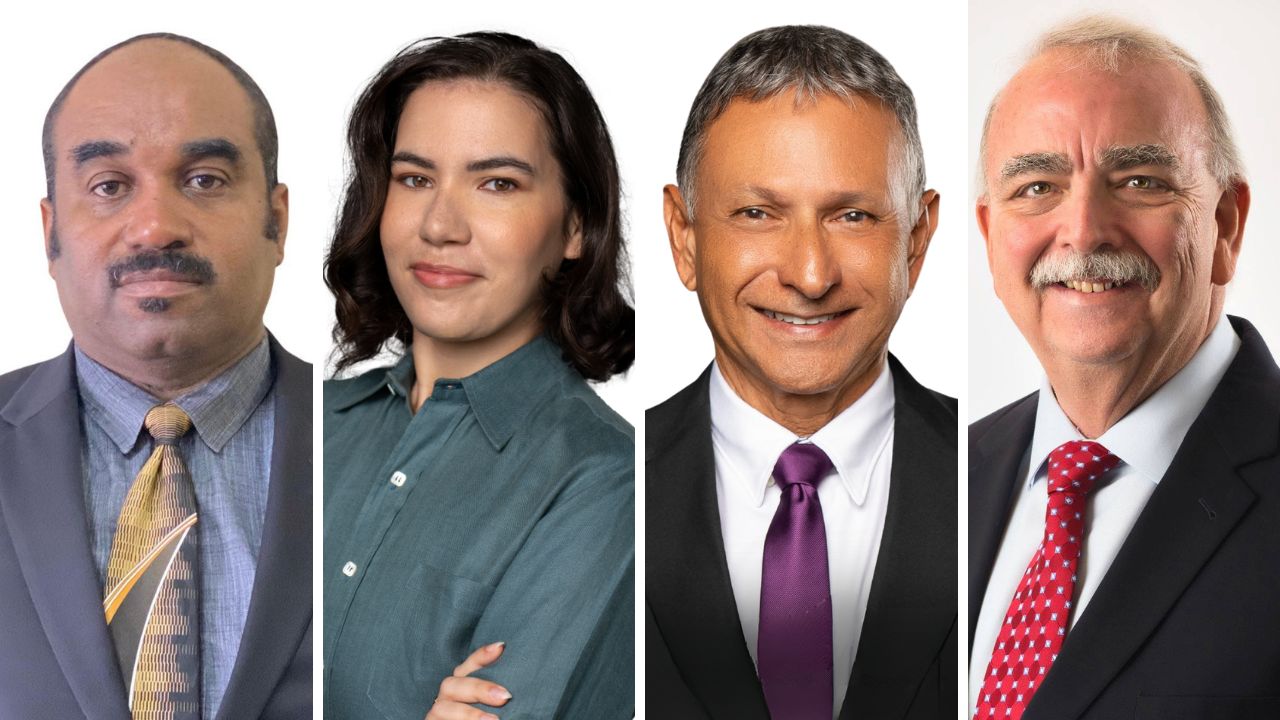
Candidates
- Oscar Bodden (IND)
- Emily ‘Em’ DeCou (TCCP)
- Vassel ‘Bud’ Johnson (CINP)
- Roy McTaggart* (PPM)
* incumbent
In the final Chamber of Commerce constituency forum before the party leaders’ debate and the 30 April election, it was the turn of the George Town East candidates to respond to questions from the chamber panel.
Current chamber president Omari Corbin and president-elect Cristina Spratt formed the panel, along with chamber CEO Wil Pineau, who also served as the moderator.
Each candidate was given two minutes to answer 12 questions on topical issues, followed by two-and-a-half minutes to give closing remarks.
The forum
Incumbent Roy McTaggart opened, saying he was standing on his record.
“I believe firmly, the country needs someone like me that’s back as minister of finance to re-establish fiscal responsibility. What I’m seeing now deeply disturbs me. The country needs a strong, steady hand, an experienced hand, to navigate these troubling times and ensure that Cayman emerges stronger and more resilient,” McTaggart said.
Vassel ‘Bud’ Johnson said, “The Caymanian way of life is quickly disappearing. We have a looming financial crisis, our children are unable to find jobs or afford housing.”
Oscar Bodden said, “I have decided to run in this upcoming election to give our Cayman Islands people a better way of life. For far too long, we have been treated like second-class citizens in our own islands.”
Emily ‘Em’ DeCou said she was running for election because “I imagine that you, like me, will be looking for someone who is not anti development, but rather pro sustainable development. Someone who represents current and future generations in decision-making, who is relatable, proactive, but most of all, courageous in the face of the crisis we are and are going to be facing.”
Top three national priorities
For Johnson, the three top national priorities were national spending and national debt, along with concerns about “the rate of the grant of Cayman status and the growth of our population through immigration. We would be looking to slow that down.”
He believed traffic congestion is also a top national priority that needs addressing.
Bodden said his priorities were education, immigration and jobs for Caymanians, as well housing.
“Some residential areas should only be reserved for only Caymanians to purchase that land,” he said, adding, “It may require land banking by government.”
For DeCou, the top national priorities were “rolling out utility-scale alternative energy” and addressing the landfill, which she described as “an eyesore which impacts our public health, environmental health and possibly the economy”. She also had schools and the education system at the top of her list, pointing out a recent report, which showed “74% of the students are leaving primary school not having attained in core subjects”.
For McTaggart, the most pressing issue was the deterioration in financial health over the past two years. He pointed to a recent report projecting that for 2025 and 2026, the country is going to have a fiscal deficit.
“We will be spending more money than we actually take in,” he said. “The projections show that by the end of 2025, the government will fall foul of the framework for fiscal responsibility and by the end of 2026, we will no longer have 90 days of reserves of cash.”
He also had the need for a waste management solution and the delivery of a national development plan on his list of priorities.
Key issues
Health insurance costs
On the topic of making health insurance more affordable for all residents, including retirees, DeCou noted, “As we’ve seen recently, health insurance premiums have skyrocketed, and we’re still quite unsure as to where the money is going.”
She believes we need to “take proactive steps, increasing competition amongst insurance providers and reducing the costs of healthcare as a whole.”
McTaggart said, “The Progressives have included in our manifesto that we intend to look into the possibility of providing free healthcare coverage to children up to the age of 18, and also to cover retirees who do not have employer-sponsored health plans, or have no other form of health insurance coverage.”
Johnson said the Cayman Islands National Party was aware of “retired constituents who choose between paying their mortgage and paying their health insurance”.
He said the party is considering establishing a national captive fund to provide health insurance for seniors, along with a segregated insurance fund to make sure it is being used as effectively as possible. He also said they would “review the health insurance law, to ensure that insurance companies are required to provide cover for seniors at a reasonable and fair rate”.
Bodden said, “We should provide free insurance for kids, not only the age of 18, but until they’re finished with their education.”
He also believes Cayman should provide free insurance to the elderly.
“They are the most vulnerable. They are our pillars, so we should look and see where we can assist them best,” Bodden said.
Flooding and storm-water management in areas like the South Sound and Randyke Gardens
“One of the things that we will look into implementing is a pumping system,” Johnson said.
“It has been tried in the Prospect and Red Bay areas with some success, and with the assistance of the National Roads Authority and the Public Works Department, we will look at the possibility of implementing that in the Randyke Gardens area.”
Bodden said he would recommend using blowers and pumps for storm-water management.
“They would probably go hand in hand. The blowers will help to dissipate the water. The pumps will help pump it out,” Bodden said.
He also suggested installing flood barriers.
“A flood barrier would basically go around the area affected by flooding, and those high-water level areas will just run around the flood barriers. It would not run into the basin. The flood barriers would help protect it,” he said.
DeCou said, “Storms are not only going to get more frequent, but more intense, and that water needs somewhere to go.”
Noting that the issue is of critical importance to public health, property values and people’s quality of life, she recommended “creating a national sustainable development plan that factors in constituency associations, which would be in charge of coming up with solutions for the different neighbourhoods within the South Sound basin and George Town East.”
McTaggart noted that, “The issue of flooding in Randyke is a 40-year-old problem.”
He said that from the time it was developed, “The ground was not raised sufficiently high in order to allow for the residents in the area to enjoy a life and a home where they were free from flooding.”
The NRA have tried many things, he said, including digging drainage wells and using pumps.
“They basically don’t work because the water table is too high,” he said.
“The only sure-fire thing that works down in Randyke right now is the opening of the culvert that exists in South Sound that drains the water out of the swamps.”
He noted that due to the flood waters going into the sea, “Algae is now starting to grow on coral there, so it’s creating another problem.”
“Some of the solutions that we have thought about include water barriers,” which he added may need to be subsidised.
“Whether it’s through waiving all import duties, or whether you go further and subsidise the total cost of such a programme as that, but that’s only a temporary solution. It’s not permanent, so a lot of work needs to be done,” he noted.
Erosion on Seven Mile Beach
The candidates were asked what actions they would take to address erosion on Seven Mile Beach and how they would fund them.
Johnson said, “We don’t need to begin another study. We simply need to revisit the existing work that has been done and determine how best to move ahead with it.”
He added, “One of the things to bear in mind is that there are prescriptive rights to walk the beach up to the high-water line.”
With the loss of the sand, he said, “It is not just the tourists that are being deprived, but also the rights of Cayman citizens to walk Seven Mile Beach.”
Bodden believes the solution is through a private-public partnership.
“Government could be responsible for areas that are for Caymanians and the public, and when it comes to private beaches, they should be responsible for replenishing the sand,” he said.
He added that the parrot fish should also be protected and fines implemented for those catching them, because they are helping to create sand that replenishes the beaches.
DeCou said we should consider “man-made solutions to this problem in the short term, then we need to look at how we can begin to naturally restore, allow the beach to restore itself.”
She added, “We need to perhaps put a moratorium on the construction of sea walls and do what we can to help properties meet the required setbacks.”
She also said we need to look at the issue through the lens of “a sustainable development plan where paradise is not bulldozed at the expense of the soul of what makes up these islands, namely, our precious beaches.
“When it comes to looking at how to fund these solutions, perhaps we need to look to those who created the issue in the first place, and also sources of funding that we can rely on, such as the Environmental Protection Fund.”
McTaggart said, “I think that a replenishment programme must take place initially, and I think it’s a combination of the government, landowners or homeowners and businesses that need to pay for it.”
McTaggart added that he “believes firmly that there is sand that is resting just offshore that could be used and pumped up onto the beach, in order to restore and replenish it”.
In the absence of any of that, he said, “We may even have to look at importing sand.”
Notable exchanges
The most notable exchanges came during the closing remarks, when the candidates attempted to set themselves apart from the incumbent, McTaggart.
McTaggart, who was the first to provide his closing statement, again leaned into his track record, saying pointedly, “The truth is, managing $1 billion in annual revenues and a $5 billion economy is simply beyond the skill set of most of the candidates.”
Johnson urged people “to look very carefully at the track records of the so-called experienced politicians, particularly the PPM”.
He added, “Just a few months ago, the PPM leadership was criticising the UPM government for failures in a number of areas: the increase in public debt of economy, the increase in unemployment, a lack of attention to cruise tourism and the Re-Gen project. Now the same PPM group has embraced those same UPM politicians and are asking you to vote for them.”
Bodden closed his remarks saying, “The people of George Town East deserve more than promises. They deserve a representative who listens, who delivers. My vision is a Cayman that works for Caymanians, where our young people thrive.”
DeCou spoke about red flags in her closing remarks.
“Tonight, we have heard a former party leader who you would think would be extremely qualified to make good financial decisions. But we know that it was his proposed government’s decisions that put us in the dire straits we are in. That is a red flag,” she said.
“We also know that the same former party leader has welcomed the big spenders that put our country in debt, back into his party with open arms. That is a huge red flag.”
The Chamber of Commerce forums will conclude Wednesday, 9 April with the party leaders’ debate between André Ebanks (TCCP), Joey Hew (PPM) and Dan Scott (CINP). The forum will air live at 7pm on Compass TV.