


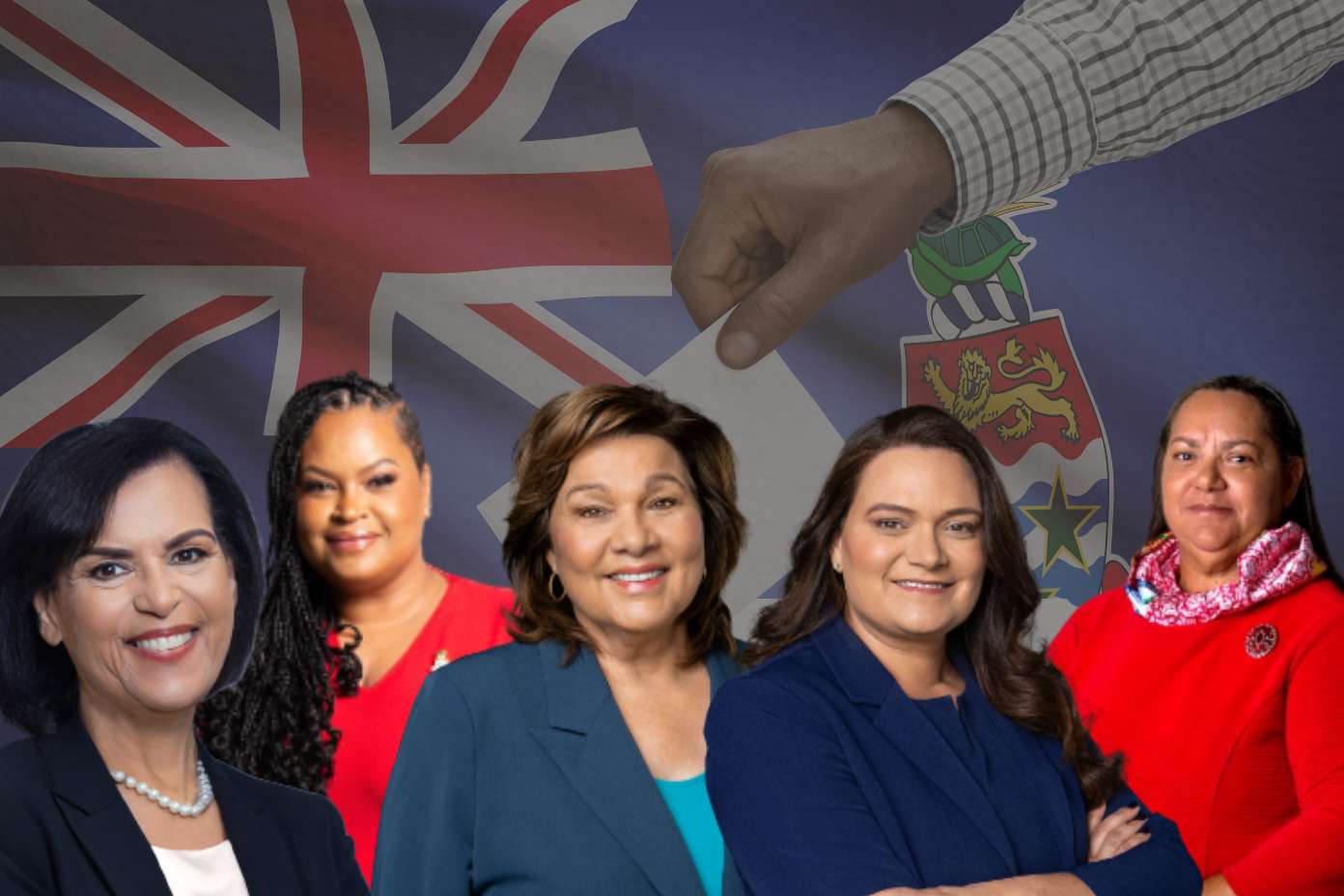
With women winning 26% of the seats in Wednesday’s general elections, the Cayman Islands has surged past the Anglophone Caribbean average of 22% female political representation, according to data from the Inter-Parliamentary Union.
While it’s not the first time women have secured more than a quarter of Cayman’s 19 constituency seats, this election marks a significant moment for women in the nation’s political history.
Here’s why.
Five female candidates — Katherine Ebanks-Wilks, Heather Bodden, Juliana O’Connor-Connolly, Pearlina McGaw-Lumsden, and Julie Hunter — captured 30% of the popular vote, earning 5,481 of the 18,539 ballots cast in this year’s election.
Bodden emerged as the third most popular candidate overall — behind André Ebanks and Kenneth Bryan — racking up 690 votes.
And in a historic upset, a female newcomer, Hunter, unseated the longest-serving political figure in Cayman’s history.
While the outcome of the 2025 elections favoured women at an equal rate to 2021, a much larger percentage of women vied for seats.
Nineteen of this year’s 59 candidates were women — 32% of the field, up from 22% (11 women) in 2021. This marks a notable climb from 2017, when just three women won seats out of 62 candidates – though that was the first time more than one woman held a ministerial role.
The biggest shake-up of the 2025 election came at the hands of CINP’s Hunter, who toppled political titan McKeeva Bush, ending his four-decade reign in West Bay West.
Among the 10 TCCP candidates, four were women: Katherine Ebanks-Wilks, Sabrina Turner, Heather Bodden and Emily Decou.
Ebanks-Wilks won West Bay Central with 67% of the vote, and Bodden reclaimed Savannah with 60%. Turner narrowly lost Prospect to CINP’s Michael Myles by just 16 votes, while Decou fell short in George Town East with 22% of the vote, compared to Roy McTaggart’s 38%.
On the 13-person PPM ticket, two of five women emerged victorious. Juliana O’Connor-Connolly defended her Cayman Brac East seat, which she has held since 1996, beating CINP leader Dan Scott by an 18% margin. Newcomer Pearlina McGaw Lumsden won George Town West with more than half the vote.
While Cayman’s female candidates have not traditionally run on platforms associated with women’s issues, an electorate that consisted predominantly of women (53%) could have played a role in female success on the ballot this year.
Since 1997, the year Cayman appointed its first female cabinet member – O’Connor-Connolly – the jurisdiction has become gradually more progressive with respect to women’s involvement in politics.
O’Connor-Connolly also broke barriers as the first (and, so far, only) woman to serve as premier, holding the office twice.
Women’s political involvement is considered to be one of the primary indicators of women’s equality in society. In Cayman, this year’s numbers and momentum suggest historic progress in this domain.