


-PM Phillips says project aligns with govt’s broader energy agenda, signals major shift toward solar-powered electricity
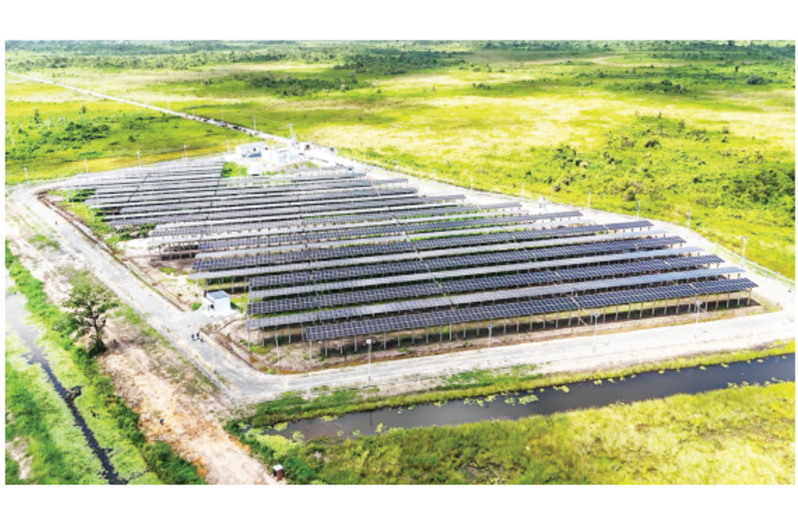
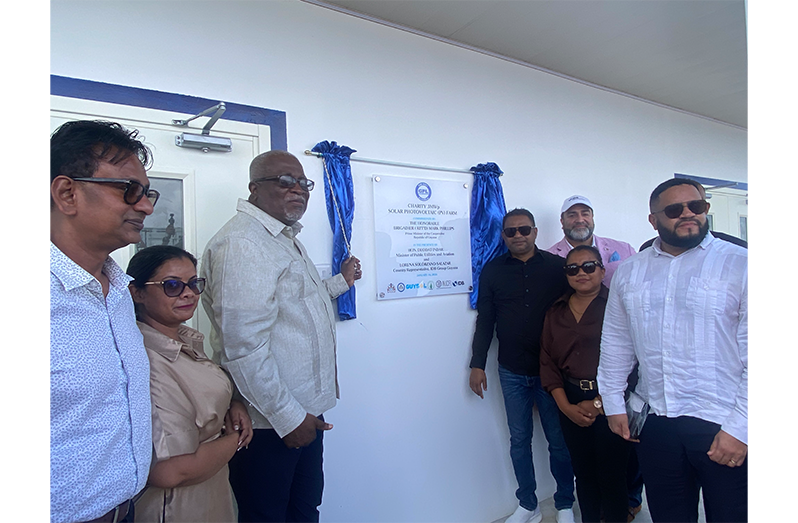
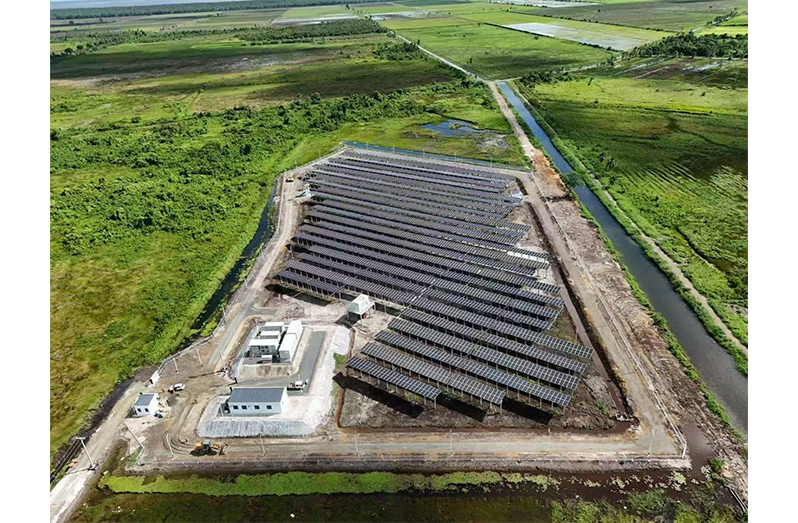
OVER 3,000 Region Two residents are set to benefit from more reliable, clean, and renewable energy following the commissioning of the US$8.14 million, 3MWp Charity Solar Farm on Friday.
The project, which will significantly reduce power outages and support Guyana’s transition to sustainable energy, is expected to slash annual fossil-fuel generation costs by GY$267 million, generate approximately 4,600MWh of power annually and offset nearly 3,500 tonnes of CO₂ emissions. Additionally, the solar farm will be supported by 2.25MW of battery-energy storage.
Prime Minister, Brigadier (Ret’d) Mark Phillips in his remarks said the project signals a major shift towards solar-powered electricity, noting that Region Two is experiencing rapid development with essential services being decentralised to reach even the most remote communities, which requires an increase in reliable power.
He urged residents to take advantage of the expanding opportunities that will be created by the improved energy access.
Highlighting the government’s broader energy agenda which included investments in solar, small hydro, and the landmark gas-to-energy project, he noted that by the end of 2026, approximately 300 megawatts of electricity will be generated from gas, while the proposed 165-megawatt Amaila Falls Hydropower Project remains on the government’s development agenda.
He further stated that the government plans to construct more solar farms across Guyana to meet the country’s growing energy needs.
Last November, a US$10.4M solar farm was commissioned at Onderneeming. This together with the one at Charity is expected to offset more than 9,300 tonnes of carbon dioxide emissions annually. Investments in remote-controlled substations and real-time monitoring systems are also expected to improve grid reliability and responsiveness. The two facilities contribute 8MWp of solar capacity and 12MWh of battery storage to the regional grid.
Meanwhile, Minister of Public Utilities and Aviation, Deodat Indar, described the commissioning as “a happy day for Region Two,” noting that the solar farm will supply electricity to approximately 3,500 households.
He said the project has created new opportunities for residents and will support long-term development across the region.
Also speaking at the ceremony was Chief Executive Officer of the Guyana Power and Light Inc. (GPL), Kesh Nandlall, who described the commissioning of the Charity Solar Farm as a proud moment and a significant milestone in Guyana’s journey towards a resilient, low-carbon energy future.
He explained that the project forms part of the Guyana Utility-Scale Solar Photovoltaic Programme (GUYSOL), executed by GPL and administered by the Inter-American Development Bank (IDB). GUYSOL will deliver 33MW of solar power across Regions Two, Five, Six, and 10, utilising some US$83.8 million from Guyana’s earnings under the Guyana–Norway Partnership for forest services. Of that amount, US$18.5 million—nearly G$4 billion—has been invested in Region Two alone, with the Charity Solar Farm accounting for US$8.14 million, or approximately G$1.75 billion.
Nandlall explained that the Charity Solar Farm is a state-of-the-art facility constructed on a 10.8-acre site and features 4,928 solar modules, eight solar PV inverters, and a 2.25MW, two-hour (4.5MWh) battery-energy storage system. The 3MW system can deliver up to 2.64MW of solar power and 2.25MW from battery storage, providing critical support to the Essequibo Coast grid.
A newly constructed 13.8kV transmission line connects the facility to the north feeder, further enhancing grid stability.
Under the GUYSOL programme, Berbice has also benefitted from the addition of 10MWp of solar capacity through the commissioning of solar farms at Hampshire, Prospect, and Trafalgar, strengthening energy security in Regions Five and Six.
Highlighting the programme’s focus on inclusive development, he informed the gathering that 31 women, including nine from Region Two, have been trained in solar PV installation, while 20 young professionals—including persons with disabilities—have gained hands-on experience through apprenticeship programmes in engineering, finance, procurement, and environmental management.
He noted that the project aligns directly with Guyana’s Low Carbon Development Strategy 2030 and complements the government’s 300MW gas-to-energy project at Wales, which aims to reduce electricity costs and improve grid reliability nationwide.
Further, Chief of Operations at the IDB, Ivan Gaviria, said the commissioning represents a strong commitment to the people of Guyana, describing the project as an investment that will lead to lower energy costs, increased business opportunities, and a stronger foundation for investment. He commended the Government of Guyana for its leadership.
Regional Chairman Devin Mohan in his remarks, described the solar farm as a landmark investment in sustainable energy and long-term resilience for Region Two. He said the project delivers immediate and lasting benefits by strengthening grid stability, improving electricity supply to households and essential services, and contributing to a cleaner and healthier environment.
He added that reliable energy will create conditions for growth in agro-processing, tourism, and other industries, while boosting investor confidence and employment opportunities for residents.
The Charity Solar Farm was built through a joint venture between SUMEC Complete Equipment and Engineering Company Limited and XJ Group Corporation. Financing was provided through the Guyana–Norway partnership and administered by the Inter-American Development Bank.