


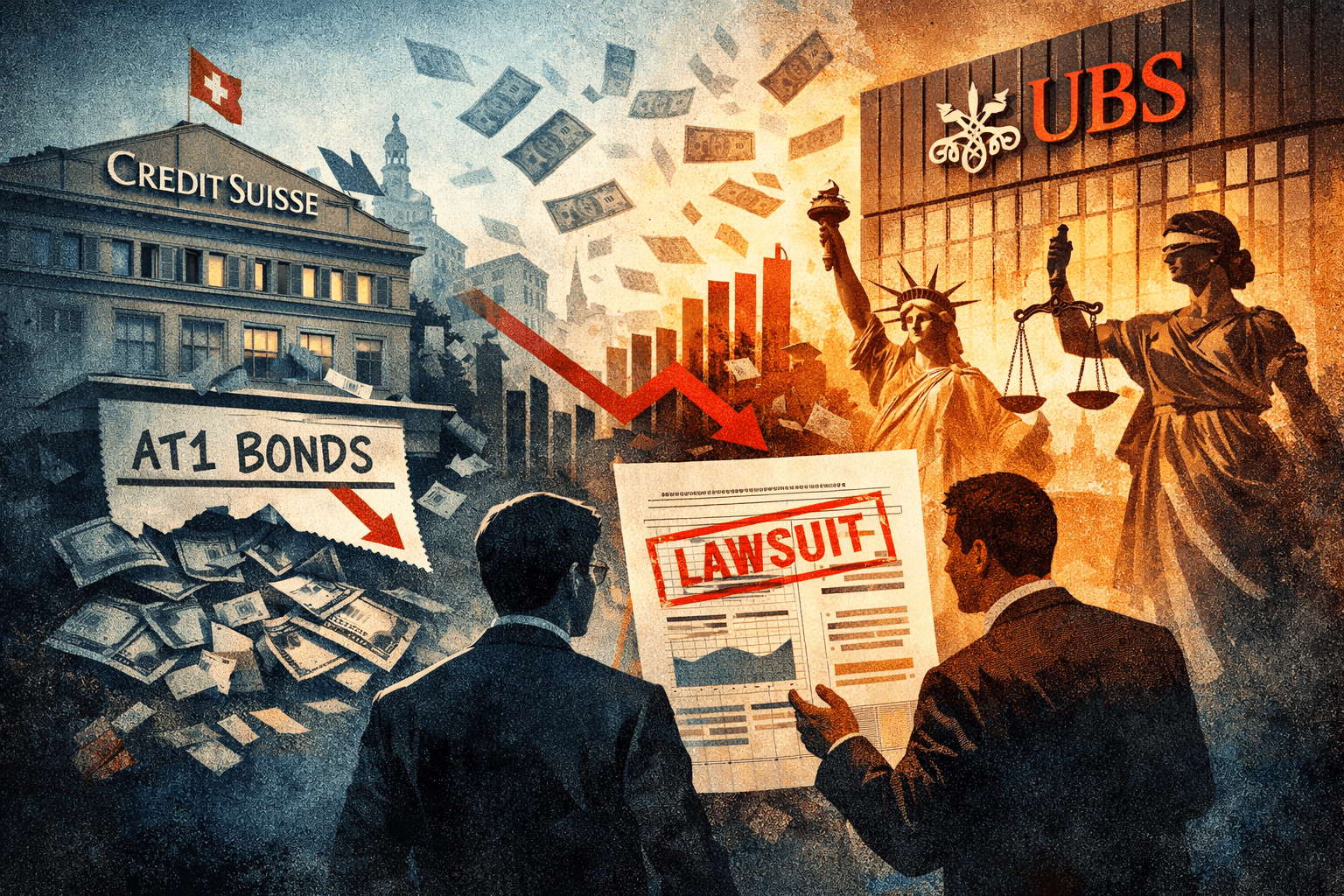
A U.S. judge has allowed investors suing over Credit Suisse’s 2023 AT1 wipeout to pursue securities-fraud claims in New York. In a March 26 ruling, Judge Colleen McMahon of the Southern District of New York dismissed the plaintiffs’ New Jersey racketeering claims in Palomino Master Ltd. v. Credit Suisse Group AG, but allowed claims under Section 10(b) of the Securities Exchange Act and Rule 10b-5 to proceed. She also ordered the case to be consolidated for pre-trial purposes with related Credit Suisse securities litigation already pending in Manhattan.
The ruling does not determine whether fraud occurred. It does, however, keep the core case alive. McMahon held that the plaintiffs — Palomino, Azteca and Appaloosa — had plausibly alleged domestic transactions in Credit Suisse AT1 bonds, which is enough at this stage to keep U.S. securities law in play. She also noted that, on this motion, the defendants did not challenge falsity, scienter or materiality.
The backdrop was the March 2023 banking panic. Credit Suisse, Switzerland’s second largest bank, runs to the Swiss National Bank for a bailout after a distressing fall in stock recorded the rush for emergency support, while Switzerland’s biggest bank, UBS, buys Credit Suisse to halt banking crisis tracked the state-backed sale to UBS. As part of that rescue, FINMA ordered the write-down of roughly CHF 16 billion of Additional Tier 1 bonds, a class of loss-absorbing bank capital instruments.
The New York case turns on what Credit Suisse and its senior executives said in the narrow window before that write-down. According to the court’s summary of the complaint, former chief executive Ulrich Körner and former chairman Axel Lehmann reassured markets on March 14 and 15, 2023 about liquidity and the bank’s position, while a March 14 fixed-income investor presentation restated Credit Suisse’s capital position and loss hierarchy. Plaintiffs say they bought AT1 bonds between March 14 and March 19 in reliance on those statements, only for the securities to be wiped out days later. The same factual tensions were at the centre of CREDIT SUISSE AT1s CASE: The Unspoken Things and AT1 case: Credit Suisse relationship managers lied to clients, too. (antigua.news)
McMahon said the complaint had done enough, for pleading purposes, to allege domestic trades. It said orders were placed from New Jersey, quotes were received in U.S. dollars, payment went through Goldman Sachs as a U.S.-based prime broker, the executing counterparties appeared to be U.S.-based, and the bonds were trading in the United States. That was sufficient, in the court’s view, to allow the federal fraud claims to move forward.
The judge did narrow the case. She held that the New Jersey RICO counts were not barred by SLUSA because the complaint concerned AT1 bonds rather than covered securities listed on a U.S. exchange. But she dismissed those claims because the plaintiffs had not adequately pleaded a distinct enterprise or a racketeering conspiracy. What remains is the securities-fraud case.