



– Advertisement –
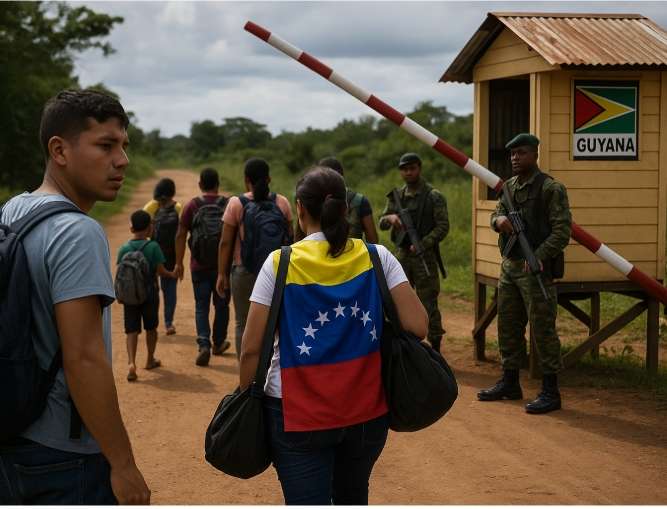
From a wooden jetty on Guyana’s northern frontier, Inspector Marcel Sandy looks calmly across a narrow creek at a group of Venezuelan soldiers just a hundred yards away.
About fifteen troops in camouflage stand on the opposite bank, watching the handful of Guyanese officers guarding this remote border post.
The only sound in normal times is the dip of paddles from passing canoes, but now this quiet place could be pulled into a regional conflict. Donald Trump’s threats to remove Venezuela’s ruler Nicolás Maduro, combined with a large U.S. military buildup in the Caribbean, have raised fears of escalation.
Only five people are stationed here, and two are asleep when visitors arrive. Yet Inspector Sandy, age 43, seems unconcerned. With an old FAL rifle across his lap and a cigarette between his fingers, he says he sleeps better knowing the Americans are nearby with destroyers, fighter jets, a nuclear submarine, and thousands of troops. “I endorse what Trump is doing,” he says. “No one will dare move while the U.S. is out there.”
Still, the U.S. airstrikes on small boats suspected of carrying drugs have created new problems. A source in Guyana’s Customs Anti-Narcotics Unit (CANU) says drug flights from Venezuela have increased sharply since the strikes began. Light aircraft now cross Guyana’s vast jungles more often, using hidden airstrips to drop cocaine later moved by semi-submersible boats toward the Atlantic.
At least 32 people have been killed in U.S. attacks on suspected traffickers. On Friday, three people linked to Colombia’s ELN guerrillas were killed in a drone strike. Two survivors will face prosecution after being repatriated. Trump celebrated the operation online, calling it “my great honor to destroy a very large drug-carrying submarine.”
Although several South American governments have condemned the attacks as illegal, Guyana has remained largely silent. The ELN has long been active along the border, building and using semi-submersibles to ship cocaine. Guyanese authorities see Venezuela’s government and the drug cartels as part of the same threat.
CANU head James Singh admits the country cannot stop all the flights. “Traffickers look for the path of least resistance,” he says. “The U.S. operations offshore make them nervous, so some are shifting routes through Guyana. We’re determined not to become a narco-state like Venezuela.”
Investigators have found hidden airstrips and bunkers full of cocaine in the jungle. In one raid, 4,400 kilograms were recovered, worth £131 million, along with a semi-submersible craft and weapons. Gunfire exchanges with Venezuelan militias have become more frequent, especially since Venezuela held a referendum claiming Guyana’s Essequibo region, which covers two-thirds of its territory.
The nearby villages of the Warao people are caught in the middle. Some locals trade fruit and fish across the border; others mine for gold. But traffickers also use these crossings.
At one small landing, a villager was murdered after destroying a packet of cocaine he found. His widow, Solomé Henry, says he was tricked into crossing the border and shot in the head. “He was a good man,” she says. “He thought he was doing the right thing.”
The story shows the violence that comes with the drug trade along this unguarded frontier. Guyana’s oil boom—over 700,000 barrels a day—offers hope for better security funding, but vast forests still make the region impossible to police effectively.
Meanwhile, Venezuelan migrants in Guyana are uneasy. Ernesto Viloria, 29, who fled his collapsing homeland, says U.S. military pressure could spark wider conflict. “If they start firing missiles, it will hurt civilians, not politicians,” he warns.
Back in the mangrove swamps, Inspector Sandy and his small team remain at their posts, guarding America’s newest ally in the region. “I sleep with my rifle and sometimes a bulletproof vest,” he says, half joking but not entirely at ease.
Source: Daily Telegraph, UK.
– Advertisement –