


 There are men who pass through history, and there are men who shape it. The late Hon. James Ronald Webster was undeniably the latter. Born on 2nd March 1926, he rose from humble beginnings to become the chief architect of modern Anguilla, earning the title “Father of the Nation”.
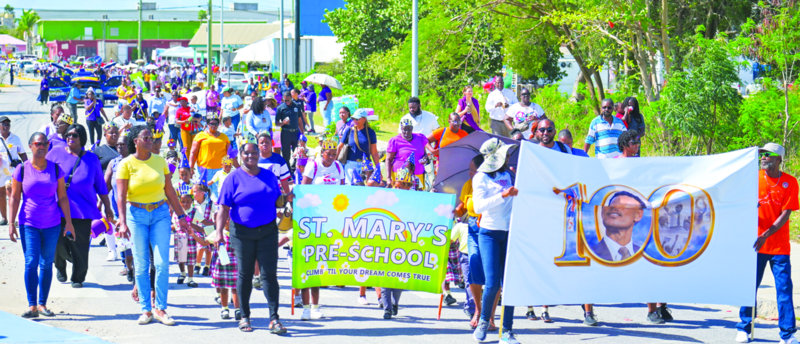
As the island prepares to mark what would have been his 100th birthday on 2nd March 2026, the nation’s gratitude was on full display during a moving Centennial Birthday Parade hosted by the Department of Education on Tuesday 24th February 2026.
The parade commenced along Calvin Lake Washington Road and flowed through the heart of The Valley before culminating at the namesake James Ronald Webster Park. It was more than a procession; it was a living tribute. Students from all public and private primary schools, preschools, and the Albena Lake Hodge Comprehensive School marched proudly alongside their teachers, donned in purple and gold — colours symbolising national pride and reverence for the man many credit with giving Anguilla its voice.
Hand-crafted banners and birthday cards designed by school pupils fluttered in the breeze, each one a vibrant testament to Webster’s enduring influence. Their artwork, bold and heartfelt, reflected a generation that understands the shoulders upon which it stands.
 Music animated the streets as Mr. Marvin Gumbs’ specially composed anthem, Happy Birthday Hero, set the rhythm for dancing students and cheering onlookers. The ALHCS Steel Orchestra performed from a large truck rolling steadily through The Valley, their melodies swelling with unmistakable pride in Anguilla. Adding a touch of spectacle was a towering purple cake emblazoned with the number “100”, gliding through the streets as an amusing yet powerful symbol of a century since Webster’s birth.
Among those in attendance were Hon. Ministers Shellya Rogers-Webster, Kyle Hodge, Cordell Richardson, Opposition Member Hon. Merrick Richardson, Her Excellency the Governor Julia Crouch, and Hon. Deputy Governor Perin Bradley. Significantly, members of Webster’s family were also present, including his sister, Olive Hodge.
 Speaking to Radio Anguilla, Hon. Minister Cordell Richardson described the celebration as “a great milestone,” adding, “It’s great to see the kids here and it’s a wonderful feeling to celebrate this momentous occasion. I’ve always thought a lot of him growing up and I followed the things that he’s done for Anguilla. So that’s been a great inspiration for me, especially in my political career.”
Hon. Minister Shellya Rogers-Webster underscored Webster’s foundational role in shaping Anguilla’s public institutions. “He has been central in organising the Anguilla Public Service. And of course, education has benefited tremendously from that development,” she said. She pointed to the establishment of the Department of Education, the Ministry of Education and the Education Planning Unit as tangible outcomes of his vision for a strong and healthy public service. Reflecting on her own journey from classroom teacher to minister, she noted that government scholarship opportunities and structured advancement within the public service were part of Webster’s legacy. “It’s important for us to honour his memory and legacy… he saw an opportunity for Anguillians to define our own destiny.” Hon. Minister Kyle Hodge described Webster as “a man who led the Anguilla revolution back in 1967 — one of sacrifice and great national pride.” He recalled Webster’s early departure to St Martin at age ten, where he spent more than two decades before returning to an impoverished Anguilla lacking paved roads, electricity, running water and adequate healthcare. “He could have stayed in St Martin… but he came back in the toughest of times to change the system and develop Anguilla,” Hodge said. He urged continued education about the 1967 Revolution, reminding listeners that “we live in the present, but we must always remember our past in order to build strength to continue moving forward into the future.”
 That revolution altered the island’s trajectory. In May 1967, Anguillians expelled the St Kitts–Nevis administration, protesting neglect and underdevelopment. Webster emerged as the movement’s political leader and later served as Chief Minister of Anguilla in 1976 and again in 1980, steering the island through formative years that culminated in Anguilla becoming a separate British Dependent Territory in 1980.
Olive Hodge’s recollections painted a picture beyond politics. “He was my brother and my family provider first,” she shared. Though he lived in St Martin, “he always remembered Anguilla was his home.” She fondly recounted a humorous memory of Webster hiding in the bush during tense revolutionary days and mistaking the sound of a broken record caught in a prickly pear tree for a hymn singing “Son of my soul.”
Reflecting on the island’s progress, Ms. Hodge said, “Anguilla has been blessed… we got what we wanted — electricity, proper communication, and so on.” Her hope was simple yet profound: unity.
James Ronald Webster passed away on 9th December 2016 at the age of 90. His funeral procession echoed the very scenes witnessed this week, with students lining the streets in tribute. A decade later, that commitment from the education sector remains steadfast — literary competitions, speech contests and annual commemorations continue to embed his story in young minds.
By Janissa Fleming