


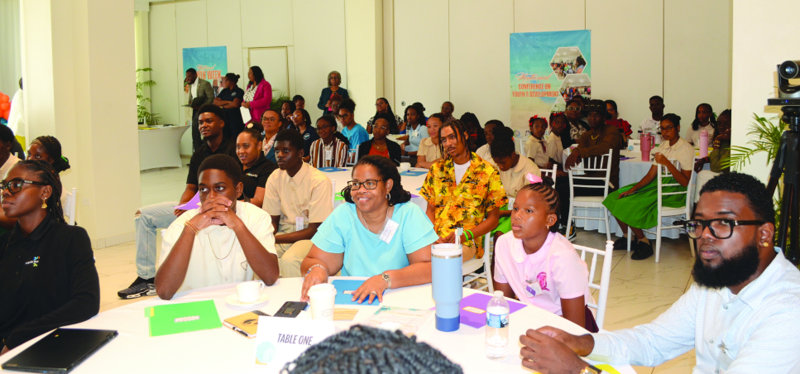
 The future may not be written in stone, but on Monday 29th September 2025 it was scribbled with purpose and passion. The 18th Annual National Youth Conference on Youth and Development, staged at the Aurora Resort as part of Youth Week 2025, gathered Anguilla’s youth in all their variety – from eager primary schoolers right up to 35-year-olds, alongside the members of the Anguilla National Youth Council, Anguilla Youth Parliament, and the National Youth Ambassadors Corps.
 This year’s theme, “Building Tomorrow, Today – Rewriting the Script: One Voice, Many Stories”, struck a chord with the audience, which also included Her Excellency Governor Julia Crouch, Hon. Premier Cora Richardson-Hodge, Hon. Ministerial Assistant Jeison Bryan, and Hon. Parliamentary Secretary Cordel Richardson.
In his final outing as President of the Anguilla National Youth Council, Mr. Neil Gumbs delivered welcome remarks that set the tone of the event.
“For too long, we have been told that young people are the leaders of tomorrow… But I want us to be clear today: the future is now. Our voices are not something to be put on hold. They are essential, urgent, and powerful today,” he said, urging young Anguillians to tell their stories with courage, act with purpose, and recognise their collective impact.
Ministerial Assistant, Mr. Jeison Bryan, followed with the keynote address, reminding the young audience that “tomorrow is being written right now in this room”. He challenged them to be “fearless, innovative… the architects of a better tomorrow,” insisting that history itself has often been reshaped by youth who refused silence.
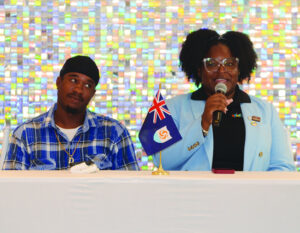
 The day was rich with storytelling and testimony. In the opening session, “Rewriting the Script – My Story Matters”, panelists Ms. Tyeisha Emmanuel and Mr. Delano Smith shared raw accounts of their lives. Emmanuel spoke of climbing out of poverty to stand today as a youth ambassador, while Smith candidly admitted his past prison time before turning to community advocacy. Both rewrote their own scripts, demonstrating that destinies are not predetermined.
From there, participants dived into session two – titled “Collective Voices, Shared Future” with workshops and discussions on identity, education, mental health, leadership, technology, social justice, and environmental stewardship.
The conference then moved into its third session, titled “Youth Innovation For A Better Tomorrow”. Panelists Jevohn Martin (Technology), Jasmin Ruan (Environment), Devi Hodge (Social Justice) and Cassilda Thomas-Carty (Entrepreneurship) pushed the conversation beyond theory: technology, climate action, social equity, and enterprise were treated not as separate silos but as the scaffolding of practical, youth-led solutions.
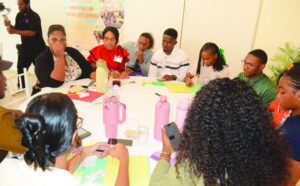
 The session fed directly into Interactive Workshop 2, where participants sketched social-impact projects for Anguilla 2026 and prepared pitches that would later be voted on — a tangible moment when ideas became plans.
Grouped by tables, the participants presented no small plans. Each project reflected the creativity and urgency of youth voices, and one will ultimately be chosen by popular vote to become a Department of Youth and Culture initiative for 2026.
Proposals ranged from rehabilitation programmes for incarcerated youth and technology-driven career pathways, to advocacy against student burnout and extracurricular revitalisation. Other ideas included hubs for e-commerce and digital branding, expanding AI education and access, ensuring equitable extracurricular opportunities, and creating a renewable innovation lab to tackle environmental challenges. Together, the projects showcased a generation eager to transform ideas into actionable plans for Anguilla’s future.
After the final pitches, votes were casted – with the winning project, as of this writing, set to be announced later this week on the Department of Youth and Culture’s Facebook page.
The day also featured a presentation from the Anguilla Youth Business Foundation, which reminded participants that entrepreneurship is a viable pathway. With loans of up to $28,000, mentorship, and training available, young people were encouraged to use facilities like the Innovate Anguilla Centre to flesh out their business dreams.
As the curtains closed, the youth collectively recited the Youth Commitment Statement – a pledge built on integrity, empathy, creativity, and purpose. Thanks flowed to Aurora, moderators, panellists, youth organisations, and officials.
But the real applause, perhaps, belonged to the youth themselves. They were not simply talking about the future; they were sketching it out, rewriting it, and voting on it. In their many stories, a single voice rang clear: the future is not tomorrow – it is already being built today.
By Janissa Fleming