


by Yao Atunwa
What we do and don’t know can be crucial in any given scenario. When it comes to genealogical research, usually there are more questions than provided answers.
Something else to consider is that the imprints embedded in our DNA (in its latent yet potent expressions) can defy or complement material knowledge or memory. For an avid genealogy researcher, there is little choice but to welcome the many questions that arise in the process. In fact, the process begins with questions, like any investigatory journey. And perhaps with the modern scientific tools at our disposal, we can be even more strident and appreciative of the many questions abound regarding our backgrounds, and embrace the bareness, if that is, in fact, the starting point.

Great improvements have been made in the field of genealogical research and scientific endeavours as a whole since the advent of the Human Genome Project (HGP, 1990–2003), in the greater reach and capacity it has afforded humanity. Whether one is a professional researcher or not, the aim basically is to do more with the mapping of our gene sequence insofar as length, spacing and their functionalities and wide implications thereof to us. It is oftentimes all that we can rely on when human material knowledge or memory is lost and/or faded, as it often does over time. Fortunately, by and large, blood ties remain over multiple generations. It is, therefore, only a matter of time before those blood ties reveal their true identities by our very conscious act of recapturing stories and records and/or the genes themselves speaking to each other (as captured in DNA analyses and converted in made–easy language for you and me).
Such is the gist of a story of family connections that I am about to explore with you in this essay; in particular, that of 3 of Grenada’s most celebrated heroes in Kirani Zeno James, Lewis Carl Davidson Hamilton, and Maurice Rupert Bishop. Those names undoubtedly do not require any formal or lengthy introduction per se to do justice to a Grenadian audience, and to a great degree, not even with a wider audience beyond our shores. It is no hyperbole that these personalities are Caribbean–renowned and world–renowned (within their spheres of influence or respective fields of endeavours).
Notwithstanding the characteristically small population that is Grenada, a feature which has not changed over the many decades and would politely seem to posit that the general degree of separation among Grenadians ought to be low in count, it is most supremely worthwhile, indeed, to independently and individually trace the many lines that give rise to one’s unique DNA representation. The naturally diversified expressions of which gave rise to the individual that is you, genetically, biologically and otherwise (unless one is an identical twin, of course).
In acknowledging such and more directly engaging in this general project, i.e., archival/genealogical research, we are essentially giving missing depth to our origin stories to include an understanding beyond the familiar in most cases, to essentially fill the proverbial and quite literal gaps. It is important to note also, whether we are conscious of it or not, at play is a historiography that attempts to encapsulate the plights and strivings of our forebearers in the context in which their lives played out and, in one way or another, shape the present. That is the ultimate mission undertaken in genealogical research, as it seeks to inform and empower our understanding of our social reality and ourselves, ultimately. Such is the defining and capacity–building power of history, but more specifically, our approach to delving into subject matters of historical significance. Hence, we must engage in our own narrative generation as opposed to others seeking to do so on our behalf.
To begin with (in telling this story of connection), the agrarian–based or plantation–based economy and society (plantocracy) of colonial Grenada bears the linkages that are shared between all 3 gentlemen. Their connections were first forged during the colonial epoch, and their common forebears (in this instance) were principal players of that period in our collective history. They owned and controlled the means of production, i.e., land, labour, and capital (both human and non–human), to put it rather bluntly. Such is the tale primarily of their male progenitors rather than the females. As was customary of that period, the men dictatorially dominated the political and socioeconomic realities of the day. Moreover, these were men who had direct ties to Europe (if not full–blooded European(s), European extractions).
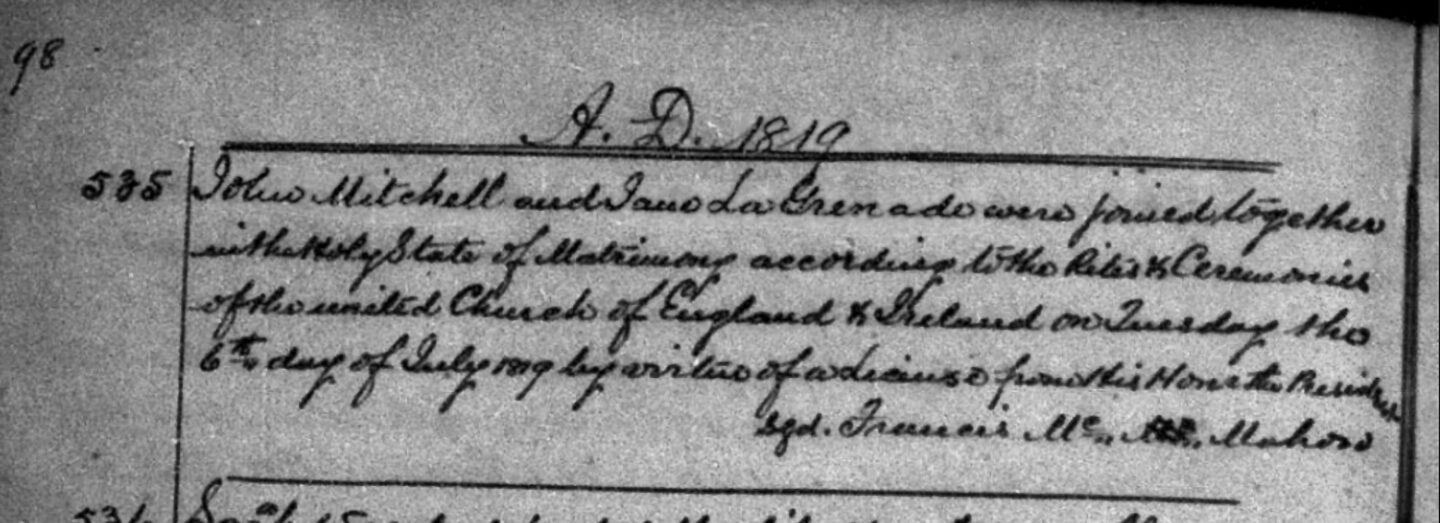
The principals among these common ancestors/progenitors of all 3 gentlemen were Samuel Mitchell (1750–1803), the proprietor of Hope Vale estate in the south of the island, and his contemporary Louis La Grenade (1776–1850), himself proprietor of multiple estates apart from being a politician, including Morne Jaloux estate, which is also in the south of the island. Mitchell would have served as acting Governor of Grenada (1795–1796) during the Fedon Revolt, after the demise of Governor Sir Ninian Homes, who was summarily executed by Julien Fedon’s troops during that uprising, which began in 1795 and lasted some 14 months. Mitchell’s tenure in that role was intentionally brief, as he would eventually depart for England in 1797 or 1998, permanently. Prior to serving as acting Governor of Grenada, Mitchell was a member and, at one point, President of the Legislative Council of Grenada (1790), where he served with other members of what was termed the propertied class.
It is well documented that late Prime Minister Maurice Bishop (1944–1983) shared in the lineage of predecessor Louis La Grenade, stemming from his mother, Alimenta Bishop (nee La Grenade, 1914–2014), who was a great-granddaughter of La Grenade and his wife Maire Reine Hill (1780–1830). For those who recalled or would have read chronicles of those covering the rise and eventual collapse of the Grenada People’s Revolutionary Government (PRG,1979–1983), much was alleged about Maurice’s departure from being an upholder of the status quo when he formed alliances with other young revolutionaries to topple the incumbent Sir Eric Matthew Gairy, who many would have deemed to have lost his radicalism (on his ascension to political office) as an effective mobiliser of the workers of the nation in agitating for their causes across the many plantations across Grenada in the 1950s, upon his return from Aruba in 1949. Coincidentally, the very place Maurice was born.
Others would have viewed Maurice through another set of lenses, to offer the view that he did not abandon the class he hailed from, but instead sought to embolden its grip on the Grenadian society. Arguably, a very minuscule number of Grenadians had the latter view of the widely championed political leader (and his comrades by extension). His ideological stance and political activities centred around the eradication of imperialism and dependency, which is what colonialism had and continues to represent for people in the southern hemisphere (the global south or the developing world, as it is labelled).
His much younger distant cousins, Kirani James and Lewis Hamilton, were yet to be born when his People’s Revolutionary Government suffered an implosion due to internal conflicts and the eventual invasion by US forces under the banner Operation Urgent Fury (25 October 1983): one that was rehearsed way in advance, off the coast of Puerto Rico, on its dependent island of Vieques.
Lewis Carl Davidson Hamilton, who carries the first name of his father’s maternal grandfather, Carl Celestine Mitchell (1912–1947), as a middle name, would be born in England in 1985 to Anthony C Hamilton and Carmen Labelastier. His younger brother, Nicolas Carl Hamilton, would follow in 1992 during his father’s second marriage to his current wife, Linda Cole. In fact, Lewis would have been born after the early death of his paternal grandmother, Agnes Hamilton (nee Mitchell), in 1976, aged 43, in England, where she resided with her husband, David Augustine Hamilton (1931–2018). The senior Hamilton couple hailed from St John, namely Gouyave and Grand Roy, respectively. They would have ventured to join the wave of West Indians during the great migration (Windrush) to the UK in the wake of World War II to assist in the rebuilding efforts and secure better economic standing in the process, coming from a by far less economically developed economy and society. Unmistakably, such a trend in migration continues for our people, only now, North America is where such focus lies, generally.
Kirani James, mutual cousin to both Lewis Hamilton and Maurice Bishop, Grenada’s foremost athlete being the celebrated World and Olympic champ that he is, in the rich legacy he has cultivated as the most decorated 400 m sprinter in the event’s history (as is his compatriot, Lewis Hamilton, the most decorated Formula 1 driver in the sports’ modern history, having captured the most overall titles on the circuit where it matters most), is the product of Dorrani Marshall and the late Ann Pamela James, both of whom are from Gouyave, St John.
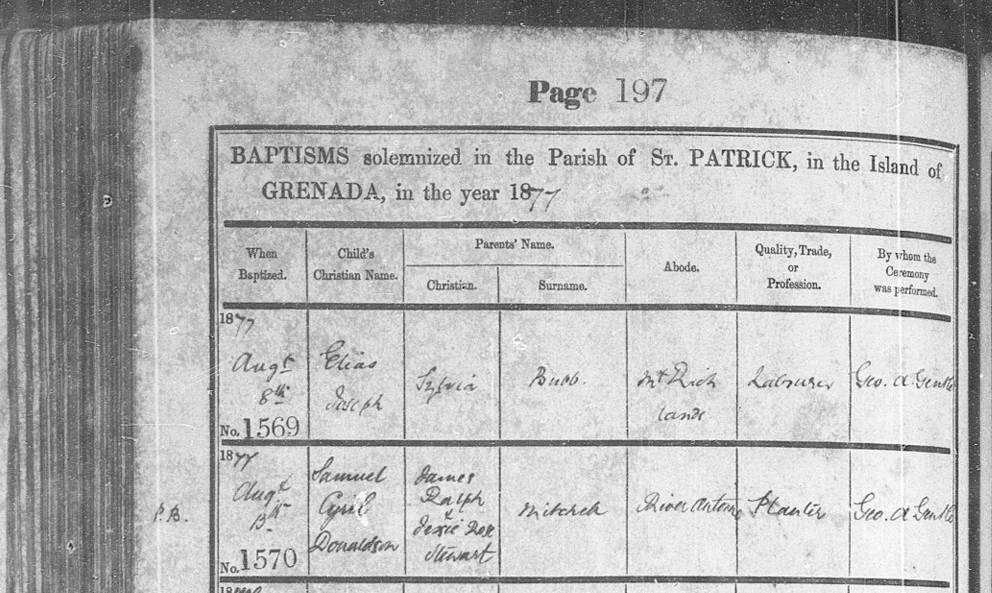
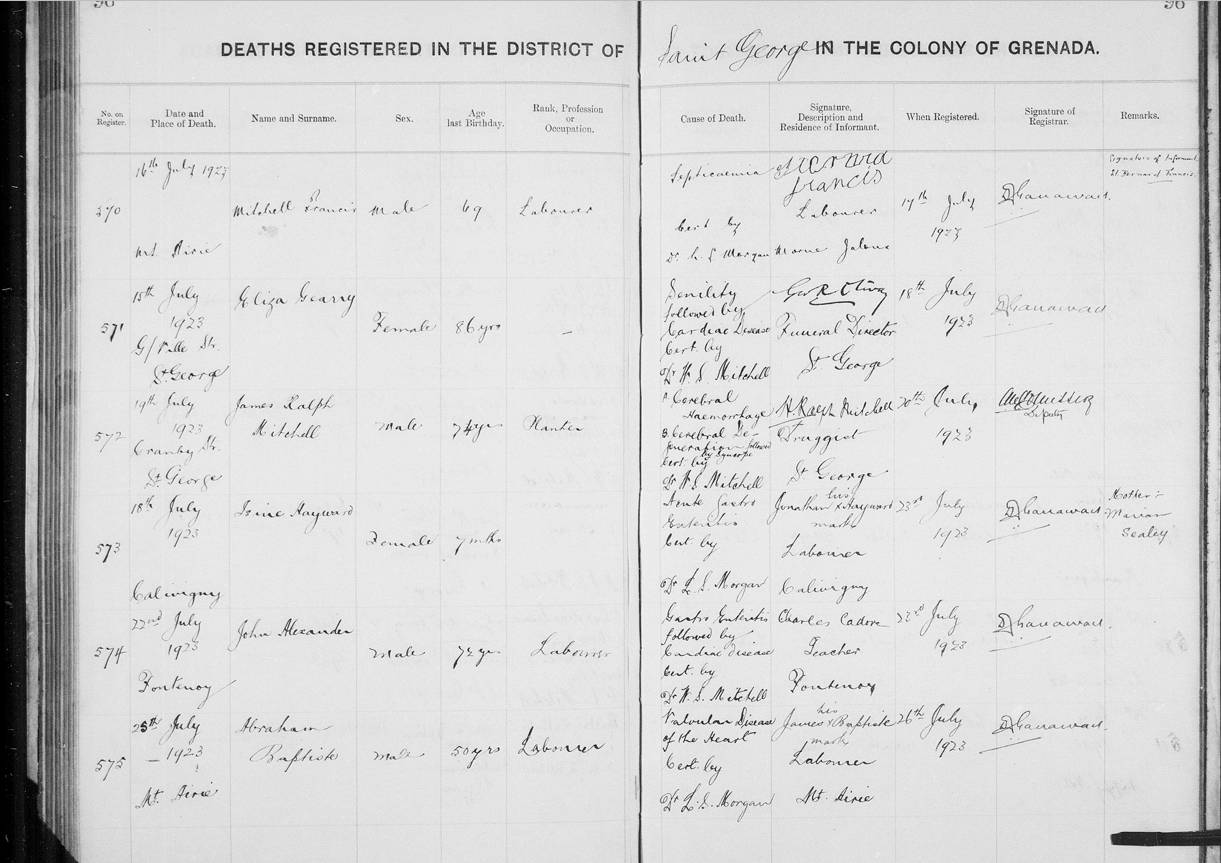
Kirani’s Mitchell lineage stems from his paternal grandfather, Sandford Williams (–1984), an entrepreneur of modest means in the Gouyave and Marigot communities in the 1950s to the early 1980s. Sandford Williams’s father, Joseph Mitchell (–1932), was the older half–brother of Carl Celestine Mitchell (1912–1947), Lewis Hamilton’s paternal great-grandfather via his father’s mother, Agnes Hamilton (nee Mitchell). These 2 brothers were 2 of several offspring of their father, albeit separate mothers: Samuel Cyril Donaldson Mitchell (1877–?), who reportedly had offspring with 3 women. From this point onwards, there is a straight line of Mitchell men for several generations (4 in total) to the progenitor himself, senior Samuel Mitchell. It is important to use the marker “senior” in this case for the obvious reason being the fact that the name Samuel Mitchell is recycled over multiple generations, with few departures.
Those breaks initially started with John Mitchell (1777–1841), one of 2 sons of senior Samuel Mitchell and his enslaved African housemaid, Victoire, for whom not much has been brought to light other than she was of African descent or perhaps born in West Africa. Continuing with that branch, John Mitchell and his wife Jane Mitchell (1800–1846, neé La Grenade) produced the paternal grandfather of Samuel Cyril Donaldson Mitchell in that of his namesake Samuel Mitchell (1820–1889; who served as Colonial Secretary of Grenada in 1885), as he was the father of James Ralph Mitchell (1849–1923), Samuel Cyril Donaldson, Mitchell’s father.