


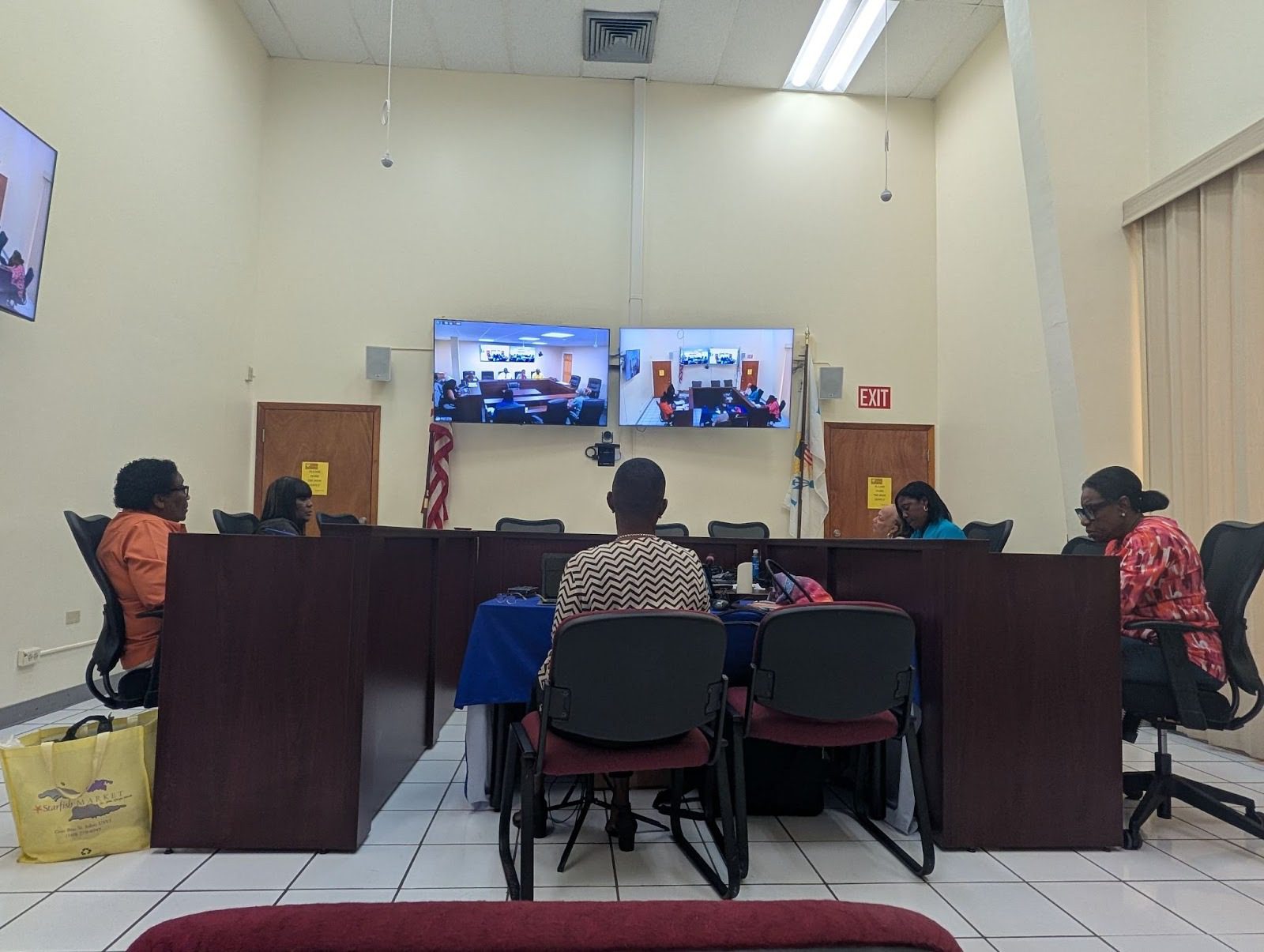

The Virgin Islands Board of Elections held a special meeting Thursday to prepare testimony for lawmakers on election operations and potential legal reforms, a session that also became a public airing of long‑simmering frustrations over blurred lines of authority.
The meeting was convened in advance of the board’s expected appearance before the Senate Government Operations, Veterans Affairs and Consumer Protection Committee, where they are slated to update lawmakers on the board’s operational status and discuss current election law issues.
During the first half hour on the record, members worked through roll call, wrestled with a flurry of technical problems, struggled to access the agenda, and clarified who could join the virtual meeting, all before reaching the stated purpose of addressing operational challenges.
“I gotta say, in my opinion, the first 30 minutes of this special meeting clearly shows that we are a dysfunctional board,” board member Kareem T. Francis said. He added that the chaotic opening reflected deeper, ongoing problems, including inconsistent procedures and a lack of unified direction as the territory approaches the 2026 election cycle.
The discussion repeatedly returned to a handful of core disputes that members said have persisted. Much of the disagreement centered on how to interpret Title 18 of the Virgin Islands Code and Act No. 8690, a recent law that made significant changes to the territory’s election system.
Several members said provisions of Act 8690 have created confusion about the division of authority between the Board of Elections and the Supervisor of Elections, and they pointed to ongoing debate over the code’s language on operational responsibilities, policy oversight and quorum requirements as evidence of differing interpretations. Members said this ambiguity has complicated the board’s ability to carry out its duties, and noted that they have been raising the same concerns in board meetings for more than a year.
Others pointed to practical breakdowns; they complained that meetings rarely start on time, that agendas and supporting documents are not consistently distributed in advance, and that rules governing when in‑person attendance is required are applied unevenly.
Members also raised broader legal questions about how the Virgin Islands handles elections for the non‑voting delegate to Congress. Member Barbara LaRonde alleged in a letter read during the meeting that Supervisor of Elections Caroline Fawkes intentionally placed a federal candidate on the same ballot as local races, contrary to Title 18 and federal law, and later acknowledged doing so to save money. LaRonde warned that this could significantly increase the board’s exposure to federal enforcement and civil litigation.
Although much of the testimony focused on grievances, Board Chair Raymond J. Williams repeatedly reminded members that the board’s authority is limited to making recommendations. He said their immediate task was to pinpoint specific sections of Act 8690 and Title 18 that need correction so their testimony would give senators clear guidance. “We can make recommendations to the Legislature,” he told the board, noting that they cannot change the law themselves and that any adjustments to the disputed duties and quorum provisions would ultimately have to come from lawmakers.
Fawkes, who spoke near the end of the meeting, pushed back on suggestions that her office had overstepped. She said the election system’s current structure and many of the amendments in Act 8690 reflected years of work comparing Virgin Islands law with election codes from other jurisdictions. Fawkes argued that her office manages day‑to‑day election operations while the board sets policy and provides oversight, a division she said is typical in other states and territories.
She also asked the board to include in its testimony a request for more funding for the 2026 general election, calling the existing general‑election budget “inadequate” and urging an increase from roughly $275,000 to about $400,000 – $450,000.
After extended back‑and‑forth, members moved from abstract complaints to specific motions targeting Act 8690. A proposal to ask lawmakers to repeal Section 11 of the act, which several members said shifted core responsibilities to the supervisor, failed on a split vote. A narrower motion then passed by a slim margin, calling on the Legislature to closely review and revise selected subsections of Act 8690, especially those dealing with the supervisor’s powers and the board’s role in conducting elections, even as members continued to spar over separate quorum language elsewhere in the code that has produced conflicting interpretations.
Tensions peaked during a debate over a motion recommending that the Legislature repeal a section of Act 8690, when members from St. Thomas requested that the full text of the relevant statutes be read into the record before voting. The chair said the text was already clear and moved ahead with a roll-call vote, muting the microphones of the St. Thomas members as they continued to interject objections. A move both islands later questioned, saying the St. Thomas delegation was seeking clarification, not trying to obstruct the meeting.
Despite sharp divisions, often exacerbated by technical challenges, members outlined several areas for improvement where there appeared to be broad agreement. They called for setting a regular monthly meeting date so the public can anticipate when the board will meet, ensuring agendas and supporting documents are distributed in advance, increasing the frequency and clarity of reports provided to the public, upgrading the board’s technology for hybrid meetings, and clarifying Title 18 so that the supervisor’s day‑to‑day responsibilities and the board’s oversight and policymaking role are clearly spelled out in preparation for the 2026 election cycle.
