


What travels at over 90 miles per hour but hasn’t made any progress in decades? It sounds like the set-up to a joke, but the answer – Cayman’s speeding problem – is no laughing matter.
With thousands of car crashes across the Cayman Islands every year, campaigners, politicians, the police and the public have been calling for a curb on Cayman’s speed for years.
Yet speed cameras, which have been shown to reduce speed, injuries and fatalities around the world, are nowhere to be seen on Cayman’s speeding hotspots, in spite of the National Roads Authority and other key government agencies promising that they would be up and running a year ago. So what’s the delay?
The problem with speed
Excessive speed contributes to 40% of all vehicle collisions on Cayman’s roads, according to the NRA, and the outcome of this unchecked need to speed can be serious and even deadly.
The National Road Safety Strategy 2023-2028 bluntly states, “In the Cayman Islands, speed is a factor in the majority of road deaths. Speeding, which encompasses excessive speed and inappropriate speed, is recognised as a major contributing factor in the number and severity of road traffic collisions.”
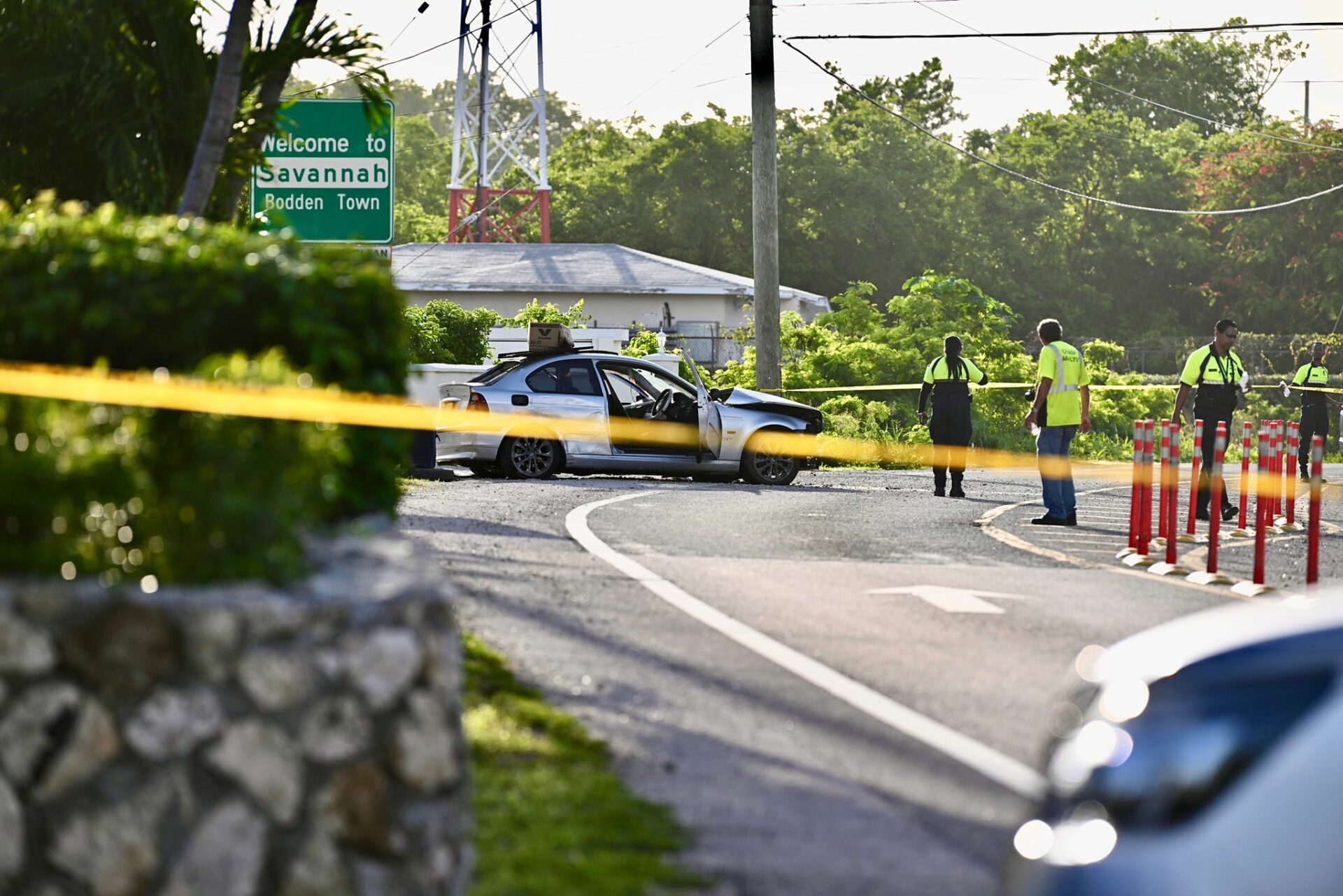
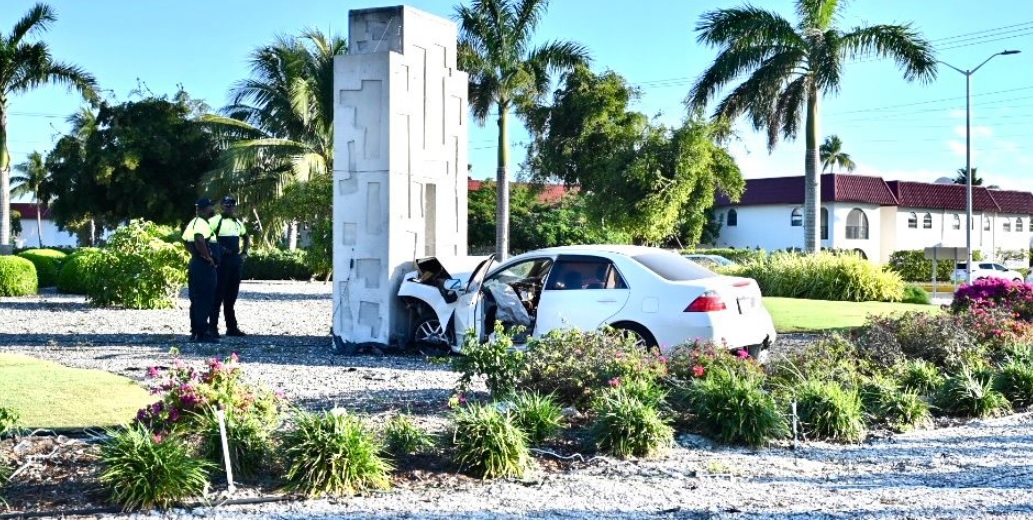
The statistics on Cayman’s overall traffic problem, in which speeding plays such a large part, make for grim reading. In 2023, the most recent full year for which statistics are available, there were 3,196 car crashes on Cayman’s roads, an average of 61 a week and 10% more than in 2022. There were nine fatal crashes that year, with excess speed being cited as a leading contributory factor along with careless driving and mechanical failure.
The full picture for 2024 has yet to be released, but information already available paints a worrying picture. Towards the end of the year, car crashes were running at an average of 66 per week, more than in the whole of 2022. During a single two-week period in November/December, the rate hit an all-time record high of 94 collisions a week. This meant tragic consequences for some: four people were killed on Cayman’s roads in December alone, bringing the year’s total to 14 deaths – five more than in 2023.
Speeding is, of course, only one factor, with other driving offences, such as driving under the influence of drugs or alcohol, using a mobile phone while driving and driving without due care or attention, adding to the troubles on Cayman’s roads. But there is no doubt that speeding is a major part of the problem, and it is not a new one either.
History of speeding
More than 50 years ago, a stern editorial in The Caymanian Compass (as it was then known) said, “Holiday weekends in Cayman often seem to provide opportunities in the past for drivers of vehicles to be led into the temptation of speeding and driving in a dangerous manner. With the Easter weekend imminent, we warn drivers to desist from this thoughtless pastime.”
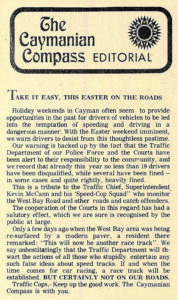
New road paving in West Bay in 1975 had led some to comment that the area would become “another race track”, an idea strongly opposed by this newspaper at the time. “If and when the time comes for car racing, a race track will be established. BUT CERTAINLY NOT ON OUR ROADS.”
Back in 1975, 19 drivers had already been disqualified in the first three months of the year, thanks to the efforts of traffic chief Superintendent Kevin McCann and his ‘speed-cop squad’, but 50 years on, the problem has become significantly worse.
Jump in speeding tickets
There have recently been increased attempts by the police to tackle the problem. The number of speeding offences recorded in 2023 jumped a massive 52% to 4,654, compared with 3,063 in 2022, with drivers travelling at an average of 17 miles an hour over the speed limit.
But with police limited to mobile units and traffic patrols, the number of speeding offences actually committed is likely to be far worse. An investigation by the Compass last month found that, in just 10 minutes, 65 cars, buses, trucks and vans were found to be speeding, with the most egregious instances being 97mph.
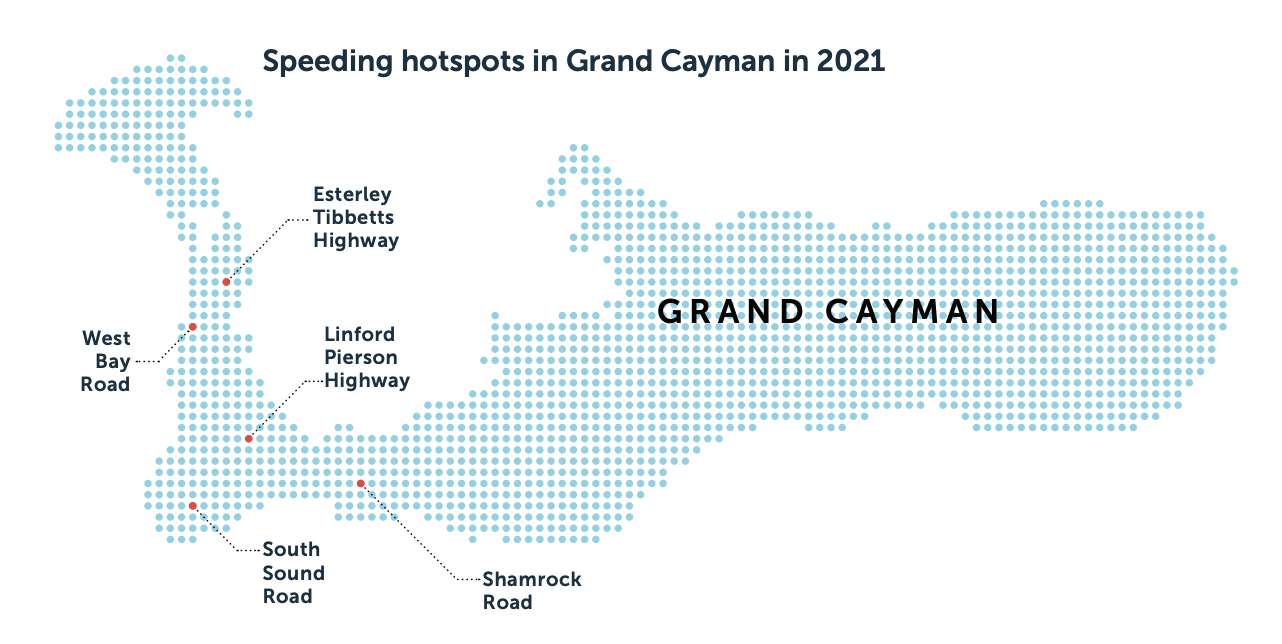
This kind of behaviour isn’t a one-off: in a single day in January this year, police stopped three young drivers for excessive speeding, with a 17-year-old boy doing 62mph in a 40pmh zone on Esterley-Tibbetts Highway, a 21-year-old woman driving at 62mph on Rex Crighton Boulevard, also a 40mph zone, and a 22-year-old woman driving at 64mph in a 25mph zone on Walkers Road. All were fined, with some facing disqualification and even a custodial sentence.
Given the limits on police resources, could installing a network of fixed speed cameras be the answer to finally curbing Cayman’s excessive speeding?
The wait for cameras
Thanks to changes in legislation, speed cameras have been legal on the Cayman Islands since 2012. In the UK, speed cameras had an instant impact on speeding when they were first installed in 1992. Called ‘Gatso’ cameras after the company that made them, they used radar technology to record the speed of a vehicle and take a photo if it was exceeding the speed limit.
Police data cited by the UK’s Royal Society for the Protection of Accidents show that, in the first three years of operation, speed cameras reduced the number of people killed by 70%, the number of people seriously injured by 27%, and the number of people slightly injured by 8%.
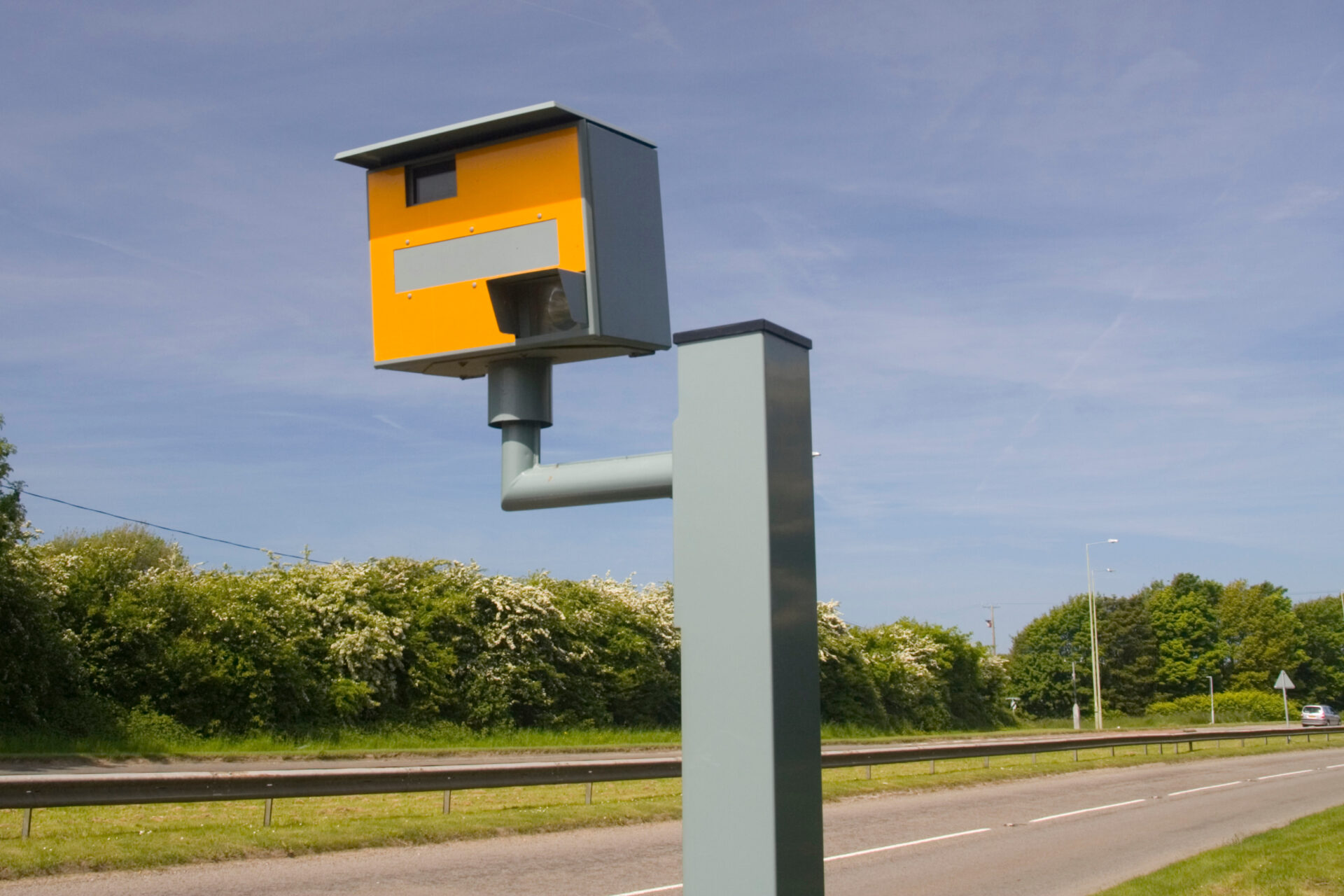
Following the success of speed cameras in the UK and other nations, there have been calls over the years to use speed cameras in the fight against speed in the Cayman Islands as well. In 2023, the then-Police Commissioner Derek Byrne said the RCIPS was looking at speed cameras as part of a national road safety strategy, saying that the benefits of the project “would be immense”.
A spokesperson for the RCIPS told the Compass that the RCIPS “maintain their support of the implementation of a speed camera network as was expressed by former CoP Byrne, but the decision-making regarding implementation, which includes infrastructure, budget, etc, sits with Cayman Islands government”.
Speed cameras promised
In 2023, government published the National Road Safety Strategy 2023-2028, which listed as one of its main short/medium-term action points: “Develop a Speed Camera Strategy, via legislative changes, that allows the camera-based technology to enforce speeding offences, ensuring drivers and riders travel at safe speeds.”
In the report, it promised “the implementation of over-arching speed cameras planned for 2024, to guide effective speed enforcement and deter speeding, with the ultimate objective of reducing road deaths and injuries”.
However, a spokesperson for the Ministry of Planning, Agriculture, Housing, Infrastructure, Transport and Development told the Compass in a statement last month, “At this stage, no trial of speed cameras has been officially scheduled. The current speed enforcement business case, which is under review, outlines various options, including the potential use of speed cameras as one tool within a broader enforcement strategy. Should this business case receive the necessary approvals, a trial phase may be implemented as part of our overall road safety initiative.”
The statement went on to outline all the steps that government says need to be completed before any speed cameras can be introduced. “These include a comprehensive legislative and regulatory review, the development and approval of a detailed speed enforcement business case, and close coordination with our key stakeholders – including the National Road Safety Committee, the National Roads Authority, and law enforcement agencies. This multi-step process is essential to ensure that any measures adopted are both effective and sustainable.”
‘We have a problem’
Eric Bush, the ministry’s chief officer, frowned as he watched the footage of speeding traffic on West Bay Road, and admitted, “We have a problem,” adding, “We have a systemic issue whereby a number of drivers in the Cayman Islands are not following the laws, particularly around speeding.”
“I think everybody who drives on the road sees it, but it’s something that we can only solve together.”
He said that government had been trying to tackle the issue through the National Road Safety Strategy and all the various stakeholders, but said, “This cannot be solved by the police alone. This is not a police problem, this is a Cayman problem. This is a community problem. The community has to get on board.
“The community has to say ‘no more’, and the community has to be a part of the solution in saying, ‘I’m not going to tolerate this anymore, and I’m not going to do this anymore …’ We cannot prosecute our way out of this problem.”
He added, “Are we getting it perfect? Absolutely not, but we’re getting better and better every day. But what I would love to see is the community buy-in.”
The issue of using speed cameras to tackle Cayman’s speeding problem is not a new one to Bush, who was quoted in the Compass in 2012 as saying government wanted to add speed cameras and red-light cameras to the current CCTV system on the roads.
A 13-year wait
Given that he was calling for speed cameras 13 years ago, why hasn’t it happened?
“In terms of the why, I honestly can’t answer that,’ he said. ‘That’s beyond my remit. I mean, that’s a political and government decision to say that speed cameras, we want to deploy those, we are going to allocate funding for that. But I can say, yes, the legal framework is still in place … At the end of the day, it takes the government of the day to say that we want speed cameras and that we’re going to allocate funding for the project.”
Bush pointed to other efforts currently being taken to try and reduce speeding and promote safer driving, such as installing new roundabouts and lane delineators down the middle of roads to prevent overtaking, as well as ongoing public awareness campaigns, such as Arrive Alive.
“I don’t want to say that speed cameras are the silver bullet in all of this,” he said. “That’s not the case at all, [but] will it help? I absolutely believe that, hand on heart. Is it something that I hope we can deploy in the very near future? Absolutely.”
If it seems confusing that there is money for new roundabouts, but none for speed cameras, that’s because they fall under different parts of government.
“Road improvements are within the remit of the NRA and they have the budget and, if you will, the parameters to improve the road in that way,” explains Bush. “For speed cameras, it needs to be government policy and funding specifically for that project.”
Connected enforcement
Bush hopes that the current CCTV system, which records whether cars are licensed and have up-to-date insurance, will soon be connected with enforcement software, as currently the data is recorded, but nothing can be done with it. “It’s one thing to capture it and another to enforce it,” he says.
In the meantime, the planned demerit points system is expected to be implemented in the next few months, whereby drivers breaking the law will be given points as well as fines. Those who rack up a certain amount of points in a certain time period – the actual details are still to be revealed – face being disqualified from driving for a fixed amount of time.
While there will be a cost associated with installing speed cameras and the necessary technology, the revenue generated from fines could be considerable. With drivers fined $20 for every mile per hour over the speed limit they were travelling, and 4,654 speeding fines issued in 2023 with an average of 17 miles per hour over the speed limit, a simple calculation yields an annual $1.6 million in fines from just mobile speed units and police patrols alone.
That’s not to say that there won’t be an initial outlay required, which Bush estimates at being between $3 million and $5 million. As the cameras take effect, there should be a reduction in speeding and therefore a reduction in fines, but the reduction in injuries and fatalities is incalculable.
Campaigning for cameras
Safety campaigner Sophie Miles used to live on crash hotspot Shamrock Road. After yet another fatal crash, this time of Premier Juliana O’Connor-Connolly’s niece Channah Connor, Miles set up an online petition ‘Save Lives on Shamrock Road’, calling on government to implement road-safety measures, including speed cameras and the enforcement of traffic laws. The petition has received almost 800 signatures and Miles has spent the last year trying to find out what is being done about speeding on the island.
“There absolutely is a speeding problem in the Cayman Islands,” she told the Compass.
“We’ve grown so quickly as an island and there are so many different driving cultures here,’ she said. “Speeding is just one of the factors involved here, but speed cameras would go a very long way to help – they’re budget-friendly, they’re revenue-making and we know where the traffic hotspots are.”
Putting delineators down the middle of Shamrock Road, as has been done elsewhere on island, in Miles’ opinion, has made it more dangerous rather than less. “People aren’t really slowing down, and they’ve made the margin of error much smaller,’ she says. “Drivers are being filtered along a corridor.”
As for political action, Miles points to a private member’s motion proposed by McKeeva Bush in Parliament last May to increase fines and enforce road safety, including reducing speed limits and the introduction of ‘digital speed signs capable of recording and issuing tickets’, which was unanimously passed by MPs, but resulted in no actual action.
“The political will is there and the money is there … but they just don’t have the ability to get things done, which is very disappointing,’ she said.
“The government are putting the responsibility back on the drivers,” she added. “I’m 100% in favour of driver responsibility, and we do have to slow down, but government won’t help us do that as they’re not designing smart roads; they’re designing ways to carry lots of people very quickly because they won’t put public transport in.
“What’s it going to take – a child, a tourist to be hurt – for people to take action?”