


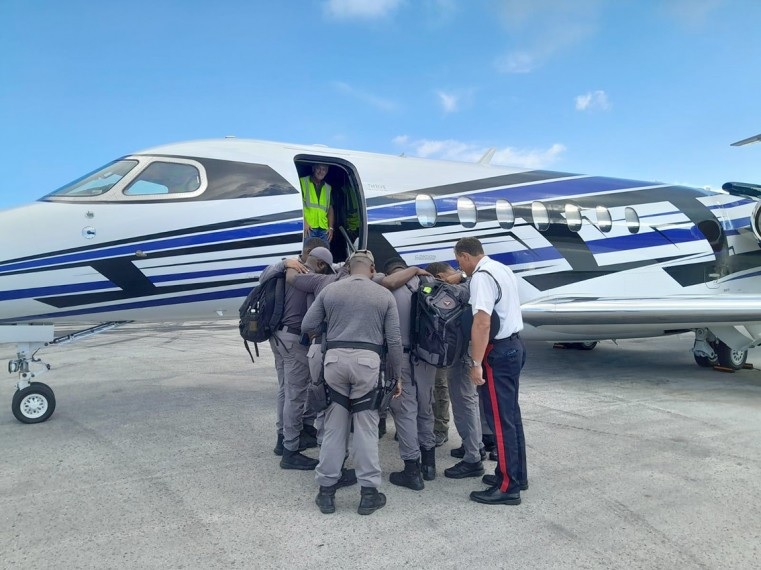
The Royal Cayman Islands Police Service has deployed eight of its officers to Anguilla to help police on that island with gang violence.
Six firearm officers, a police inspector who is a tactical firearms commander, and a drone operator will be spending a month in Anguilla to bolster the work of the Royal Anguilla Police Force in tackling an escalation of serious crime on the island.
There has been a rise in shootings on the island recently. Two men – Jaheim Gumbs, 22, and Rashe Hodge, 31 – were shot dead in separate shootings on 9 May, and a tourist and a local teen were injured in a shooting on 6 May at the island’s Blowing Point Ferry Terminal.
Last week, the governor of Anguilla, Julia Couch, and the island’s premier, Cora Richardson-Hodge, met with UK Minister for the Overseas Territories, Stephen Doughty, to discuss the rise in gun crime and gang tension.
During those talks, Doughty pledged additional UK support to reinforce Anguilla’s police service, including sending officers to the island from Britain and Cayman.
Cayman Islands Commissioner of Police Kurt Walton, in a statement on the recent deployment of his officers, said, “It is important that we support our [British Overseas Territories] colleagues whenever possible. We have been very fortunate here in the Cayman Islands, where there have been limited reasons to call for outside help.
“However, I am confident that if the circumstances were reversed, the support would be reciprocated.”
‘Crime knows no bounds’
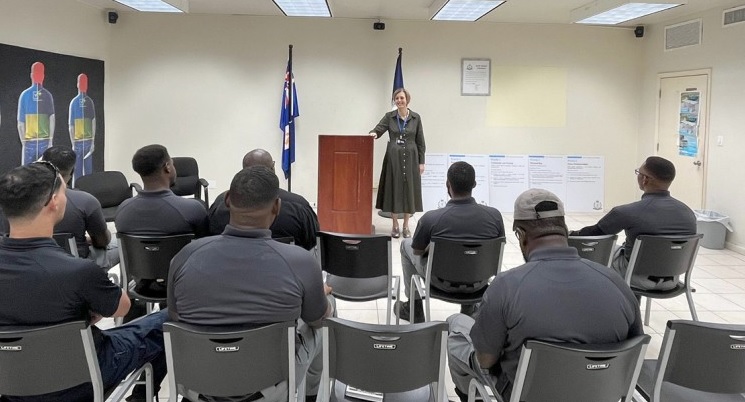
Governor Jane Owen, speaking on Compass TV’s ‘Forefront’ show on Thursday, said small island nations needed to support one another and collaborate when it comes to crime or disasters.
“Crime knows no bounds,” she said. “It is so easy, especially in a relatively small society, to just go over that tipping point, and that is the concern with the gang activity going on at the moment in Anguilla.”
She noted that the 35-square-mile island, which has a population of about 15,000, was experiencing “the worst spike in violence maybe that they’ve ever had, certain than they’ve had in some time”.
She added, “We look around the region, we see what’s happening in Turks and Caicos Islands. Everybody knows what’s happening in Haiti. It’s very easy to see that you could lose control of it if you don’t step in. That’s what we’re trying to do.”
In a press conference earlier this month, Walton spoke about declining staffing levels within the RCIPS. In his statement on the Anguilla postings, he said the deployment of officers had been “carefully balanced with our current staffing levels to ensure that our community will not be left vulnerable during this period”.
He added, “The community will continue to see high visibility patrols, proactive policing and sharp professional response from our officers.”
Echoing this, the governor agreed that the decision to send police officers overseas to help other countries had to be balanced with “making sure your island remains safe, and I know that’s something that been on the top of the commissioner’s mind”.
The governor noted that the UK, which was funding the deployment from Cayman, had also sent some of its own firearms officers there.
As well as the officers themselves, the RCIPS has also sent a drone, with an operator, to Anguilla, which will help with surveillance and tactics, Owen said.
She added that the Cayman officers would be under the command of the RCIPS Firearms Tactical Unit commander and that Walton had been “clear about command and control”. The presence of a Cayman commander, she said, would help ensure RCIPS officers were being “properly and safely deployed”.