


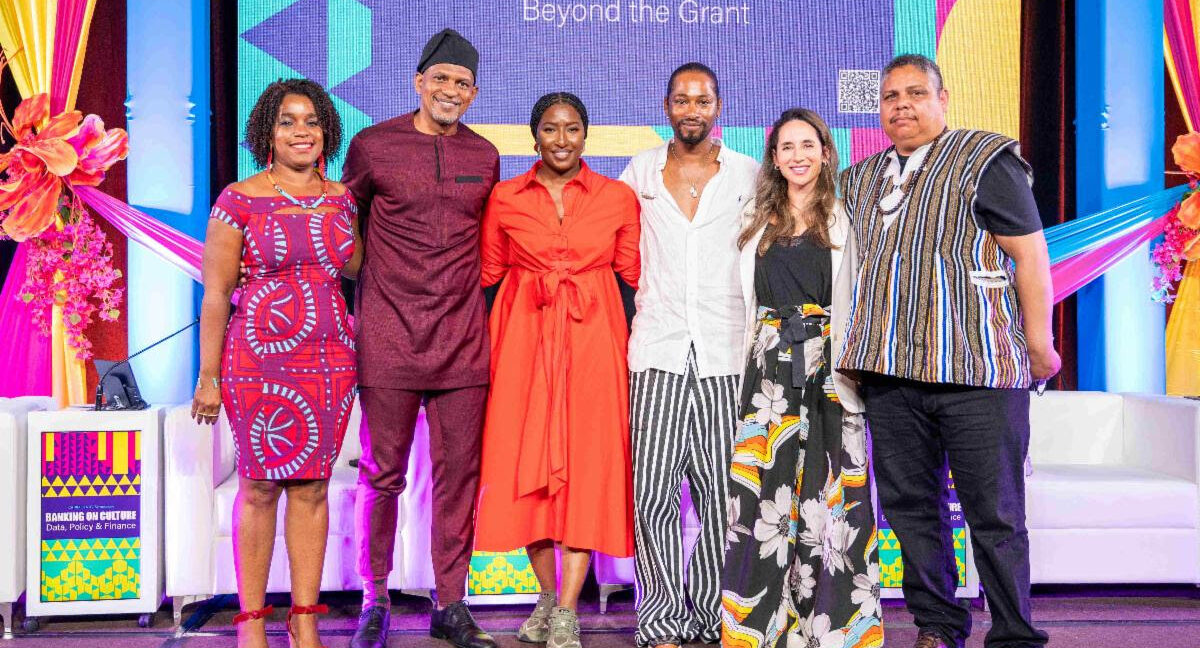

Caribbean Development Bank’s president, Mr. Daniel Best, reaffirmed the institution’s commitment to advancing the region’s creative economy through innovative approaches, sustainable financial solutions, and targeted investments. During discussions on the development of the Bank’s flagship Cultural and Creative Industries Innovation Fund (CIIF), President Best emphasized the critical need to bolster Caribbean creators in establishing competitive and self-reliant creative businesses on a global scale, said a press release from CDB.
According to Best, “CIIF is a game-changer for the region—supporting not just talent, but the systems and resources creatives need to thrive. We are moving beyond handouts and designing tools that make it possible for creatives to own their future. This is about sustainable growth, not just for the industry, but for the region’s identity.”
Addressing a symposium at CARIFESTA XV titled “Beyond the Grant: Financing Futures in the Creative Economy,” the release stated that President Best discussed various obstacles faced by Caribbean artists and the opportunities under consideration by CDB. Reportedly, CIIF has directly supported over 1,000 creatives across 17 nations, generated 144 new employment opportunities, and funded 30 projects with successful outcomes. Additionally, the release shared that the fund invested USD 200,000 in Haiti to bolster the capacity of 90 creatives through technical support and skill development initiatives.
While the fund provides training and grants, Best stressed the importance of shifting from reliance on grants toward sustainable financing models. In this context, CDB’s Board approved the organization’s inaugural Trade Finance Guarantee Programme, designed to mitigate risks associated with investments in Micro, Small, and Medium-sized Enterprises (MSMEs) engaged in trade—including those within the creative sector. A subsequent MSME Partial Guarantee Scheme is scheduled for launch in 2026, aiming to improve access to capital for creative entrepreneurs.
The re-capitalization of CIIF through 2027 signals a new phase focusing on blended finance, receivables-based funding, and readiness for investment. The Bank outlined that it is also working to narrow the gap between creative professionals and financial institutions by training loan officers to evaluate intellectual property and creative assets, while also providing creatives with guidance on proposal development and financial literacy.
Best remarked, “We’re pulling out all the stops—blended finance, guarantees, receivables financing. It’s time for creatives to receive the kind of sustainable investment they need to flourish. We’re making it make sense.”
The Bank’s broader vision incorporates linking climate resilience initiatives with cultural financing, recognizing that major cultural events like Crop Over, Trinidad and Tobago Carnival, and Junkanoo are vulnerable to climate disruptions.
“The biggest revenue earners in our economies are tourism and culture. One weather event could devastate these sectors. The two, therefore, cannot be considered mutually exclusive,” Best explained.
Through CIIF, CDB continues to promote capacity-building, mentorship, and policy development, while advocating for cultural equity and representation. By leveraging strategic partnerships and data-driven strategies, the Bank says that it aims to shift the balance from idea extraction to ownership, ensuring that Caribbean talent is celebrated while being sustainably supported.