


The Cayman Islands Chamber of Commerce has launched a Tariff Impact Survey to assess how the islands’ businesses are being affected by US tariffs.
The initiative comes amid growing concerns that the tariffs, announced by US President Donald Trump, could impact Cayman’s import-dependent economy.
On 2 April, Trump declared a 10% blanket tariff on all US imports, effective 5 April, along with steeper duties on goods from 57 countries. The policy, which US Secretary of State Marco Rubio defended during a visit to Jamaica as a step toward fairer trade and stronger US manufacturing, has triggered global backlash.
While the new US tariffs are unlikely to affect Cayman’s limited export trade, the broader effect on imported goods could drive up costs across a variety of sectors. Over 80% of Cayman’s imports, including food, construction materials, equipment, and retail products arrive here via the US. Any goods derived outside the US may become more expensive here if they first arrive in the US.
The Cayman Islands government assesses import duties on the cost of goods arriving here. If US exporters increase prices because of tariffs they have to pay, Cayman businesses and consumers will effectively have to pay higher duties because of taxes collected by the United States.
“Unfortunately, the global trade tariff landscape significantly impacts the Cayman Islands, as we import many of our goods and products from countries that are imposing high tariffs, driving up prices,” said Chamber CEO Wil Pineau. “If these tariff disputes are not settled, we can expect higher prices for many items, as local businesses will be forced to pay more for these goods.”
Economist Marla Dukharan told the Compass that the situation could worsen already high living costs.
“Cayman is already the second most expensive jurisdiction in the Caribbean, and we’ve seen an increase in poverty and inequality over the years,” she said. “What’s happening globally with tariffs and price hikes will only make things worse. It’s time for decisive policy action.”
Chamber members already feeling the impact of tariffs

Pineau said that the Chamber had received feedback from member businesses that had been experiencing “substantial increases in some products and goods”, prompting the rollout of the survey, to capture the scope of the problem.
The survey asks respondents to share information on business size, industry and tariff-related impacts to identify which sectors are most vulnerable. This is intended to help direct future conversations on how businesses are coping with rising costs and inform policy discussions.
“The survey will help the Chamber Council gather information that we can share with policymakers to determine what measures, if any, can be introduced to support these businesses,” said Pineau.
The Chamber is also offering guidance to its members on how to adapt.
In a recent Chamber article titled ‘“Navigating Cayman’s economic waters amid Trump’s tariff war’, Pineau outlined strategies such as diversifying supply chains and embracing collaborative purchasing strategies. He encouraged businesses, particularly small and medium-sized enterprises, to explore alternative sourcing options in the Caribbean, Latin America, Canada, or even within Cayman itself.
Progressive Distributors says it is actively working to cushion tariff-related price increases by leveraging a bonded warehouse and free trade zone in Miami, while also exploring new, tariff-free sourcing options across the Caribbean.
Transparency is another key focus. The Chamber urged businesses to be upfront with customer about price fluctuations. “Honesty about pricing pressures in economic uncertainty fosters trust and builds brand loyalty,” the article noted.
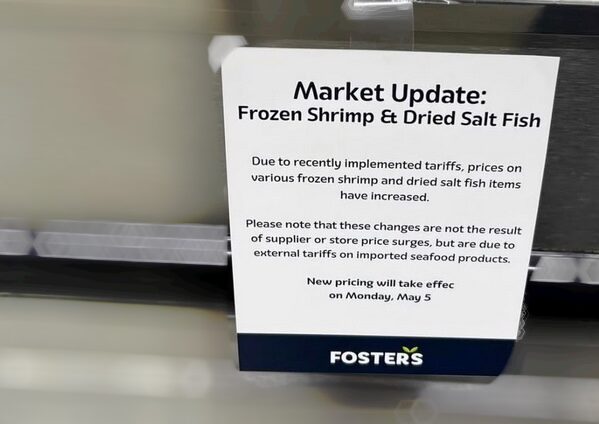
Foster’s Supermarket, for example, has taken steps to inform customers of tariff-related price changes. Signs recently posted in frozen seafood sections read: “Due to recently implemented tariffs, prices on various frozen shrimp and dried salt fish items have increased. Please note that these changes are not the result of supplier or store price surges but are due to external tariffs on imported seafood products.”
Pineau and Chamber President Omari Corbin are expected to meet with importers next week to discuss strategies for price stabilisation and gather further input. In the meantime, members are encouraged to participate in the survey shared via an email link. The deadline for Chamber members to take the survey is today, 16 May.