


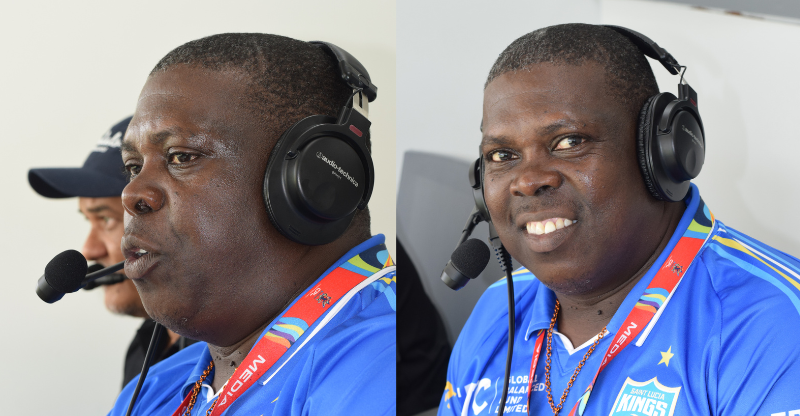
Long before the first ball was bowled at the Daren Sammy Cricket Ground last week, cricket fever had already taken hold across Saint Lucia. The Kings, champions of the Republic Caribbean Premier League, were back home, and fans were ready – packing the stands, tuning in from their living rooms, and following every moment on their phones and radios.
Others would have tuned in to radio broadcasts around the world, originating from the Media Centre end of the Daren Sammy Cricket Ground. And one of the main voices they heard would have been that of Clivus Jules, cricket coach and Director of Sports in the Ministry of Youth Development and Sports.
“I’ve been doing commentary in Saint Lucia for quite some time,” Jules explained. “I did a lot of the local games. I do the regional
first-class games once they are here. I’ve been around cricket for quite some time. So I think from my exploits in the local scene, somebody would have heard, and I was approached, and of course, I actually love this. So I welcome the opportunity.”
Jules comes from the era when fans brought transistor radios to the ground, listening as they watched. He still does the same, though now, the “radio” is on his mobile phone. Back then, especially before the 1990s, keeping up with the West Indies team meant staying up late and tuning in to AM or shortwave broadcasts from far-off places.
Even with today’s high-definition coverage and global streaming, Jules believes radio still holds its place.
“For me, radio can never really lose its place,” he said. “With the advent of T20, people are more about the excitement and the fanfare, and not so much about the game. But radio, for the true cricket fan, is what cricket is really.
“I remember growing up and listening to cricket. We did not have a TV. I never really saw cricket until very late on TV, but I would have seen it by listening to it. So the radio brought a lot more information, a lot more flair, a lot more colour. For me, the commentators used words to literally paint a picture for you. I appreciate that, and I think that value remains to this day for the cricket purist.”
Though he models his style after legends like Joseph Reds Perreira and Tony Cozier, Jules is quick to say that commentary isn’t his main calling. His heart lies in coaching, and quietly, he’s made a lasting impact.
One of his former proteges is Theo Edward, now captain of the Windward Islands Under-17 team, who made headlines two years ago for his record-breaking performance at the Under-15 tournament.
“I think coaching is the thing for me, because I look at myself as a career teacher,a career educator,” mused Jules. “I’ve taught for a long time, and coaching for me is the biggest thing. That’s where you can have the most impact. That’s where you can create the most change. For me, that’s where you can build better people, and if you build better people, you build a better country for that reason.”
Jules is steeped in cricket, not just through experience but through study. He was among the first Saint Lucians to earn a degree in cricket studies at the University of the West Indies, a programme developed by Professor Hilary Beckles to explore the sport’s role in Caribbean history and development. Jules learned about cricket’s cultural significance, its management, and its potential as a tool for regional progress.
Now, whether he’s behind the mic, on the training ground, or shaping policy as Director of Sports, Clivus Jules is living out those lessons – one ball, one broadcast, one young player at a time.