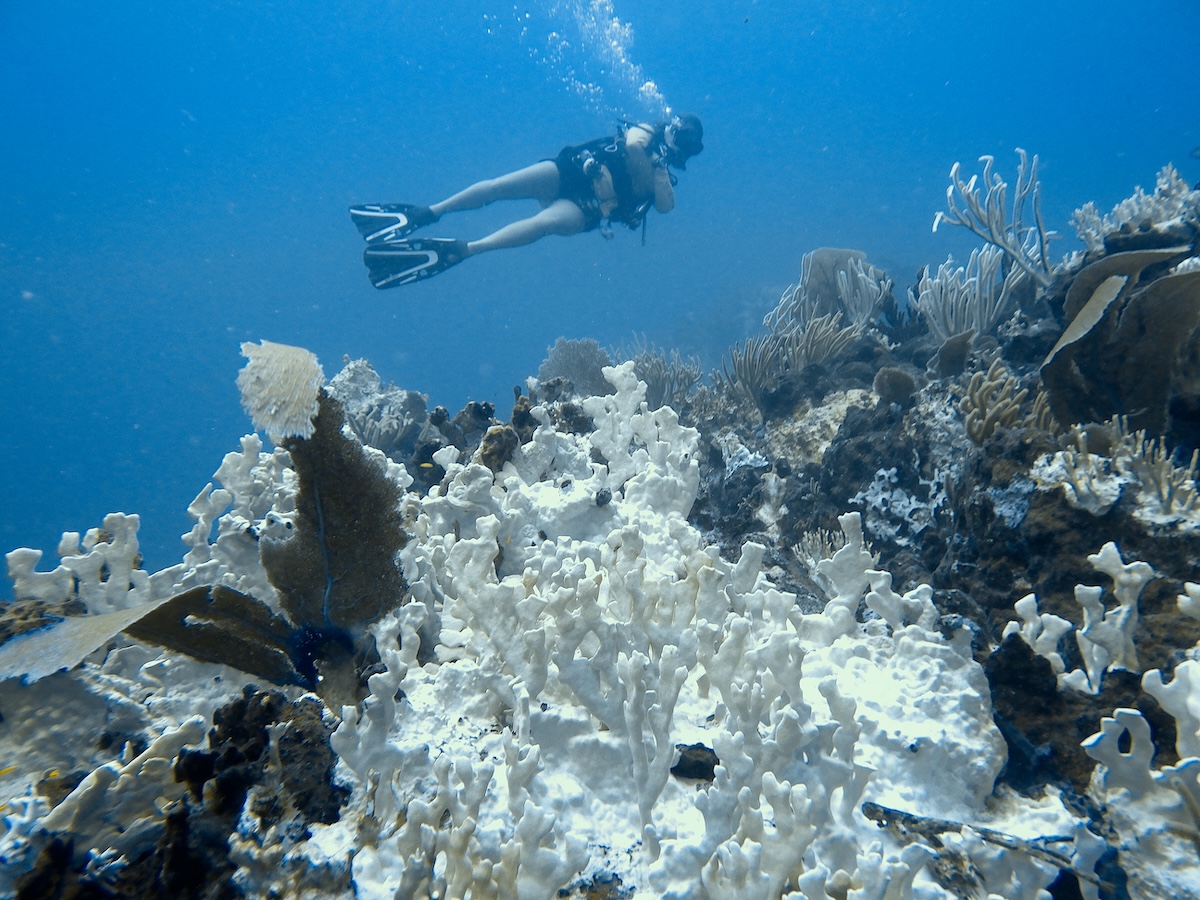
A historic coral bleaching event has swept across the Caribbean over the past two years, threatening the ecosystems that feed, protect and sustain life across the region. This multi-part investigation, reported from six countries and territories, reveals the scale of the damage — and the human costs mounting beneath the surface.
On a sweltering day in 2023, Virgin Islands fisherman Zacchari Stoutt was suiting up for a routine dive when he glimpsed something unusual on the seafloor. At first, he thought it was a sunken boat.
“It was quite visible,” recalled Mr. Stoutt, who fishes lobster, fish and conch with his father and brother. “But putting on my mask and looking over, I did notice that it was in fact coral that went pale: bleach-bleach white.”
He was witnessing the local onset of what scientists now call the most severe global coral bleaching event in history.
Since January 2023, bleaching-level heat stress has hit nearly 84 percent of the world’s coral reef area, causing mass bleaching in the waters off at least 83 countries and territories, according to the United States National Oceanic and Atmospheric Administration (NOAA).
For fishers like Mr. Stoutt, the impact is deeply personal. But in the Caribbean, home to about 10 percent of the world’s coral reefs, the losses extend far beyond individual livelihoods — threatening tourism, food security and coastline protection in a region where more than half the population lives within a mile of the sea.

Coral bleaching is a stark example of global climate injustice: Small-island states, which emit a tiny fraction of global greenhouse gases, suffer many of the most catastrophic impacts of a warming planet.
But the Caribbean’s coral crisis is also a result of local and regional policy failures. For decades, governments have failed to protect reefs even as experts warned of the risks.
“The late 1980s is when people started realising, ‘Hey, we might be having some problems with these ecosystems,’” said marine biologist Melanie McField, founder of Healthy Reefs for Healthy People, a non-profit that works to protect the 625-mile-long Mesoamerican Reef off the coast of Mexico and Central America. “Sewage pollution, overfishing, sedimentation and runoff, and it’s the same things. We’re not fixing those problems.”

That pattern of neglect continued as the recent bleaching reached new extremes, according to a yearlong investigation led by Puerto Rico’s Centro de Periodismo Investigativo (CPI) with reporting from The BVI Beacon and other partners across six countries and territories in the Caribbean.
Even during mass coral die-offs at the height of the crisis in the hottest months of 2023 and 2024, the investigation found that reefs were still being undermined by decades-old destructive practices, regulatory shortfalls, perennial enforcement failures, and a chronic shortage of global funding to prevent and mitigate damage.
Still, scientists see hope. Emergency interventions under way in the region include land-based coral “arks,” bioengineering projects, and studies of reefs that have survived extreme conditions.
However, most of these projects are small-scale and underfunded. And with 90 percent of the world’s reefs projected to bleach annually by 2050 under current warming trends, scientists say the Caribbean’s future is grim without dramatic global emissions cuts and bold new investments.
“The people on these islands would not be here if it weren’t for those coral reefs,” said Bryan Wilson, a marine biologist at the University of Oxford who studies reefs in the Caribbean and the Indian Ocean.
“Those coral reefs are their absolute lifeline to the ocean. They protect the islands from storm surges and … hurricanes. They provide the fish that we eat. They provide the tourism dollar that pays for much of what goes on in the islands. We lose those reefs, the islands lose everything. Literally everything.”

A bird’s-eye view
While divers like Mr. Stoutt watched coral turn bone-white beneath Caribbean waves, marine biologist Derek Manzello was tracking the same crisis from above.
As coordinator of the Coral Reef Watch programme at the United States’ NOAA, Manzello monitors the world’s reefs using satellite data and field reports. In his more than two decades at the NOAA, good news has been rare — particularly in the Caribbean.
Even before the recent bleaching, scientists estimated that the region had lost 50-80 percent of its hard coral cover since systematic monitoring began in the late 1970s, leaving Caribbean reefs among the most degraded and vulnerable on the planet.
Now, rising temperatures are accelerating the decline.
Corals, reef-building animals that resemble tiny jellyfish, rely on colourful symbiotic algae that live in their tissues and provide food through photosynthesis.
When summer ocean temperatures rise even two to four degrees Fahrenheit above normal, corals often eject the algae and turn white — a process known as bleaching.
If temperatures drop in time, algae can return and recovery is possible. If not, corals often die — particularly if they are already weakened by pollution, runoff, disease or other stressors from overfishing, development or heavy tourism.

‘A wild phenomenon’
By mid-2023, with an El Niño climate event under way and temperatures rising, Mr. Manzello began to see troubling signs to the south.
“In early July [2023], we saw the development of heat stress in Florida that was record-setting by a large margin,” he told CPI. “And unfortunately, this record-setting heat stress then went on to develop throughout the entirety of the wider Caribbean.”
That summer, some Florida reefs experienced temperatures more than five degrees Fahrenheit above average during a marine heatwave — conditions so extreme that some corals skipped the bleaching stage altogether.
“We saw what is called rapid tissue loss, which is basically the corals just dying and sloughing off their tissues,” Mr. Manzello said. “They get so hot so fast, they don’t even have time to bleach, which is a wild phenomenon.”
As the waters cooled in the winter months, some of the region’s coral recovered. But scientists, who are still assessing the damage, say up to 100 percent died in other areas.

For the Caribbean, the stakes are particularly high.
Coral reefs, often called the “rainforests of the sea,” cover less than one percent of the seafloor worldwide but host nearly a quarter of marine biodiversity.
In the Caribbean alone, an estimated 41 million people likely depend heavily on them for food or their livelihood, according to the Washington D.C.-based non-profit World Resources Institute.
Yet the crisis remains mostly out of sight.
“The problem is, it’s happening underwater, where most people don’t see it,” said Marilyn Brandt, a coral biologist in the US Virgin Islands. “The average person probably has no idea this is happening.”

The human cost
For fishers like Mr. Stoutt, however, the bleaching was all too obvious. He watched it spread through the reefs that he fishes across the VI, many of which were still recovering from the Category 5 Hurricane Irma in 2017.
Roughly 100 miles away in Puerto Rico, fisherman Miguel Ortiz said the bleaching forced crews farther offshore as shallow reefs declined.
“We notice the changes, we live with the changes, but we’re also part of it,” he said, adding, “Nature is demanding: It’s telling people, it’s telling the world, it’s telling governments: ‘Stop pollution so I can recover again.’”
Tourists have noticed too. In the Dominican Republic, Belgian diving instructor Julie Piron said visitors often asked about the pale coral — but kept coming to see the remaining fish. She worries that will change.
“We know it will affect us in the long term, because the more corals die, the fewer fish we will have,” she said. “So it’s all like a spiral.”

That spiral extends beyond reefs. As corals degrade, so do the beaches and other coastal features that draw tourists — one of the Caribbean’s biggest economic engines.
“Over time, if everything’s dying, you’re not going to have that reproduction of sand,” warned VI marine biologist Shannon Gore, who has studied the receding shorelines in this territory. “It’s just going to eventually go away.”
If tourists go away too, the region has much to lose.
A 2019 study by The Nature Conservancy found that reef-associated tourism alone draws 11 million visitors and nearly $8 billion to the Caribbean annually, making up 23 percent of all tourism expenditure — equivalent to 10 percent of gross domestic product in the region.
Coral ecosystems also contribute an estimated $300 million more in fisheries each year, as well as coastal protection services worth up to $2.2 billion, according to the World Resources Institute.
“The entire fabric of the maritime economy, or at least a large part of it, depends on these healthy ecosystems,” said Jessica Crillon, a project manager at the Martinique National Marine Park. “And yet, we are now realising that the deterioration has been extremely severe and rapid in recent years.”
‘It’s like a dynamite blast’
By late 2023, the global bleaching had grown so severe that the NOAA’s Coral Reef Watch expanded its heat-alert system from two levels to five.
Then in April 2024, the agency confirmed what many biologists had feared: Earth was experiencing its fourth global coral bleaching event — and worse was on the horizon as the waters warmed again last summer. In the Caribbean, nearly 100 percent of reefs have experienced bleaching-level heat since the start of 2023, and at least 25 countries and territories in the region have seen mass bleaching, according to the NOAA.
The damage is no longer invisible — even from land.
In Martinique, conservationist Louise Chourot had spent years nurturing a colony of endangered staghorn coral which had been transplanted off the south-coast village of Sainte-Luce as part of a coral restoration project at Grande Caye reef.
The coral, already weakened by years of pollution and other pressures, bleached badly.
“They were stressed [by heat] for almost a year between 2023 and 2024,” said Ms. Chourot, who is the head of scientific projects at the environmental non-profit L’Asso-Mer Martinique. “Coral stress, manifested by the bleaching of the polyps, weakens the animal, the coral.”
Then Hurricane Beryl hit. When it passed south of Martinique in July 2024 as a Category 4 storm, the island was pounded by tropical storm conditions and heavy swells that wreaked havoc underwater.
“It’s like a dynamite blast that made everything explode,” Ms. Chourot said. “All the huge coral structures that had been there for hundreds of years are now on the ground and are sanding away.”
A village exposed
With the Grande Caye reef broken near Sainte-Luce’s southern shore, the storm’s full force hit the coastline.
In the water, the destruction also further compromised the habitat of dozens of species of colourful reef fish and coral that have long drawn divers and snorkelers to the area.
On a Monday afternoon in May, fisherman Steve Senzemba, 31, stood on the shore in Sainte-Luce and pointed toward the sea after selling his last mahi-mahi of the day.
“Where you see the waves coming out, you used to be able to see the rocks coming right out of the water,” he said.
The hurricane, he added, broke this barrier.
“So now there’s no protection,” he said. “So now everything’s coming in: seaweed, sargassum, waves. Frankly, it’s a big problem for the town of Sainte-Luce.”
As more coral dies, this pattern could repeat across the region. Studies show that coral reefs, which can reduce average wave energy by up to 97 percent, help protect about one-fifth of shorelines in the Caribbean.


Centuries of degradation
From the shore in coastal villages like Sainte-Luce, the Caribbean’s coral crisis may seem sudden. But scientists say its roots reach back centuries.
During his voyages to the hemisphere in the 1490s, Christopher Columbus frequently wrote about reefs in his journal. But he was describing their danger to his ships, not their ecological value.
His observations foreshadowed centuries of exploitation. For more than 400 years, European colonisers treated coral reefs not as natural treasures, but as navigational obstacles to be removed — or resources to be extracted.
As the Caribbean population grew, coral was increasingly quarried for forts, homes and other buildings, while turtles, manatees and some large reef fish were hunted nearly to extinction in many areas.
“The events in the last sort of 40 or 50 years have been really bad,” said Peter Edmunds, a marine biologist who has studied the reefs in the USVI for about four decades. “But long before that, we set in motion the removal of the big vertebrates and we set in motion changes in land use, and that has all contributed to what we see now.”

Danish colonial records about St. Croix include descriptions of enslaved people mining coral directly from shallow reefs for construction in the mid-1700s.
Brain corals were particularly prized for constructing churches and other buildings, according to Mr. Edmunds.
“It was readily dressed stone to make impressive arches to help people be impressed by the power of Christianity,” he said. “It just seems almost impossible to believe that corals were so abundant you would just go down to the shore and prise out big old boulders and cut them into slabs and build a church or build a house. And it was a different time.”
In 1851, the US Coast Survey commissioned renowned naturalist Louis Agassiz to study Florida’s coral reefs with the hope of slowing their growth and improving shipping safety, according to the NOAA.
Mr. Agassiz, however, came up short.
“I do not see the possibility of limiting in any way the extraordinary increase of corals, beyond the bounds which nature itself has assigned to their growth,” he wrote in his report.
Tourism boom
With the advent of scuba technology in the mid-20th Century, scientists began to study reefs more intimately.
But by then, much damage had already been done, and more was on the horizon.
A post-World War II tourism boom brought resorts, marinas and other coastal construction to many islands — along with rising pollution, crowds, overfishing and other marine pressures.
Coral cover began to collapse. A sea urchin die-off in the early 1980s triggered algae overgrowth. New coral diseases — including black band, white band and white plague — spread across the region.
Then came the warming.
In 1987, Mr. Edmunds had just begun his teaching career on St. John in the USVI.
“The first Caribbean bleaching unfolded around November and December of ’87,” he recalled. “The reefs turn white. And we’re diving and — ‘Oh my goodness, you know: There’s all these white trash bags across the bottom. What’s going on?’”
Since then, regional bleaching has become increasingly common. Global bleaching events followed in 1998, 2010 and 2014–2017 — each more widespread than the last.
Climate change also brought another threat: Ocean acidification, caused when the sea absorbs excess carbon dioxide from the atmosphere, further weakened coral.
The 2010s brought even more pressure. Invasive lionfish devastated food webs. Then came Stony Coral Tissue Loss Disease, which wiped out up to 60 percent of coral cover in some areas.


Out of sight, out of mind
As reefs declined over the past half-century, scientists warned of the consequences.
But in Caribbean nations, many of which were newly independent or politically unstable in the 1970s and 1980s, environmental concerns often took a backseat to economic survival.
Even as a regional environmental movement gained traction in the 1960s, it focused mostly on terrestrial issues.
“We live in a post-colonial society where the relationship with the water is one more of fear than respect,” said Nickie Myers, the general manager of the non-profit Alligator Head Foundation in Jamaica. “So a lot of the time, there’s no connection with what is happening in the water — because [of], clearly, the generational trauma that comes with our relationship with the ocean.”
Today, scientists say protections for Caribbean reefs tend to be weak, patchy and largely unenforced.
Though most Caribbean governments have made some progress and signed on to global and regional goals — including a pledge to protect 30 percent of marine areas by 2030 — a study published last September in the journal Ocean & Coastal Management found that less than eight percent of the region’s waters were under formal protection.
Many of those protections exist only on paper, said marine biologist Lance Morgan, who heads a California-based non-profit that operates a global Marine Protection Atlas.
“To actually move beyond that — and implement regulations and management plans and monitoring and enforcement — is all very slow,” he said. “In the Caribbean, it’s even slow to get them designated.”


‘Absolutely horrible’
By early 2025, Mr. Stoutt had seen many signs of recovery on VI reefs. As ocean temperatures cooled in the winter, he said, much of the territory’s coral had regained its colour.
But while diving for lobster recently near Jost Van Dyke, he discovered a car-sized slab of coral he believes was destroyed by the anchor of a luxury cruise ship.
“It’s now [like] two mountains to swim in between, because the edge [of the coral] has been ripped on one side,” he said, adding, “I’m like, ‘Oh, my God: This is absolutely horrible. Terrible.’”
Anchoring on coral is illegal in the VI, which is home to hundreds of charter yachts.
But Mr. Stoutt said the government doesn’t strictly enforce such laws. (VI environmental officers including Ronald Smith-Berkeley — the permanent secretary in the Ministry of Environment, Natural Resources and Climate Change — didn’t grant interviews.)
Meanwhile, formal protections cover less than one percent of the territory’s waters, despite a shelved plan to expand protections to 30 percent of important biological habitats by 2017.
“There has been so much anchorage on our reefs now that it’s heart-breaking,” Mr. Stoutt said, adding, “Right now, I could go and probably dive up 20 to 25 anchors. And I’m not even over-exaggerating.”


‘Nasty’ pollution
Mr. Stoutt’s story is not unique. Across much of the region, CPI found that illegal anchoring, pollution, unsustainable coastal development and other damaging practices continued even at the height of the bleaching crisis.
In Guadeloupe, nearly all waters are officially protected, in part to guard one of the longest reefs in the region: an 18-mile underwater ecosystem said to host 60 species of coral and 250 species of fish.
But Guadeloupe conservationist Mariane Aimar-Godoc said the protections are largely unenforced — and compromised by issues including chronic sewage pollution.
“It’s been 20 years since we alerted the authorities on the problems of water quality. Most wastewater treatment plants in Guadeloupe are non-operational. I think we have 75 percent of wastewater treatment plants that don’t work,” she said, referring to the share of facilities deemed “non-compliant” by public authorities.
This issue exacerbated the recent bleaching, according to Ms. Aimar-Godoc, who directs the environmental non-profit IGREC Mer.
“Inevitably, every time there’s a bleaching episode or a problem in the water, the poor water quality will accelerate the mortality process. It’s stupid and nasty,” she said, adding, “We’re always talking about this longest coral reef, but it’s 90 percent dead today.”
‘I’ve had nightmares’
In Puerto Rico, CPI found that overlapping local and federal jurisdictions have often created bureaucratic paralysis that has left coral reefs exposed even when they are protected by law. Efforts are further undermined by a shortage of marine patrols, a scarcity of local funding, slow federal disbursements for mitigation efforts, and weak penalties.
María Vega-Rodriguez, a marine ecologist who has led the Puerto Rico government’s Coral Reef Conservation and Management Program at the Department of Natural and Environmental Resources for nearly three years, said public officials are doing their best, but the task is overwhelming.
“I’ve literally had nightmares, because in the time I’ve been managing the programme, I’ve seen the impacts of the Stony Coral Tissue Loss Disease, I’ve seen the sea urchin mortality, I’ve seen the bleaching of coral reefs, which are a lot of added stressors,” she said.

Coral nurseries collapse
With government support often lacking, some non-profits have stepped in — but often with limited, short-term funding.
As the bleaching reached Jamaica’s waters in 2023, ecologist Aldo Croquer, a marine conservation manager with The Nature Conservancy, was helping launch a $7.5 million German-funded restoration effort under the CoralCarib project.
The cross-border initiative — which aims to boost marine biodiversity across more than 4,600 acres in Jamaica, the Dominican Republic, Cuba and Haiti — was hit hard.
“Everywhere where we had coral nurseries — not only as part of the CoralCarib, but also in other institutions that have been working on coral restoration for years — they lost 90 to 95 percent of their nurseries,” Mr. Croquer said. “They tried to come up with strategies because they knew that heat stress was coming. … In some cases, they were successful. For the majority of cases, they were not.”
Still, they didn’t give up. Mr. Croquer’s team and their partners have experimented with land-based nurseries, manually cleaning algae off reefs, and working with communities to offer alternative livelihoods, among other projects.
But the funding gap for such efforts is huge, according to Ms. Brandt, the USVI biologist.
“The amount of money that’s been allocated for coral conservation, coral research, coral restoration, is a fraction of what is needed to actually protect these ecosystems or to restore these ecosystems,” she said.
Such projects, she added, are well worth the spend.
“The amount that you get back is many hundreds of times that, because these ecosystems are so important,” Ms. Brandt said.


‘A war on nature’
At the height of the bleaching crisis last October, the United Nations convened a special emergency session on coral reefs during its biodiversity summit in Colombia.
Peter Thomson, the ocean envoy to the UN’s secretary general, told a sparsely attended press conference that such sessions are usually called during crises such as wars.
“But this is a war,” he said. “It’s a war on nature.”
The emergency session focused on seeking support for the UN-backed Global Fund for Coral Reefs (GFCR), which launched in 2020 to mobilise $3 billion in public and private finance to help protect at least 7.4 million acres of reefs across the world by 2030.
The fund has supported programmes focused on resilient reefs across more than 20 countries — including four projects in the Caribbean — and built a pipeline of hundreds of other projects it would like to assist, according to fund director Pierre Bardoux-Chesneau.
“We have the mechanism. We know the problem. We have the solutions. But we are lacking the funding,” Mr. Bardoux-Chesneau said at the press conference. “And we are lacking the funding because we are lacking the right coalition to come together and support those initiatives.”

To date, the fund says it has secured just $248 million of the $740 million capitalisation it needs to meet its 2030 goals.
But Maxime Philip, a UN programme analyst working for the fund, told CPI in March that fundraising is getting harder, not easier.
“It’s become an increasingly difficult situation to meet the needs of the programmes, because [Official Development Assistance] found financing is becoming more and more sparse with a lot of the world kind of looking inward,” he said.
Meanwhile, the clock is ticking.
Although Caribbean sea surface temperatures this year have been slightly cooler than last year’s, scientists haven’t declared the end of the global bleaching event — and NOAA predictions suggest that continued heat stress in the coming weeks could bring another wave.
Trusting nature
In the VI, though, Mr. Stoutt said the way forward is clear.
“Focus on what we can stop,” the fisherman advised.
For Mr. Stoutt, this means cracking down on illegal anchoring, installing new mooring buoys, tackling pollution, working to eradicate invasive lionfish — and trusting nature.
“The ocean has a way in healing itself,” he said. “So I would leave it up to the ocean to handle itself.”
For this multi-part series, The BVI Beacon collaborated with journalists from five other countries and territories in a project facilitated by Centro de Periodismo Investigativo (the Centre of Investigative Journalism) in Puerto Rico. Mariela Mejía contributed from the Dominican Republic. The investigation is the result of a fellowship awarded by the Instituto de Formación Periodística of the Centro de Periodismo Investigativo and was made possible in part with the support of Open Society Foundations.