


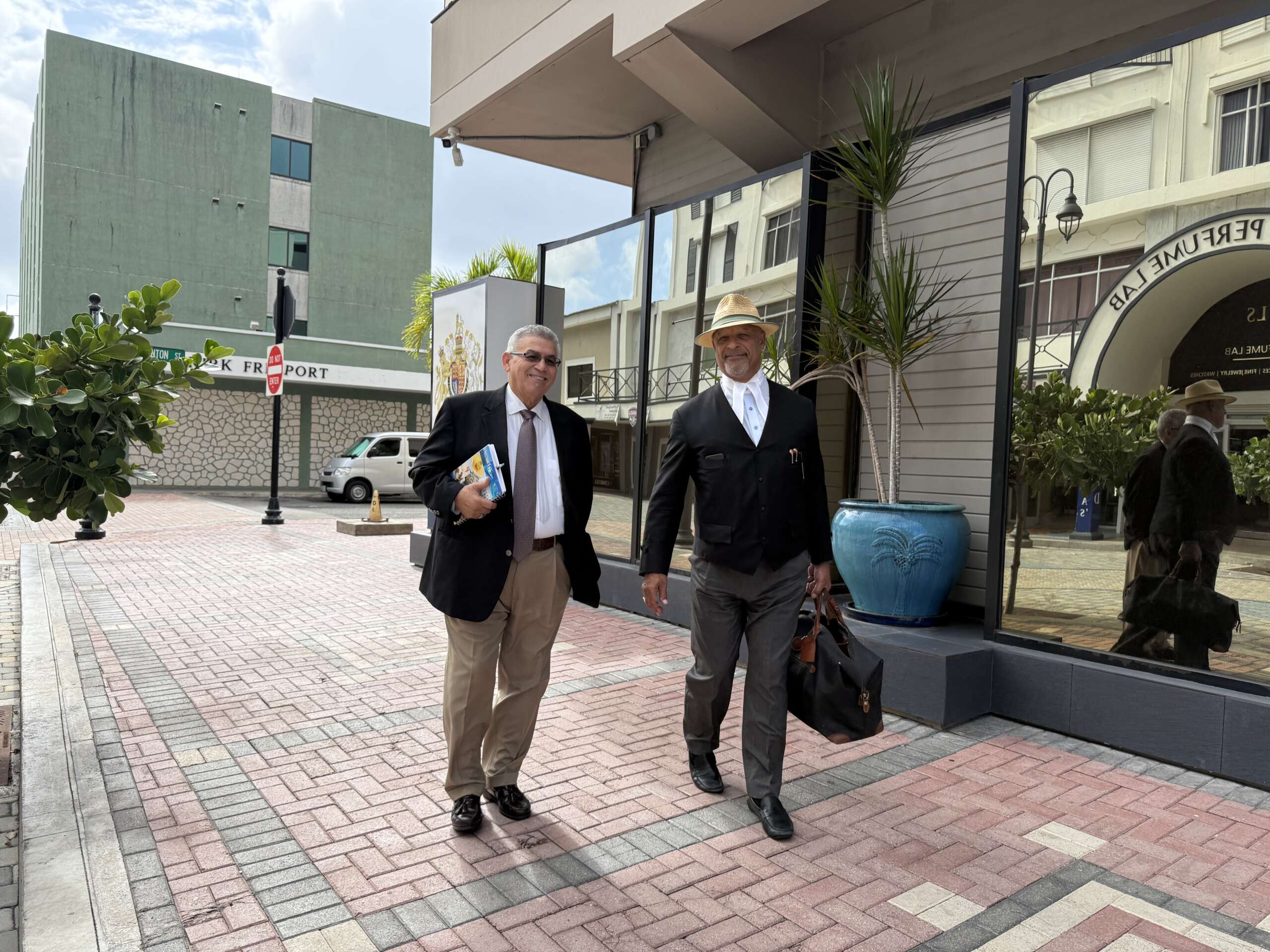
Three appeals court judges heard arguments from lawyers Tuesday on whether McKeeva Bush’s indecent assault trial last year should have been dismissed.
The Office of the Director of Public Prosecutions is appealing the decision by Justice Stanley John to halt Bush’s Grand Court trial in February last year.
The judge initially dismissed four charges relating to alleged incidents between the former premier and two female civil servants, due to an abuse of process, he said. However, in a later written ruling, he admitted that he had made an error in stopping the entire case, stating he should only have dropped the charges relating to one of the women.
During the trial, the jury had heard that that woman had indicated she did not consider Bush’s actions, in allegedly giving her a love bite on her hand while he was intoxicated, amounted to a criminal act, and she had told police and her civil service bosses she did not want to press charges.
Bush had been accused of assaulting both women at a government-sponsored cocktail reception at The Ritz-Carlton, Grand Cayman hotel in September 2022, by allegedly giving the first woman the love bite and by kissing the shoulders of the second woman.
John’s full written judgment on the case was not made public until July last year, five months after the case was abandoned, so as not to prejudice a separate rape and indecent assault trial that Bush was facing. The veteran politician was acquitted by a jury in that case.
‘Prosecutorial system misused for own agenda’
In his ruling, the judge had stated that his decision to halt the trial had been “based solely on the disclosure information provided by the defence during the course of the trial”, and that, in light of those disclosures, he had formed the view “the prosecutorial system was being misused by person or persons for their own agenda”.
Charles Miskin, KC, representing the prosecutor’s office, said that conclusion by the judge, regarding an “agenda” was “unfounded and speculative” and argued that no evidence had been submitted during the trial that could have reasonably led John to come to that determination.
He noted that issues over disclosure of evidence in the case, regarding emails or messages, had been remedied during the trial.
He argued that the decision by the judge to stay the proceedings on the two counts in relation to the first woman was wrong “and should be set aside because the facts relied on either did not exist or fell far below the threshold of the test required by the law for exceptional abuse of process”.
Miskin added, “There is no evidence that the prosecution system is being misused by a person for their own agenda, and the judge provided no factual basis for that finding.”
He noted that John had also made errors regarding the dates at which some disclosures were made, amounting, Miskin said, to factual errors and that the judge may have placed “incorrect weight on parts of the chronology”.
In the February 2024 trial, Bush’s defence attorney Sallie Bennett-Jenkins, KC, in calling for the case to be dismissed, had argued that one of the women had been “misled” and “tricked” into giving evidence, after making it clear she did not want to be involved in the case.
Miskin, however, said that the woman had voluntarily taken part in an interview with police because she wanted to provide the RCIPS with a “formal account” of her version of events. That interview was videoed and later played in court. Miskin insisted she had not been misled as to the fact that it may be used in a prosecution.
Judge’s instinct
Bush’s lawyer, Jerome Lynch, KC, acknowledged that John’s written ruling regarding why he stayed the proceedings was “not as well articulated as it could have been”, but said it was his “instinct”, as a well-experienced trial judge, to use his discretion to stop the case from going ahead because of his concerns over an abuse of process.
“The affront to justice by some impropriety on the part of the Crown or anyone in the prosecution process is something the judge is best placed to determine, especially in a case where the issue … has been piecemeal disclosure, and the impact that appeared to have to on the fairness of these proceedings,” Lynch told the appeals judges.
He played down the relevance of the ruling having incorrect dates in its chronology, saying getting the “odd date wrong or the order of things wrong is not necessarily that important”.
Lynch noted that Bennett-Jenkins had pointed out in her submission that the whole of the indictment was “tainted” because even though she was arguing that the first woman’s case was an abuse of process, the jury had already heard the evidence regarding her case, so that would be “bound to be taken into account” by those jurors.
He said this led to the judge’s instinct to say, “I’ve got to stop this,” though, on reflection, John later changed his mind.
Presenting a transcript of John’s ruling on the day he halted the trial, Lynch noted that it had specifically referenced the judge’s concerns over the process by which the first woman had attended court and had stated that the entire procedure had caused him a level of “disquiet”.
He told the appeals judges that John “having heard the evidence and seeing the witnesses deal with issues raised, formed the view that the public would be wholly unimpressed by the approach taken by the DPP to indict this particular respondent [Bush]”.
Turning to what he described as the judge’s “bold statement” about someone having an “agenda” in bringing the prosecution, Lynch argued this had “emanated from the way in which the case was presented to him” and the arguments made by Bennett-Jenkins.
He noted that Bennett-Jenkins had pointed out that no complaint had been made to the police before they started their investigation, though a rumour had been going around and the RCIPS followed it up.
In response to this, the judges asked if it would have been remiss of the police not to investigate in light of those rumours.
The Court of Appeal President Sir John Goldring, KC, said the judges would not be giving an immediate ruling, and that their judgment would be available at a later date.