


News
Paula Lindo

THE US has a long history of interference in governance in the Caribbean and Latin American regions, with multiple countries such as the Dominican Republic, Nicaragua, Honduras, Mexico, Cuba, Haiti, Grenada and Venezuela feeling the brunt of the US’ claim that the region are in its backyard.
Two of the most well-known incidents are the Bay of Pigs invasion of Cuba in 1961, where CIA-trained Cuban exiles tried and failed to overthrow Fidel Castro’s revolutionary government, and the 1983 Grenadian invasion codenamed Operation Urgent Fury, carried out by the US and a coalition of Caribbean countries, which resulted in the house arrest and execution of Grenada’s second prime minister, Maurice Bishop.
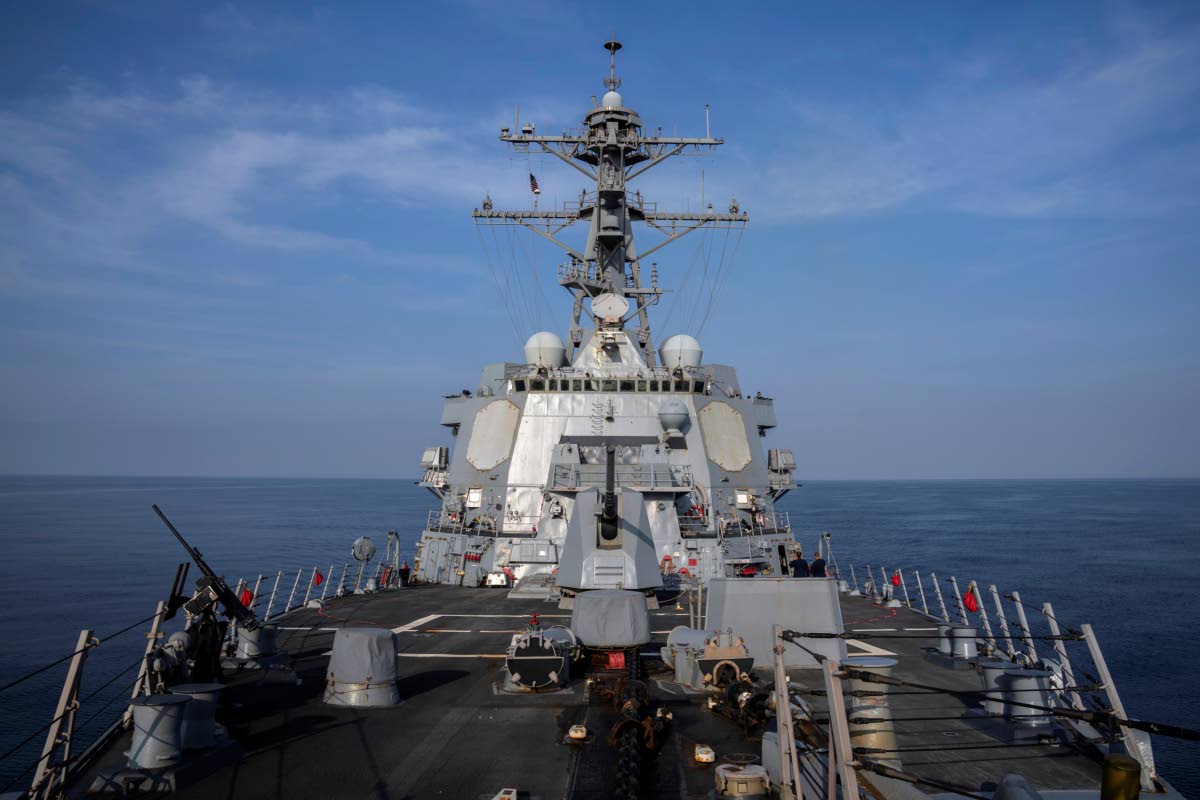
The current movement of US ships into regional waters and a lethal strike against an alleged Venezuelan drug vessel has raised concerns throughout the region about the intentions of the US. US president Donald Trump, US Secretary of State Marco Rubio and others have stated that the ships are there to control drug cartels who are using Venezuelan and Caribbean waters to get drugs into the US.
Newsday spoke to two international relations experts to find out their opinions on current events.
Dr Evan Ellis, a research professor of Latin American Studies at the US Army War College – Strategic Studies Institute, said the Caribbean had never been shown so much attention by a US administration.
“With US Secretary of State Marco Rubio’s roots coming from Cuba and he has visited the Caribbean multiple times, including places that are really unusual for a Secretary of State to visit, including to Jamaica and Suriname. The attention to Venezuela is a complement to the broader attention to the Caribbean as strategically important for the US.”
He said to the US, Venezuela plays host to many strategic threats, including criminal groups, including the ELN (National Liberation Army), Revolutionary Armed Forces of Colombia (FARC) and Tren de Aragua.
Ellis said during Trump’s first administration, when he was working for US secretary of state Mike Pompeo, the president tried to get Venezuela to return to a responsible democratic government. He said Trump tried to work with the current Venezuelan government despite not recognising it as legitimate.
“Those efforts to work and negotiate with Maduro did not work out well. Maduro would release hostages, take more hostages. There was an attempt to work with him on accepting Venezuelan migrants back. Maduro tried to turn that into a propaganda tool for the US. My sense is that President Trump has gotten to the point where he said the flow of drugs and these other activities have to stop.”
He said the US made policy determinations based on US intelligence determining that Cartel de las Solas and Tren de Aragua could be considered terrorist organisations, that Venezuelan president Nicholas Maduro was head of Cartel de las Solas and this was a legal basis for action based on the US justice system.
Among the vessels deployed to the Caribbean are the destroyer USS Sampson, guided-missile destroyers, the nuclear attack submarine USS Newport News, the 22nd Marine Expeditionary Unit and surveillance and military transport aircraft based in Puerto Rico.
Ellis said the force sent to the Caribbean was not large enough to take over a country but could be used to launch an operation to take individuals out of a country.
“It’s a force package called a marine air-to-ground task force (MAGTAF). At the core of it are three very large amphibious ships, called an LHA, a landing ship helicopter amphibious. The critical thing about the LHA is it can launch a lot of rotary-winged aircraft which can be used to take marines from ship to shore, as well as vertical takeoff fighter aircraft and Cobra attack helicopters, among others.”
He said the San Antonio ships specialise in launching fast landing craft that can take marine units and vehicles over to shore.
“In those three ships you have 2,000 marines embarked with the capability to come to a location quickly from multiple points by air and by sea if you wanted to do an extraction operation to grab Tren de Araguao or Cartel de la Solas criminal leadership and then take them to justice.”
He said an attack submarine was protecting these ships. He said the destroyers usually protected the amphibious ships as well, but also had strike missile capabilities. He said the two destroyers each have about 96 missile tubes while the Ticonderoga class cruiser has 122 missile tubes, giving a capability of approximately 400 missiles.
“These can neutralise the Russian-supplied air defences and critical targets that could threaten these ships. So these forces can protect themselves, take out most of Venezuela’s defensive capabilities, and put a force ashore very quickly to extract people like Nicolas Maduro and Tren de Aragua criminal leadership to justice.”
However, Caribbean Policy Consortium co-founder Prof Anthony Bryan said the US is not interested in regime change in Venezuela.
“That would be very difficult to accomplish. Venezuela is not a small country and to wage war to have regime change would be disastrous for the US. The bottom line is to control the cartels, and this is to stop supply of drugs into the US.
He said the possibility of extracting Maduro and other criminal elements exists, but,
“… it would have very severe repercussions, particularly with Venezuelan people and or with Venezuelans all over the world. That is a very last resort action, and to my mind not likely.”
Ellis said the force had the ability to see and stop drug boats using surveillance aircraft which could see almost anything moving over the sea.
“To me, the attack was basically a warning. It was sending a signal that US rules of engagement have changed, and Rubio made a statement saying the same thing, basically that previous administrations had intercepted drug boats, but the decision was made to send a message of more aggressive action, that these boats doing illegal crossings could be just destroyed, as was done.
“I believe Prime Minister Kamla Persad-Bissessar had a statement about that. To me, that sending of a message is only part of the capability of the force. This is a force that if the president chose to use it, could grab certain criminal leaders from Venezuela and bring them to justice. I don’t see an indication that it will be used to occupy the country, or that President Trump has committed to using this force in Venezuela. I think the possibility is there if the President chooses to do so.”
Bryan said the attack was an unusual one and that course of action could be dangerous if continued.
“Normally an intervention would be carried out at sea, but in this case they chose to destroy the vessel, possible with a drone or a bomb from an aircraft. This is very dangerous. The boat was headed to a port about 45 miles away from Trinidad on the coast of Venezuela and who knows what might be in the boat, maybe children, it’s highly unusual for that to be done.
“I can’t tell what they will do, but to continue along the path of what they did would create public outrage not only in the Caribbean but throughout Latin America, the US and the councils of the OAS, the UN and other things. It’s a risky tactic, I don’t think they would like to do it again but I might be wrong, because the Trump administration, in my opinion, is headed by a lot of hardliners who think nothing of invading other people’s territory.”
Ellis said another reason the US was showing force in the Caribbean was that it did not consider Maduro the legitimate president of Venezuela.
“What does democracy mean? Does it mean that the person who has the guns seizes power? Or the person who the people choose to give power? For me, apart from the issue of Maduro’s criminal activity, there is a convincing case that the de jure government of Venezuela is González, and that Maduro and his government are non-elected occupiers who are deeply involved in criminality that has affected not only the US but the rest of the region.” He said he understood the US’ history of military intervention could cause people to look sceptically at the military action.
“For me, that scepticism, based on historical memories, shouldn’t cause them to instinctively that all use of force in national interests and in the name of justice and democracy is bad. If one says that the TT police service has made abuses and done things against certain gangs, does that mean no police action is ever legitimate? I think there is evidence the US is acting legitimately not only in its national interest not against the leader of a country but against a usurper who is deeply involved in criminality.”
Both men addressed concerns that the US might be aiming for control of Venezuela’s oil reserves.
Bryan said up to recently, Venezuela suffered from a US embargo on oil exports.
“This has recently been overthrown by President Trump, so Venezuela is once again shipping oil to the US. Quite frankly, the US would always be interesting in Venezuelan oil and will do everything possible to facilitate it, because it’s big business.”
Ellis said while Venezuela has a lot of oil, China and Russia have been involved in exploiting the oil and propping up Maduro’s regime.
“One could also have a narrative that the Chinese and the Russians are supporting the anti-democratic criminal pretenders because they want to exploit Venezuela’s oil. Clearly there are US oil interests who would love to have access to that oil, but to me the focus has literally been on the criminal flows, especially the cocaine, and the way in which Maduro has been a real impediment to the Trump administration’s work on immigration and things like that.
“Of course there are western companies that would be interested in a co-operative democratic Venezuela where they could do business, but it doesn’t imply that the interest of doing business is the primary motive.”
Bryan addressed the silence and guarded statements from Caricom, OAS and OECS this far, as well as Persad-Bissessar’s enthusiastic support of the US’ entry into the Caribbean.
“I think international organisations that practise a high level of diplomacy wouldn’t say anything to aggravate the issue. The practice has always been that the region tries to stand together in terms of foreign policy, that has been the history. The second part of history is that in circumstances of this sort, they have always tried to be neutral in so far as possible. I don’t think they have deviated from this path, but you don’t have one person going on her own.
“As it is, the Prime Minister of TT has made her position clear but she has done that almost singularly and without reference to Caricom, the OAS and any other body. I don’t think that’s very good diplomacy actually, because you want to have strength in numbers when you make a statement and to make statements wildly and off the cuff is not a good look.”