


by Curlan Campbell
- Project Polaris 250-bed general hospital built on approximately 10 acres
- Construction expected to be completed within 3 years, with official opening projected for 2029
- Cabinet ministers have pledged one month’s salary annually until planned completion in 2029
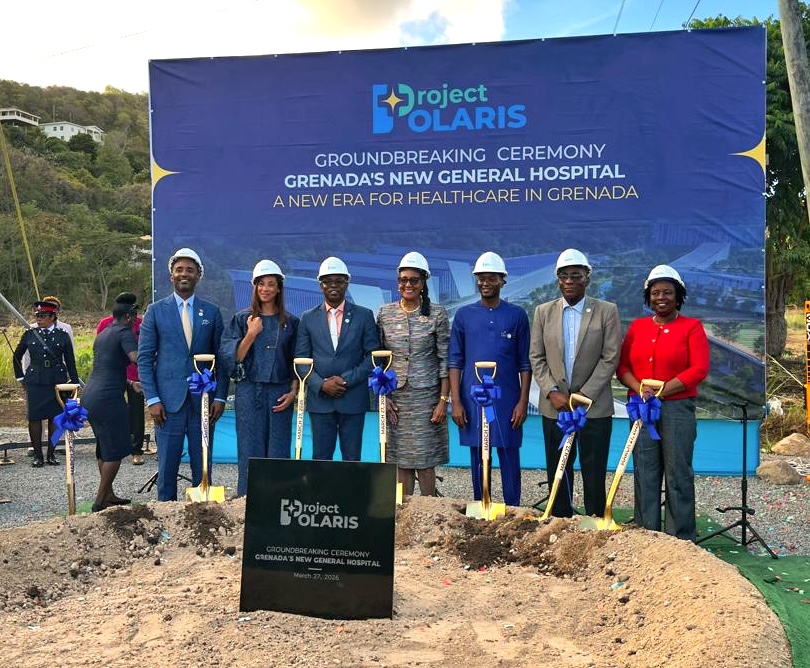
Project Polaris, Grenada’s ambitious plan to transform its healthcare system, officially entered its construction phase on 27 March 2026, as government officials, international partners, and citizens gathered for a landmark sod-turning ceremony.
“For too long, we’ve been delivering 21st-century medicine within a 19th-century framework,” said Prime Minister Dickon Mitchell, as he set the tone at the historic sod-turning ceremony for Project Polaris in Calivigny, marking what he described as a bold step toward world-class healthcare in Grenada.
Addressing a gathering of officials, stakeholders, and citizens, the Prime Minister framed the moment as both symbolic and transformational, rooted in the deep history of the site while firmly focused on the nation’s future. “We stand on hallowed ground,” Mitchell said, tracing the land’s evolution from an Amerindian settlement to plantation use, and now to the future home of a modern general hospital. “Today, the ground beneath our feet feels different. It carries the weight of history, yes, but it also carries the electric charge of a future that we are finally brave enough to build today. “We are not just moving earth-we are moving the nation of Grenada, Carriacou and Petite Martinique forward.”
Mitchell reflected on the long history of Grenada’s existing General Hospital, dating back to the 18th century. Despite surviving disasters, expansions, and decades of service, he acknowledged that incremental fixes are no longer sufficient. “Our healthcare professionals have performed miracles with limited space, and our citizens have shown incredible patience,” he said. “But patchwork is no longer enough.”
The Prime Minister detailed the journey leading to the ceremony, noting that the Calivigny site was first identified over a decade ago but only acquired by the government in 2023. He paid tribute to the Neckles family for preserving the land and enabling its eventual purchase. “It took 10 years of waiting and a second chance,” he said, describing the project as both deliberate and, perhaps, destined. Mitchell emphasised that the initiative has moved beyond the planning stages. “We have moved from concept to blueprint, and from blueprint to breaking ground today.”
Ambassador Andrea St Bernard, Project Sponsor for Project Polaris, described the initiative as a defining moment in the country’s development. “The project is our North Star, a clear direction toward a stronger, more modern healthcare system,” she said, emphasising that the milestone was the result of years of planning, consultation, and preparation. St Bernard outlined the extensive groundwork behind the project, including the government’s acquisition of the 83.9-acre Calivigny site and the establishment of a project management office to oversee execution. “Today we move from planning to construction.”
Project Polaris is a cornerstone of the government’s “Vision 75” development agenda, which aims to transform Grenada into a resilient, inclusive, and innovation-driven economy by 2050. At the heart of Project Polaris is a new 250-bed general hospital, designed as a climate-resilient, smart facility that will replace the existing hospital in St George’s. Built on approximately 10 acres within the wider Hope Vale Medical City, the hospital aims to deliver modern, accessible healthcare to citizens across Grenada, Carriacou, and Petite Martinique. The facility will expand access to specialist services, diagnostics, emergency care, surgery, and maternal and neonatal care, reducing the need for Grenadians to travel overseas for treatment.
“You cannot have a successful and wealthy nation without a healthy nation,” Mitchell asserted. “A healthy nation is our greatest asset.”
While the hospital represents Phase One, St Bernard highlighted a larger vision for the remaining acreage: the Hope Vale Medical City. Planned developments include staff and student housing, retirement residences, and wellness and leisure facilities. “We are intentionally designing a space where healing extends beyond the walls of the hospital,” she said, pointing to the integration of Grenada’s natural environment into patient recovery and wellbeing. “Millions of dollars leave our shores every year for medical care abroad,” St Bernard noted. “Project Polaris is changing that.”
The Prime Minister positioned the new hospital alongside transformative national infrastructure such as airports, ports, and educational institutions, arguing that healthcare development is equally critical to economic growth. He also outlined complementary reforms, including moves toward semi-autonomous hospital management, national health insurance, and strengthened primary healthcare systems.
Beyond healthcare delivery, Mitchell highlighted the project’s economic benefits, including job creation during construction and long-term employment in clinical and support roles. Construction of the hospital is expected to be completed within 3 years, with an official opening projected for 2029.
A key theme of the ceremony was the parallel investment in human capital and healthcare systems. St Bernard pointed to ongoing collaboration with Mount Sinai Health System, which is supporting training, quality improvement, and system strengthening at the current General Hospital. “We are ensuring that we are building infrastructure while also building capacity,” she said, expressing confidence that the project will deliver long-term benefits for generations.
International Healthcare Leader Jonathan A Wetzel echoed that sentiment, describing the initiative as “the beginning of a new era” for Grenada and a “beacon for healthcare in the Eastern Caribbean.” He said, “We will remain focused on enhancing access to the highest levels of quality, safe, equitable, and patient-centric healthcare for all Grenadians.”
Beyond healthcare delivery, Project Polaris is expected to generate significant economic benefits, including job creation, workforce upskilling, and opportunities in medical education and research through expanded collaboration with St George’s University.
Officials also see the project as a catalyst for positioning Grenada as a regional leader in healthcare innovation, with long-term potential in health tourism, biotechnology, and elder care services.
St Bernard called for national involvement, announcing plans for a philanthropic campaign to support the project and inviting citizens and the diaspora to contribute. “This is your hospital,” she said. “Together, we are building a system that meets the moment and makes history.”
Mitchell said the project will position Grenada as a hub for medical excellence within the Organisation of Eastern Caribbean States (OECS), with ambitions to attract health tourism and international partnerships. “Grenada no longer intends to be a passenger in the story of Caribbean development, but to be a pilot,” he declared.
In a notable gesture of commitment, Mitchell announced that Cabinet ministers have pledged one month’s salary annually toward the project until its planned completion in 2029. He called on citizens and the diaspora to play their part, emphasising that nation-building and health require shared responsibility. “Let this moment inspire us not just to build a hospital, but to build a healthier nation,” he said.
As ceremonial shovels broke ground, Project Polaris signalled not just the construction of a hospital, but the beginning of a broader transformation of Grenada’s healthcare landscape.