


…$25.8B for GPL as Linden eyes national grid integration under GtE plan
The Government has budgeted some $4.768 billion in 2026 as a subsidy for the Linden Electricity Company (LEC), as it moves ahead with plans to integrate Linden into the national grid upon the realisation of the 300 MW Gas-to-Energy (GtE) project.

Meanwhile, the Government has allocated $25.8 billion as a subsidy for Guyana Power and Light (GPL) to offset fuel costs amid fluctuating global oil prices, while an allocation of $998 million has also been budgeted for power and other amenities in Kwakwani, in Region 10 (Upper Demerara-Upper Berbice).
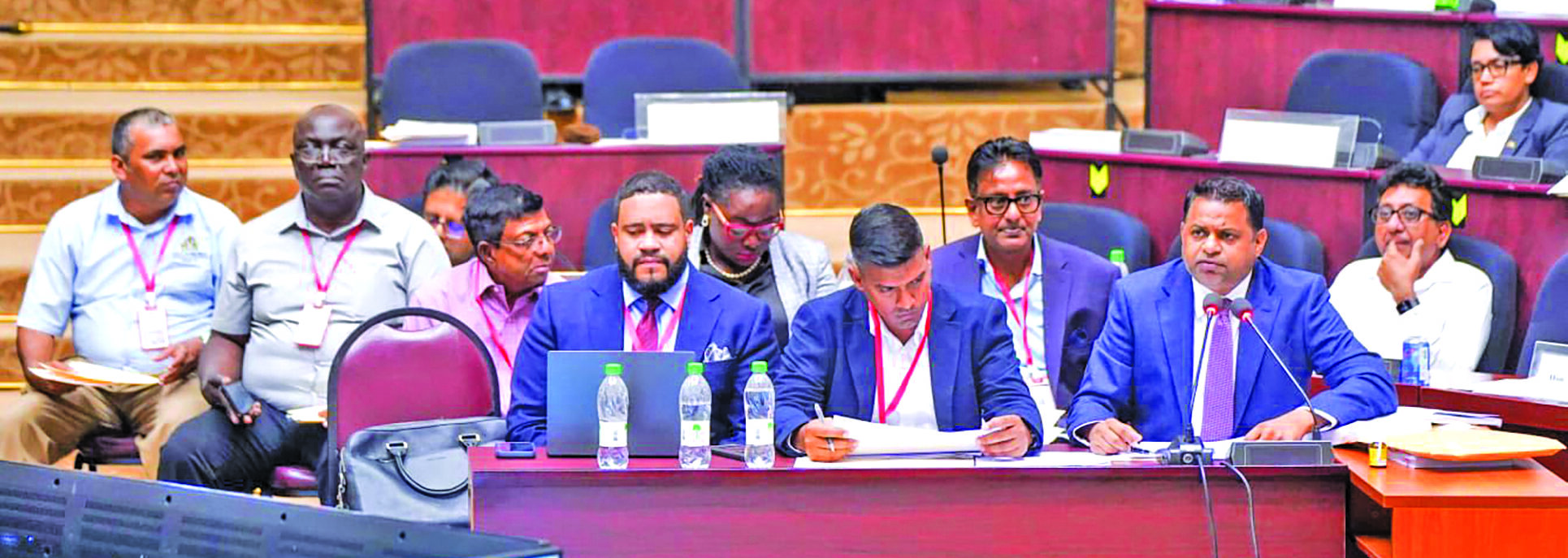
This was disclosed by Public Utilities and Aviation Minister Deodat Indar on Wednesday as consideration of the Budget 2026 estimates continued before the Committee of Supply in the National Assembly at the Arthur Chung Conference Centre, Liliendaal.
He explained that with the expansion of Guyana Power and Light’s (GPL) grid and the use of natural gas as a feedstock, the Government intends to connect Linden to the Demerara-Berbice Interconnected System (DBIS).
“With the expansion of GPL’s grid and using gas as a feedstock, we intend to move the grid towards Linden. So from the Garden of Eden going up to Linden and over to Wismar, we will run 230 KV lines so that you could take all power,” the Minister said.
He added that the integration will support expanding housing schemes and commercial activity along the Linden/Soesdyke Highway and in the town itself.
“So everybody around the highway go in all those housing schemes, development on a highway in Linden as well because, as you know, because electricity is cheap in Linden, they have about 19 sawmills. All the sawmills set up with high-speed motors because they pay a lower price, so they go there to operate,” Indar explained.

Reducing costs
Currently Linden receives electricity from the bauxite company, BOSAI. However, the electricity is bought from BOSAI at one rate and sold to the consumers at a lower rate.
“Linden receives power from BOSAI, and Lindeners pay a tariff of $5 per kWh for residential and $12 per kilowatt for commercial, and they also have about 271 pensions there,” Indar explained.
Indar emphasised that the move to gas-generated power is aimed at reducing costs.
“So if we are to continue, we want to use gas as a feedstock which is much cheaper than the HFO. We will run the power lines to take the power to Linden. In the Amaila project, it was designed to bring the power from the Amaila Falls routing through Linden, coming to Garden of Eden. So now we can run it across from Garden of Eden and take it to Linden. You can drop off the power at various points so you can have industrialisation happening throughout the Linden Highway,” Indar related.
The Minister sought to allay concerns about the future of LEC.
“I don’t want anyone to go about thinking that we are closing down LEC. That is not the case; that is not what I said,” Indar stressed.
“I can tell you – the folks in Linden, the team? They are doing a fantastic job.”
He noted that BOSAI is also expanding its generation capacity, including renewable energy.
“Although we are moving power from the grid, BOSAI itself is putting in solar because they need to grapple with the demand. The demand moved from eight MW to 12 MW and counting. We are building 15 MW of solar power, one in Retrieve, one in Bamia Block 37, so that’s 15 MW of power we added to the grid there. Those are grid-tie systems. So, the entire corridor will have enough power for the development in housing, for the development of commercialisation for all that is happening on the highway right now,” Indar said.
According to the Minister, safeguards will be implemented to cushion any potential impact on consumers as the transition takes place.
“The gas-to-energy project is designed to drop costs, not carry it up; designed to cut it by half,” he said.
Subsidy for Kwakwani
Meanwhile, the Minister explained that the $998 million budgeted for Kwakwani covers more than just electricity generation.
“The subsidy for Kwakwani represents fuel and other areas because it doesn’t act as just a power company,” Indar explained.
He also outlined subsidies for other areas that operate outside of the national grid, explaining that most allocations are for fuel.
“So the scenario is not the same as GPL, but the money is for fuel. So the scenario, as I painted with GPL, is not the same for these small power companies. So Mabaruma has $545 million. It’s for fuel. But every part of the country that receives fuel receives it at a different price, as you would know. Fuel, at a point, needs to be transported. The transportation cost makes up for the cost difference at various spot. Lethem being the most expensive. So it is not the same, but all of the monies here are for fuel except for Kwakwani,” Indar said.
Addressing the fuel subsidy to GPL, the Minister explained that the subsidy is due to the fluctuating costs for fuel on the world market, which are absorbed by the Government to ensure that Guyanese continue to pay a fixed price for electricity.
“We know that fuel prices fluctuate and has been on the rise year on year and counting. GPL budgets at a break-even point from US$70 per barrel. Anything above that, it puts GPL at a lost position,” the Minister said.
“For every dollar increase in fuel, it costs GPL $543 million, simply because of the amount that is used. 93 per cent of the fuel that is used at GPL is heavy fuel oil, and the LFO makes up the other seven per cent. Together, it’s about $47 billion per annum that we spend on fuel alone. It represents the lion’s share of generation costs. So because of that, and because we as a Government did not increase fuel on anybody in the country, we subsidise the fuel, and that is the figure there. It’s a subsidy part of the protocol. And it’s only to subsidise the fuel.”
The post Govt pumps $4.7B to support electricity services in Linden appeared first on Guyana Times.