


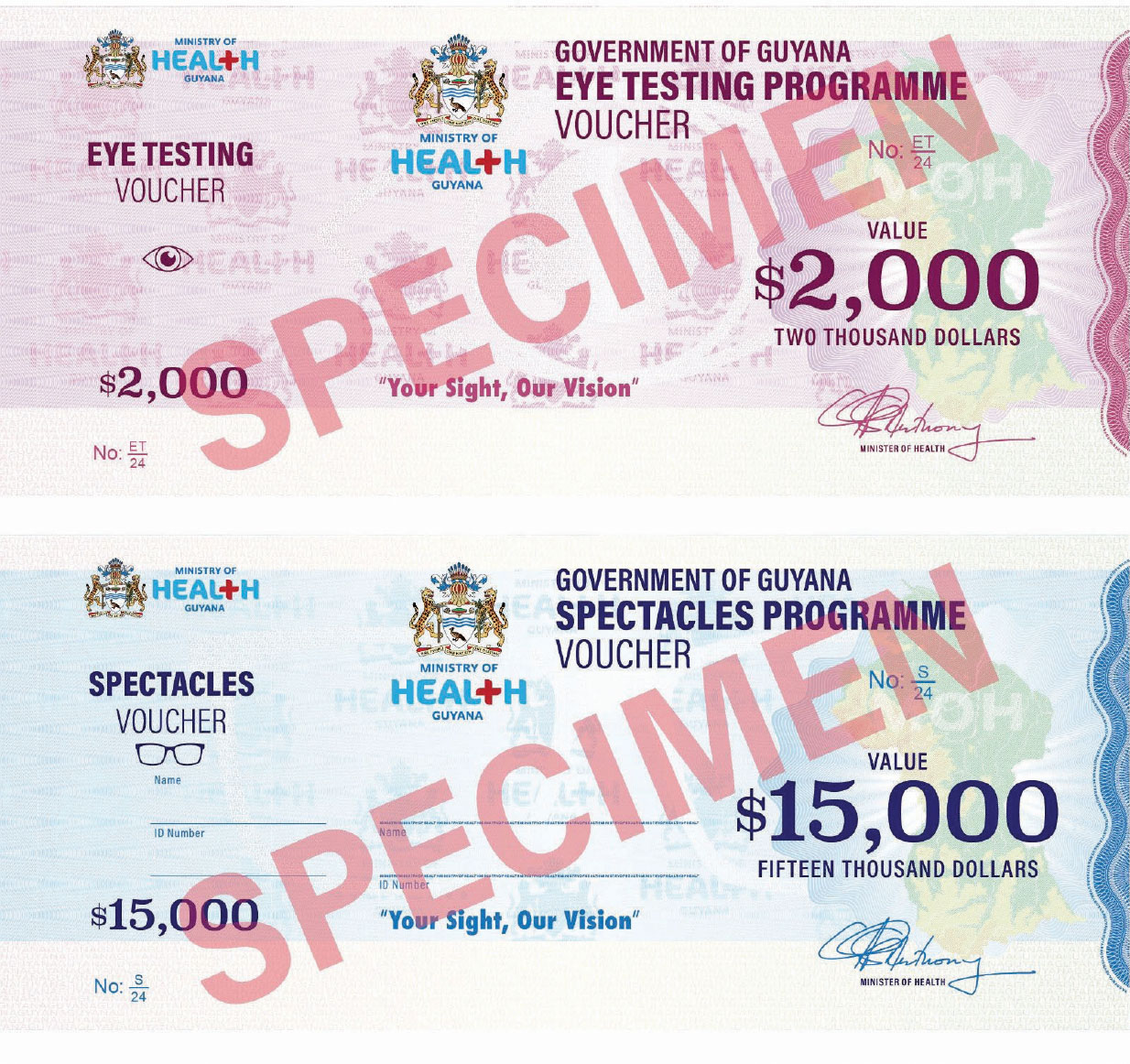
Health Minister Dr Frank Anthony has announced that eye testing services will be expanded nationwide this year, allowing anyone who requires an eye exam to access the $2000 eye testing vouchers and up to $15,000 in assistance toward spectacles. This expanded healthcare voucher programme now allows all citizens to get eye care support following the signing of a Memorandum of Understanding (MoU) on Thursday with 67 private healthcare providers. According to the Health Ministry, the change will enable all individuals to access the vouchers, removing the previous age restrictions that limited the service to persons aged 18 and under and those 50 years and older. 
Budget 2026 allocated $161.1 billion to the health sector, with the investment focusing on modernising hospitals, expanding digital healthcare, improving medical supplies and services and strengthening the healthcare workforce. Speaking about the expanded voucher programme, Dr Anthony said that the programme will be expanded this year to allow anyone who needs an eye test to access one, and those requiring spectacles will be eligible for the $15,000 assistance.
The move broadens eligibility to the entire population, following feedback, particularly from persons aged 18 to 50, who had requested inclusion. “This year, what we want to do is to ensure that we open it up now for anyone who requires an eye test, [so they] would be able to get that eye test. And if, when you test their eyes, they need spectacles, then they will also have access to the $15,000. So I think it would now widen to everybody in the population. And so I think that would be a positive thing, because one of the feedback that we got from people is that they wanted this from 18 to 50.
They wanted to be part of the programme… so I think you will have a lot more people coming this year because they fall into that category,” the Minister said. He acknowledged that while eye care services have been rolled out to all regions, challenges remain in ensuring accessibility outside coastal areas. On that note, he also emphasised the need to extend testing to Regions One (Barima–Waini), Seven (Cuyuni–Mazaruni); Eight (Potaro–Siparuni) and Nine (Upper Takutu–Upper Essequibo), as well as targeted outreaches in parts of Region 10 (Upper Demerara–Berbice), in order to bring eye care to underserved populations. He urged stakeholders to collaborate in reaching these non-traditional areas throughout the year. “While we have been trying our best to roll out to every region, we still have challenges, and we don’t want people to just be on the coast.
We want people to go into some of the regions where they don’t have these tests on a regular basis. So as we move forward this year, we want to ensure that we get all of you to work with us to do some outreaches into your non-traditional areas of operation,” he told the private healthcare providers.
Expand into interior
Minister Anthony also called on healthcare providers operating along the coastland to expand their reach into interior regions to ensure more equitable access to healthcare services, stressing that broadening operations beyond traditional areas is critical to reaching underserved populations. Meanwhile, referring to the eye testing component of the programme, the Minister noted that diligent screening had resulted in approximately 1200 persons being identified with cataracts, all of whom were brought into care and provided with the necessary treatment.
He added that cases of glaucoma were also detected and managed through appropriate medical interventions. Additionally, he highlighted data from the adult voucher programme indicating that a significant number of persons in the population are diabetic. He suggested that expanding eye examinations to include retinal screening, particularly for diabetic patients, would allow for earlier detection of complications and improved health outcomes.
The Minister urged healthcare providers to pay particular attention to diabetic patients, especially those who have been living with the condition for several years. He advised that retinal examinations be conducted to assess potential complications at the back of the eyes and that the results be shared with the Ministry to strengthen the national programme.
“So that’s something that we would like you to pay attention to. If you have a patient that is diabetic, and they have had diabetes for a number of years, then it would be quite helpful to see what’s going on at the back of their eyes, and for us to also get those results so that it helps us with our programme. Because this is not just a transactional relationship,” he said. He emphasised that the collaboration between the Ministry and private service providers is centred on improving patient outcomes. The Minister noted that the joint eye care initiative has significantly expanded access across Guyana, with most citizens now able to benefit from the programme. However, he reiterated the importance of increasing outreach efforts in interior regions to ensure equitable access nationwide.
“Ultimately, what we’re trying to do here is to help the patient. So I think the eye care that we’ve been providing jointly has really moved. And there’s hardly anybody now in Guyana who can say they don’t have access to this programme. But let’s also focus a little of your attention on the interior areas,” he added.
The post Govt’s eyecare vouchers now available to all citizens appeared first on Guyana Times.