


…receives Caricom’s backing
Guyana has undertaken the task to secure the hosting rights of the 35th United Nations annual Climate Change meeting, Conference of the Parties (COP35), in 2030 – a move that is being backed by the Caribbean Community (CARICOM).
In its communique following the 50th Regular Meeting of the CARICOM Conference of Heads of Government held last week in St Kitts and Nevis, regional leaders indicated their support for Guyana’s bid.
“Heads of Government agreed to support Guyana’s bid to host COP35 in 2030,” the communique, which was published on Sunday, detailed.
The location for the annual United Nations Framework Convention on Climate Change (UNFCCC) Conference of Parties meeting is determined through a rotation system among five recognised UN regional groups – Africa, Asia-Pacific, Eastern Europe, Latin America and the Caribbean, and Western Europe and Other Groups.
Usually, members of the designated group consensually determine which country within that geographic location would make an offer to host the conference. The interested country will then submit a bid which is deliberated on and decided by the parties at the annual COP meeting.
Following the hosting of COP30 in Belém, Brazil, last year, it was decided that COP31 would be held in Antalya, Türkiye, in November this year. However, while Turkey will serve as the host country, Australia will lead the negotiations and advance the interests of the Pacific.
Additionally, Ethiopia has been officially selected to host the 32nd United Nations Climate Change Conference (COP32), which is scheduled to take place in Addis Ababa in 2027.
Meanwhile, India has formally proposed to host the 33rd Conference of the Parties (COP33) in 2028. There is currently no specific host country to host COP34.
Guyana’s bid to host the COP35 in the next five years comes as the country continues to play a leading role in global climate discussions, including participation at the annual COP summits.
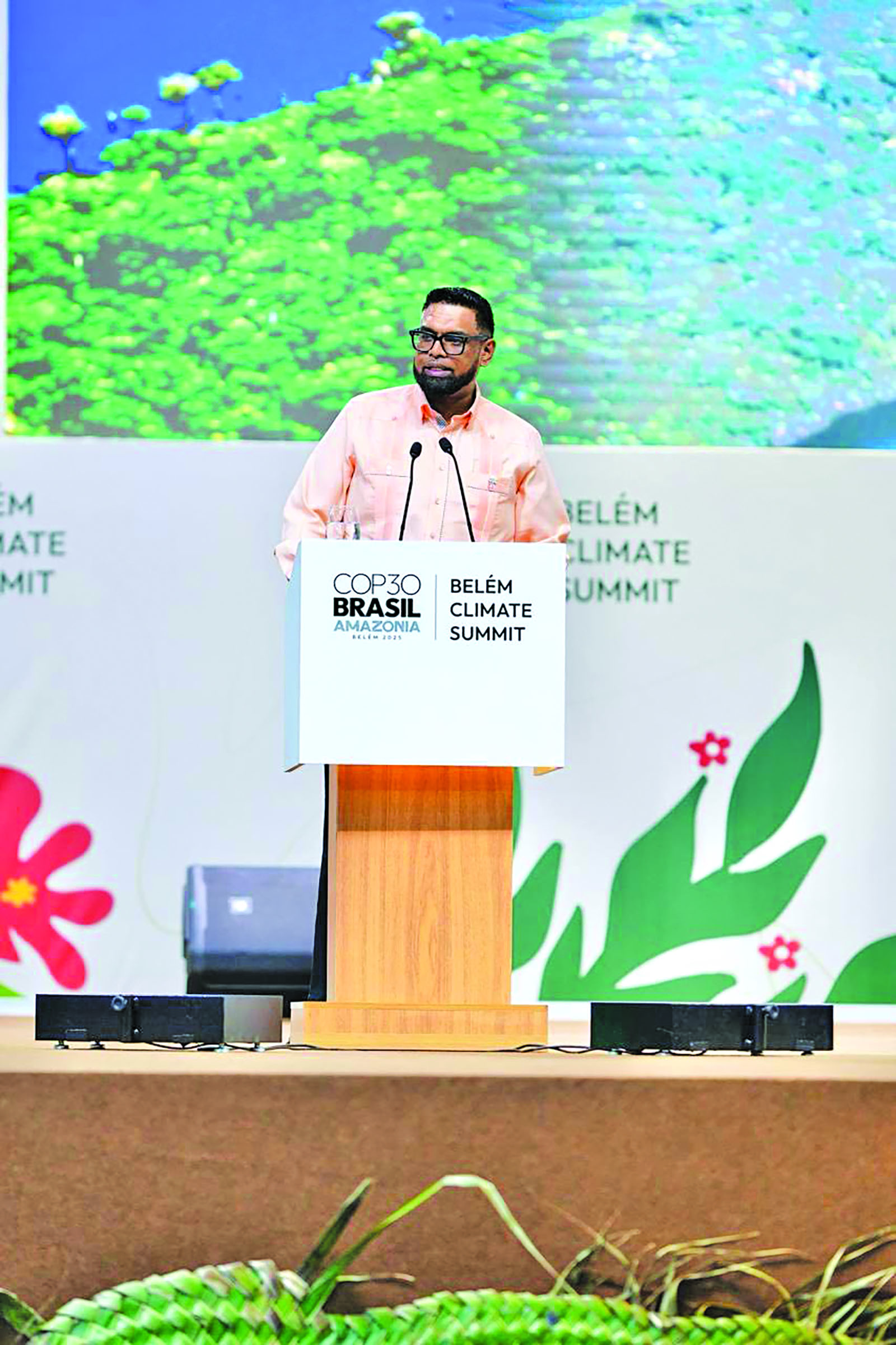
President Dr Irfaan Ali attended COP30 in Brazil last November, where he bemoaned the lack of progress and speed in achieving the global climate goals and presented a series of solutions to world leaders gathered in Belém that would accelerate progress.
Guyana’s climate agenda
Guyana’s national climate change agenda is anchored in its Low Carbon Development Strategy (LCDS) 2030, which focuses on maintaining the country’s net-zero status while driving sustainable development.
The LCDS 2030 provides a blueprint for integrating environmental protection with economic growth. It prioritises the valuation of forests, stimulating a low-carbon economy, and protecting biodiversity.
Under this framework, Guyana has implemented a high-level, forest-based carbon credit market, allowing the country to monetise its low deforestation rate and reinvest in Amerindian community development.
Guyana’s total forest cover, which spans over 18 million hectares, stores more than 19 gigatonnes of carbon and removes some 154 million tonnes of carbon dioxide from the atmosphere annually.
Already, the country has signed multi-billion-dollar deals with major international companies like Hess Corporation and Apple Inc for its ART-TREES-issued jurisdictional forest carbon credits, earning more than US$200 million in revenues.
Only last month, the Guyana Government announced that ART has issued another nine million high-integrity TREES carbon credits for the year 2023. These credits have been labelled as CORSIA-eligible, making them among the most rigorously assessed credits available globally for international aviation and other compliance-orientated buyers seeking verified, jurisdictional-scale emissions reductions.
Aggressive biodiversity agenda
While the country has been a major environmental leader since 2009, Guyana of late has been cementing this role with its aggressive biodiversity agenda that focuses on protecting its vast, carbon-rich ecosystems while fostering sustainable development. This includes doubling protected areas by 2025, achieving 30 per cent land/marine protection by 2030, developing biodiversity finance/credit markets, and raising global awareness.
Last year, President Ali launched the Global Biodiversity Alliance and hosted the first summit in Georgetown. Since then, the Alliance membership has reached more than 60 countries and is expected to further grow as the country gears up for the second biodiversity summit later this year.
Impacts on the region
Meanwhile, President Ali had travelled to St Kitts to join his regional colleagues at the CARICOM Meeting from February 24 to 26, during which he participated in a number of plenary sessions as well as held bilateral engagements on the side-lines of the conference.
During presentations at the opening ceremony, several regional leaders pointed to the fact that climate shocks continue to intensify, emphasising the importance of building resilience to climate change and the need for unity within the community in addressing this global phenomenon.
In fact, CARICOM Chairman and Prime Minister of St Kitts and Nevis Dr Terrence Drew told reporters at the closing press conference on Friday that the leaders reaffirmed their strong advocacy on the issue of climate change and its impact on the Caribbean.
“We have to advocate very strongly for ourselves,” he asserted, pointing to the recent devastations in Jamaica, which is still reeling after being battered by Hurricane Melissa last year.
Citing the destruction also in St Vincent and the Grenadines as well as Grenada, Prime Minister Drew stated it was “one of the worst hurricanes ever experienced in the whole region. That can happen to any of us at any given time… And therefore, we are living the reality of climate change, and we will continue, as a community, to advocate for climate justice, so that it can give us the best opportunity to deal with what we consider to be a serious threat to our community, to our development, and to our advancement.”
Similar sentiments were expressed by the Prime Minister of St Lucia, Philip Pierre, who is set to take over the chairmanship of CARICOM in the second half of this year.
He reminded us of the serious and existential threats climate change poses to the region and the importance of putting this on the global agenda – something which he says requires a united front as well as a deliberate effort to keep this matter high on the regional agenda.
“It’s very important that we maintain unity…we accelerate our readiness for loss and damage access, [and] we coordinate our submissions and negotiation positions early, we strengthen engagement with our partners, and keep finance and debt reform at the centre of our diplomatic efforts. It’s extremely important that the matter of climate change and resilience never be put in the background, because all our discussions, our plans can be literally wiped off in a matter of hours,” the St Lucian leader stated.
The post Guyana bidding to host COP35 Climate Summit in 2030 appeared first on Guyana Times.