


…eyes new World Bank financing tools as economy outgrows concessional aid
The Guyanese Government is expanding its collaboration with the World Bank, exploring new products and opportunities as the country’s economic transformation continues at an accelerated rate. 
This, according to Senior Minister with responsibility for Finance Dr Ashni Singh, during an appearance on the “Investing in the Future” podcast on Tuesday alongside outgoing World Bank Country Director for the Caribbean, Lilia Burunciuc.
Citing the country’s changing economic circumstances, Dr Singh noted that Guyana’s relations with the World Bank are evolving into different dimensions.
“We recognise that as our economy changes and goes through this rapid transformation, the engagement with the bank must necessarily change. So, we’re engaging with the World Bank now, exploring other products that the bank offers, including guarantee products [and] Private Sector products, using different parts of the World Bank Group – the Multilateral Investment Guarantee Agency [and] the International Finance Corporation, which are other subsidiaries within the World Bank Group which also have products better suited [for Guyana’s rapidly growing economy],” Dr Singh posited.
His remarks come as Guyana risks potentially losing its eligibility for access to concessional resources under the World Bank’s International Development Association (IDA) due to the country’s rising income per capita.
Access to IDA resources is tied to the per capita income of countries – something which the Finance Minister says Guyana has long been arguing against even before its oil boom and a challenge that the country is facing with many of its other development partners.
“Under IDA, Guyana has benefitted from successive rounds of highly concessional resources over the years… [But] with the increases that we’ve seen in Guyana’s per capita income, there is a discussion going on about possible loss of access to IDA resources, which is a challenge that we’re facing with other development partners… Our access to concessional windows has been contracting, and even with some institutions disappearing.”
“We will always fight for the largest possible access to concessional resources, but as we navigate this period of change in the Guyanese economy, other members of the World Bank Group have tools and instruments and products that will take on new relevance, including, in particular, the World Bank’s Private Sector operations… The Private Sector arm of the World Bank is now doing a lot more in Guyana, and we’re pushing them to do a lot more given the speed at which we’re seeing the Private Sector grow,” the Minister explained.
New idea or investment proposal
Meanwhile, the outgoing World Bank Country Director assured that the financial institution is committed to continuing to work with Guyana even as a high-income nation, expressing hope that this collaboration would expand into new areas.
According to Burunciuc, these include “…focusing on attracting private investments, making sure that high-quality jobs are created, making sure that not only the oil economy but also the non-oil economy is doing well, and for this, there is a need for investments… Going forward, it’s more investing in systems, investing in ‘know-how’ and investing in innovations to make sure that the economy continues to advance, and also trying to offer Guyana new innovative products like…various guarantees that will allow Guyana to access resources on the capital markets at lower cost.”
The World Bank representative further outlined that the institution has always worked with the demands of partner countries and is ready to engage Guyana with whatever new idea or investment proposal the country has.
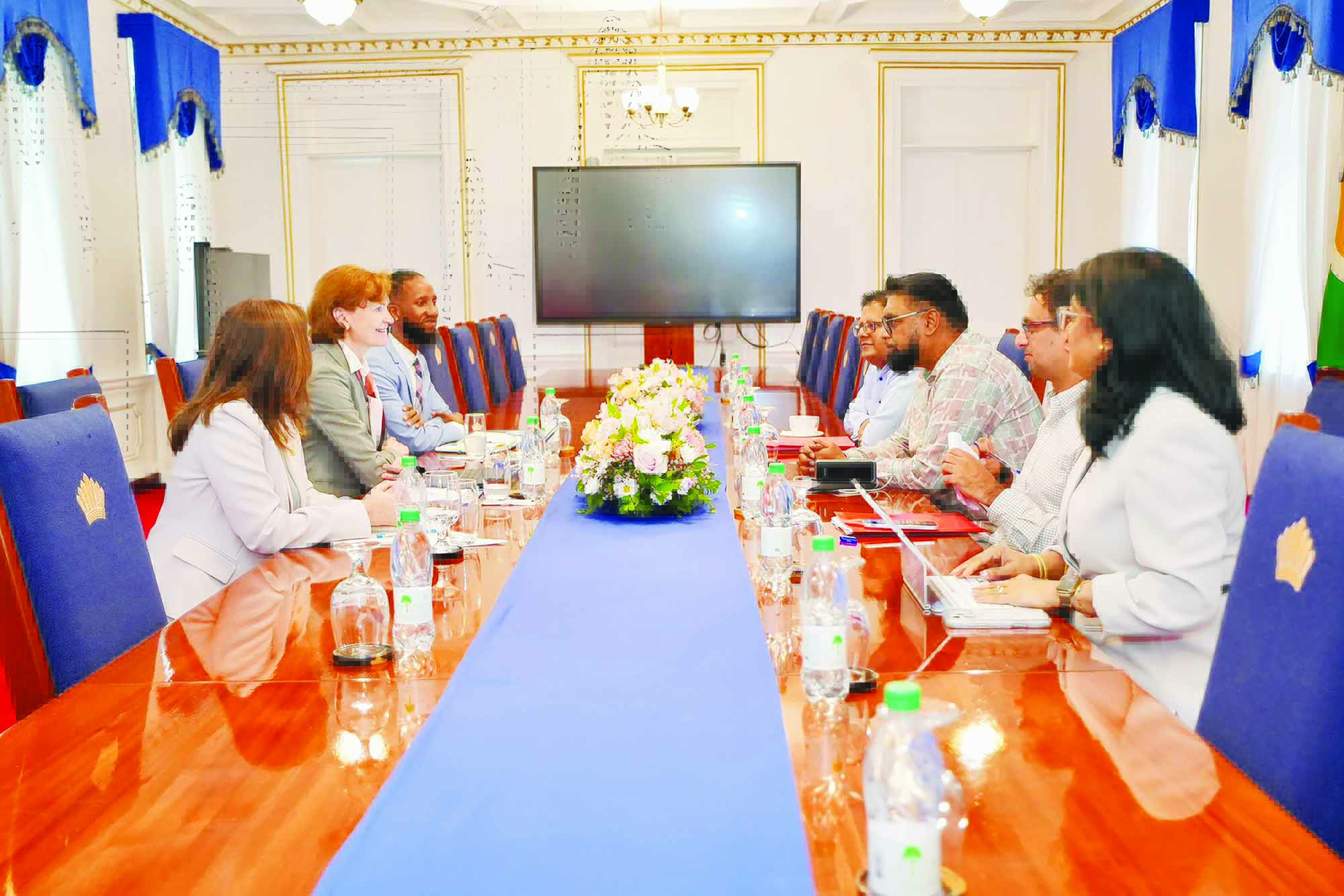
These comments come days after Burunciuc had a meeting with President Dr Irfaan Ali at State House in Georgetown earlier this week during her final country visit in this portfolio.
During the engagement, discussions focused on advancing Guyana’s development priorities in education, climate resilience and drainage and irrigation, including the successful installation of the US$6 million “bullet” drainage pump at Liliendaal.
While underscoring the importance of investing in resiliency, especially in preserving all the assets and the gains that the country has made in recent years, the outgoing World Bank Country Director also emphasised the need for investments in human capital. In fact, she lauded the Guyana Government for channelling its revenues from the oil and gas sector into building local capacity and skills development – something which the World Bank has been and will continue to support.
“We just had a meeting with President Ali [on Monday], where we reconfirmed that we will continue supporting building skills, building the human capital, and building the human capital for the future with a focus on digital skills and digital education,” she indicated during the podcast.
In fact, Minister Singh acknowledged the role that the World Bank has played in not just advancing Guyana’s human capital development but also education delivery – something which he says they will continue to build on.
“We have more jobs being created than at any other time in our history, but these are new types of jobs, requiring new types of skills… And so, we anticipate the World Bank continuing to work in this area and, in fact, continuing to be our lead development partner in human capital development,” the Finance Minister asserted.
The post Guyana lauded by World Bank director for investing in human capital appeared first on Guyana Times.