


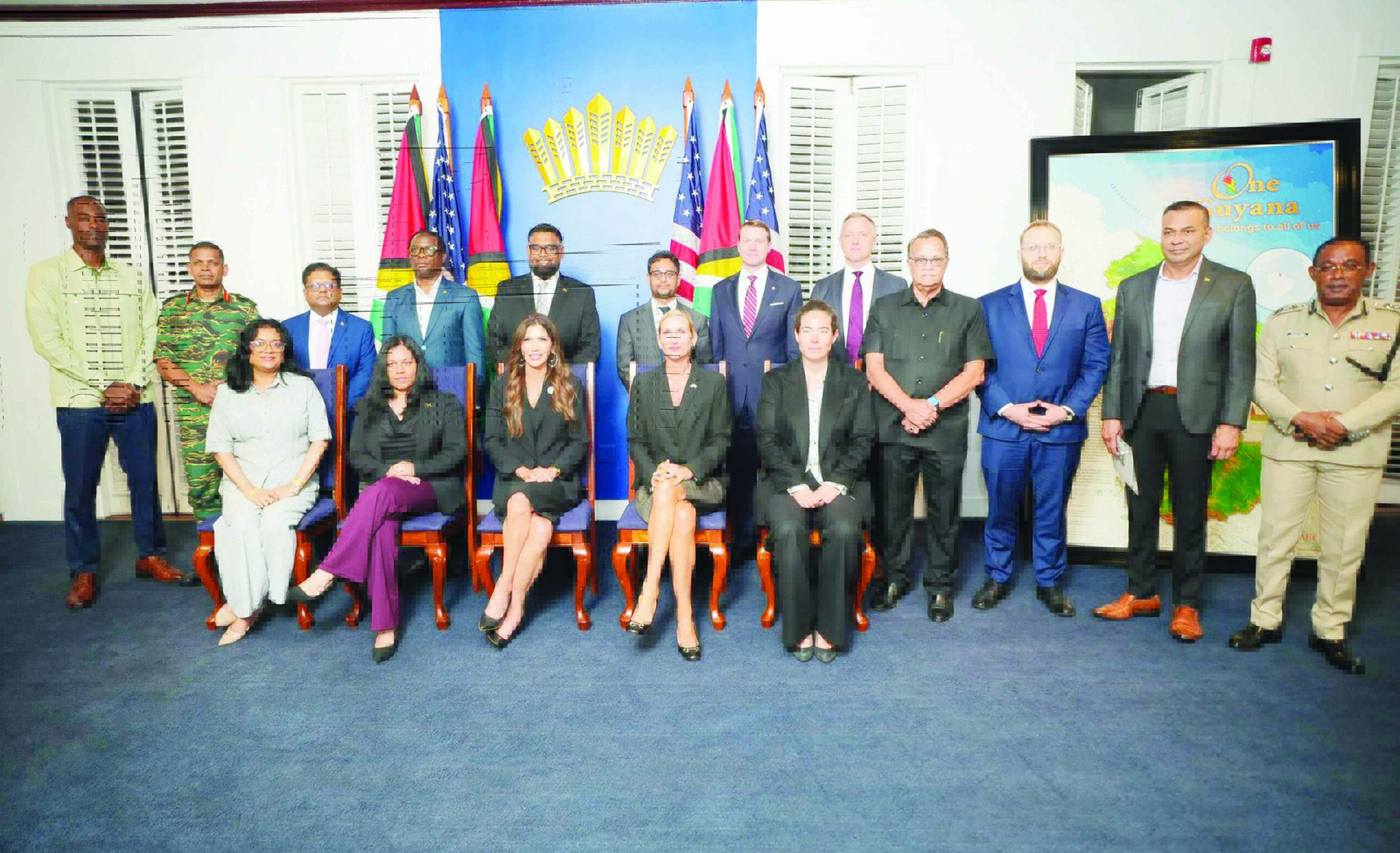
…as Pres Ali meets US Special Envoy Kristi Noem at State House
As part of efforts to further strengthen security cooperation between Guyana and the United States, President Dr Irfaan Ali recently met with US Special Envoy and former Homeland Security Secretary Kristi Noem.

The meeting was held on Tuesday at the State House in Georgetown, where the Guyanese Leader welcomed the US Special Envoy and her delegation to advance the Shield of Americas agenda.
Guyana is among 12 Latin American and the Caribbean (LAC) countries that agreed to work with the US Government to address narco trafficking and other illicit activities in the region.
In a Facebook post following the high-level discussions on Tuesday, the US Embassy in Georgetown said the officials reaffirmed the enduring partnership between the two countries.
“Their discussions focused on joint efforts to disrupt cartel and transnational criminal activity, strengthen border security, discourage illegal immigration, and promote economic opportunity,” the US Embassy said in the social media post. “Thanks to the Trump Administration’s leadership, we are building a safer, more secure, and more prosperous future in our region.”

Meanwhile, during the meeting, President Ali presented Special Envoy Noem with a Dillon Craig painting depicting Guyana’s national bird, the Canje Pheasant, alongside the iconic Harpy Eagle.
Members of the Cabinet and senior members of the Joint Services also attended the high-level engagement, the Office of the President said in a separate Facebook post.
Tuesday’s meeting comes on the heels of President Ali attending the inaugural Shield of Americas Summit held earlier this month in Doral, MiamiDade, Florida. Guyana and Trinidad and Tobago were the only two Caribbean nations invited to the March 7 summit.
President Ali along with leaders from Argentina, Bolivia, Chile, Costa Rica, the Dominican Republic, Ecuador, El Salvador, Honduras, Panama, Paraguay, and Trinidad and Tobago joined President Donald Trump to sign a proclamation, committing to the dismantling of cartels and foreign terrorist organisations operating in the Western Hemisphere.
During an interview on the sidelines of the summit, the Guyanese Leader declared Guyana’s unequivocal support for the strong actions and direct approach being taken by the US to crack down on drug cartels and transnational crimes that have plagued the Western Hemisphere for decades.

“We support the strong action on drug cartels. We’ve supported the Charter to deal with transnational crime, especially the narco-terrorism and these cartels. We have to agree first that this is a challenge to the region, and we have an approach now that is direct, and one that seeks to take the region out of the stain of criminality, cartels, and drugs,” President Ali said in an interview with Fox News’ Aishah Hasnie.
Late last year, Washington had deployed about 10,000 troops in the Caribbean as part of efforts to combat transnational crime and the illicit drug trade in the region, especially coming out of Caracas.
The Trump Administration has stated that designated narco-terrorist organisations like Venezuela’s Cartel de los Soles are using the region’s air and sea corridors to funnel drugs into the US, thus posing a direct threat to American lives and security.
On January 3, US troops captured Venezuelan leader Nicolás Maduro and his wife in Caracas, taking them to New York to face several indictments on drug trafficking and narco-terrorism. Vice President Delcy Rodriguez has since been sworn in as Venezuela’s interim president after Maduro’s ouster.
President Ali had reminded of the threats and aggression Guyana faces from Caracas, especially under Maduro’s rule.
“Guyana came under threat from Venezuela under the Maduro regime, and what we have seen since the capture of Maduro is, you know, an attempt by the Government, of course in keeping with the agreement of the US, to move towards a safer environment in which the Venezuelan people would enjoy greater prosperity, greater development prospects, and move towards a more democratic society – values that we share, values that we uphold.
“And that by itself has brought a change in the mindset, a change in the condition, and we have seen greater stability, less rhetoric, and wherever there is less rhetoric about conflict, there’s greater confidence in the system. And wherever there is momentum towards democracy, there is greater prospects for the region. So yes, that would have brought improvement,” the Guyanese Leader posited.
Over the years, Venezuela has been increasing its aggression towards Guyana in furtherance of its spurious claims to more than two-thirds of Guyana’s landmass – the entire Essequibo region, and a portion of the country’s Exclusive Economic Zone (EEZ), where over 11 billion barrels of oil equivalent (boe) have been found and oil operations are currently ongoing offshore by US oil major ExxonMobil and its partners.
In fact, only two weeks ago, the Venezuelan regime objected to efforts by the Guyana Government to conduct three-dimensional (3D) multi-client seismic exploration offshore within Guyana’s EEZ.
Back in 2018, Guyana had approached the International Court of Justice (ICJ), seeking affirmation of the final and binding nature of the 1899 Arbitral Award, which established the boundary with neighbouring Venezuela.
After receiving written pleadings on the merits of the case from both countries, the World Court will hear oral arguments in May from the two sides after which it will deliberate and issue a judgement.
The Guyana Government has already indicated its confidence in a favourable ruling.
The post Guyana, US strengthen security ties in regional security, fight against cartels appeared first on Guyana Times.