


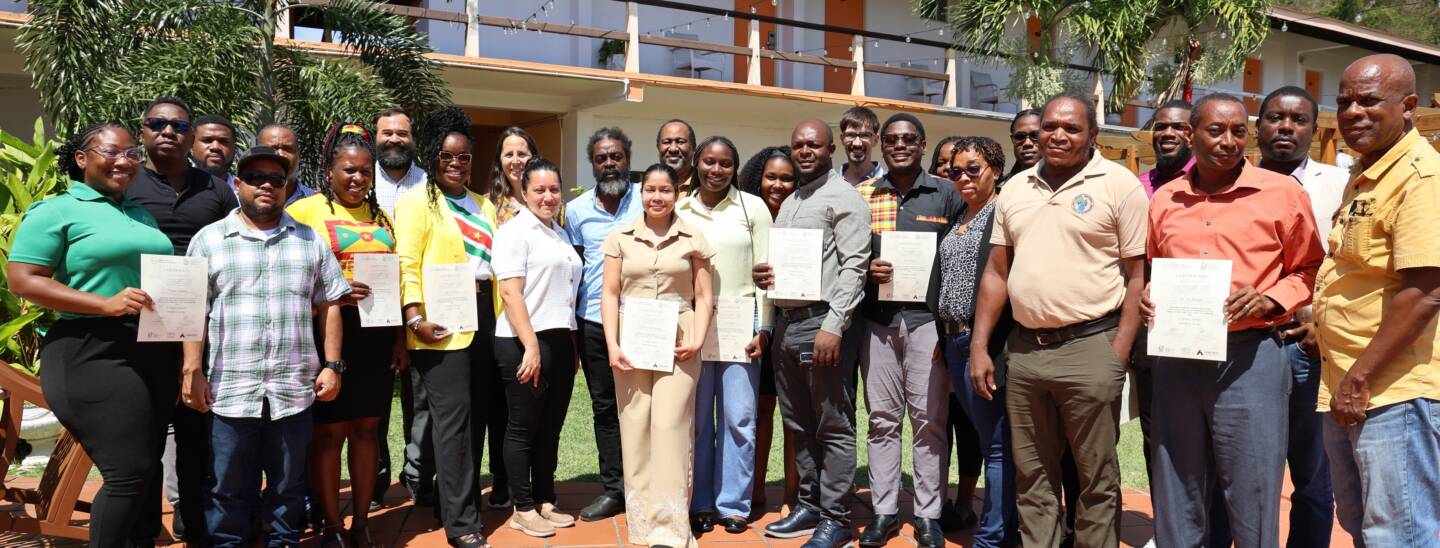
Geographic Information System (GIS) and land experts from Caribbean Small Island Developing States (CSIDS) recently participated in specialised training on high-resolution data and tools for the 2026 Reporting on Performance Review and Assessment of Implementation System (PRAIS 4).
The workshop, held in Grenada, was organised by the Partnership Initiative for Sustainable Land Management (PISLM), supported by the United Nations Convention to Combat Desertification Secretariat, financed by the Global Environment Facility (GEF), implemented by the United Nations Environment Programme (UNEP), and delivered in collaboration with APACHETA.
Zylenna Darson, PRAIS Reporting Officer in the Ministry of Oil, Gas and Environment in Suriname, highlighted the value of the workshop in validating national environmental data and moving away from default global datasets that often misrepresent land degradation conditions.
“It allowed us to discuss and validate our national data. In the past, Suriname relied on default data; so, this workshop was very helpful in smoothing out and having a more realistic representation of the country.”
The workshop also offered participants the opportunity to exchange practical solutions, enhance professional networks, and develop collaborative approaches to sustainable land management across Caribbean nations.
For St Kitts and Nevis’ representative Ayodele DeCosta, GIS Officer in the Department of Physical Planning, “Reporting for small islands was very generalised, but from this workshop, we can get a more realistic depiction of land degradation in our countries.”
UNCCD Focal Point and Director of Forest in Haiti, Eder Audate explained that with Haiti recently completing its national soil survey, the undertaking presents an opportunity to get more information about their soils. Audate said, “This training will help Haiti, to do other trainings and workshops that will help to combat land degradation.”
Bahamas’ representatives Latonya Williams and Jenny Morris, are confident that, “The high-resolution data, will help to inform projects and policies in their respective countries.”
The 5-day workshop wrapped up on Friday, 6 February 2026 in St George’s, with the PISLM encouraging participants to use the information not only for this one instance of reporting but to support stronger environmental policies and ensure that national achievements are accurately captured, promoting sustainable development and resilience in the region.
The PRAIS 4 training underscores the importance of accurate data, regional learning, and collaboration in addressing land degradation challenges across the Small Island Developing States.
PISLM