


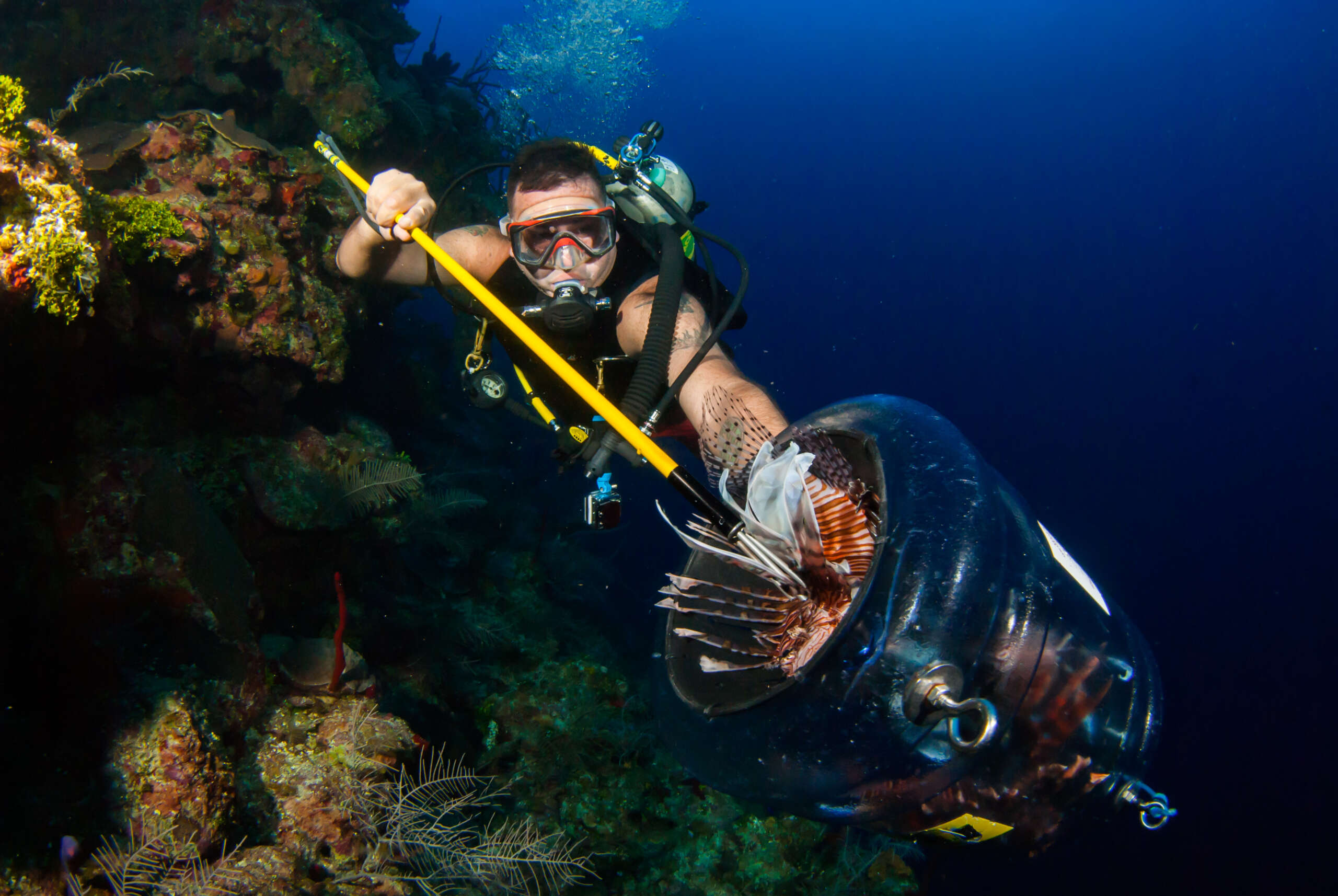
The numbers of invasive lionfish in the waters around the Cayman Islands appear to be decreasing, partially because of continued culling by local scuba divers, but also because they’re now on the menu for other marine predators.
Lionfish have voracious appetites, consuming 460,000 prey fish per acre per year in densely populated areas, and because it is an unfamiliar creature in the Caribbean Sea, it has no natural predators. There are some signs, however, that at least in the Cayman Islands, that may be starting to change.
Marine Resource Unit manager at the Department of Environment Croy McCoy says it is almost inevitable that we will have to live with the invasive lionfish in Cayman waters but there are some flickers of hope in containing their numbers.
“It is fair to say that the lionfish population has exhibited a declining trend [in the Cayman Islands] since 2009 when the department started their monitoring programme,” he said.
“Exactly what controls the lionfish population is a grey area due to human intervention and biological control.”
When McCoy mentions “biological control”, he is referring to natural predation. It appears some of the fish in the Cayman Islands are learning to catch and eat the lionfish.
“The overall picture is that we are fortunate enough to have maintained a relatively healthy predator population – our grouper/snapper complex, sharks, moray eels, etc. – which has been beneficial in controlling the lionfish population over time.”
Sergio Coni, owner of Don Foster’s Dive, which hosts lionfish culling events, has also noticed a decline in the lionfish population in Cayman. He believes the predators on the reef are starting to eat lionfish.
“The number of lionfish on the reefs is nowhere near the numbers we were seeing in the beginning,” he said.
The first-recorded sighting of a lionfish in Cayman waters dates to 2008 when a fish was spotted off the coast of Little Cayman. Within a few years, the invasive species became widespread on the reefs around all three islands.
“Culling has made a good dent in the population, but I have a feeling some of the groupers, moray eels and barracudas are now preying on lionfish. It is hard to know for sure because witnessing any act of hunting by predators is rarely seen by divers.”
Culling efforts
The voracious lionfish mainly eat other fish, and they reproduce at high rate, with female producing up to 2 million eggs annually. With few natural predators to keep their numbers in check, they can quickly overwhelm a reef ecosystem.
“As lionfish populations grow, they put additional stress on coral reefs,” NOAA’s fisheries unit states. “For example, lionfish eat herbivores, and herbivores eat algae from coral reefs. Without herbivores, algal growth goes unchecked, which can be detrimental to the health of coral reefs.”
Cayman’s initial defence against the lionfish invasion was to certify ‘lionfish hunters’ who could cull the fish while scuba diving.
Jason Washington of Ambassador Divers believes that it is critical that the diving community continues to cull as many invasive lionfish as possible.
“We have a successful local culling community, and they are at least keeping them at bay, keeping the grass cut, so to speak, but there are still a lot of lionfish on the reefs,” he said.
As cullers work to keep lionfish in check, Coni said one challenge is that the species may be adapting their behaviour so they are less visible on the reefs.
“They were observing more lionfish on night dives, and it appears the lionfish have got better at hiding during the day,” he said.
This observation is supported by research conducted by Jake Smallbone, who in 2019 wrote his university master’s thesis on the impact of lionfish on Cayman’s reefs.
“Behaviourally lionfish were less active and more evasive/elusive towards divers within heavily culled sites. Potentially this has decreased the encounter rate between diver and lionfish, decreasing the chance of detection during culling events. Therefore, this study can conclude alternative explanations for a decrease in density across the Cayman Islands,” Smallbone wrote.
“The perceived reduction of lionfish may be a consequence of the change in behaviour, as individuals actively reduce the rate of detection by avoiding divers. Frequent culling may even be causing this by unintentionally targeting bolder individuals with a higher encounter rate, leaving only timid individuals less likely to be active out in the open.”
It appears now, however, that lionfish hunters have some help in the marine world.
Smallbone noted that in January 2008, there was one of the “first observations of a tiger grouper (Mycteroperca tigris) stomach containing a singular lionfish.”
He added, “Since this observation five Nassau groupers (Epinephelus stratus), a common species around the Cayman Islands were observed to have lionfish inside their stomachs on dissection.”