


The reefs on Little Cayman are still reeling from 2023’s devastating global coral bleaching event, shows the latest report on reef health from the Central Caribbean Marine Institute.
In 2023, before the bleaching event, CCMI’s surveys recorded that the average coral cover in Little Cayman was at its highest since monitoring began in 1999, at 27.3%. Following the severe bleaching, the institute’s survey, and its latest ‘Healthy Reef Report Card‘, indicated that coral cover in 2024 plummeted to the lowest ever recorded — just 10%.
Prior to 2023, the previous all-time-low of coral cover was recorded in 2005, at 15%, said Little Cayman-based CCMI, which described the 2024 report as “sobering”.
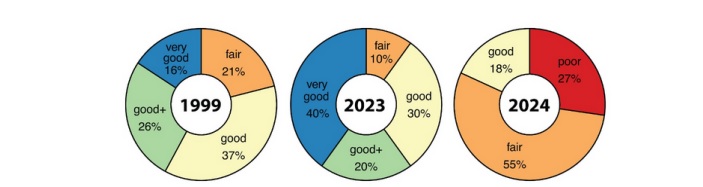
Good or better reef condition drops from 90% to 18%
“Between June 2023 and August 2024, coral health state changed substantially,” the report said, noting that in 2023, over 90% of reefs were recorded to be in good to very good condition.
In a sharp deterioration, in 2024, 0% of the reef was recorded as being in a better-than-good condition. Just 18% was found to be in good condition, 55% was in fair condition, and 27% was found to be in poor condition.
The report notes that the major reduction in coral cover originates mostly from fewer ‘weedy’ coral species, like lettuce coral (Agaricia agaricites), which have a lower thermal tolerance, but that larger, more substantial species, like boulder star and massive starlet corals, which are key reef-building structures, have shown a smaller decrease, as they are typically more tolerant to heat.
The summer of 2023, at the time the hottest on record (surpassed in 2024), brought with it the longest and most extreme marine heatwave experienced in the Cayman Islands.
Parrotfish to the rescue?
Despite the decline in a healthy coral population, and potentially driven by a proliferation of ‘macroalgae’, or seaweed, on the reefs, the CCMI report indicates there has been a “significant increase” in fish density (number of fish per survey) between 2023 and 2024.
“This increase in density is primarily driven by an increase in the number of herbivores, which has increased exponentially in the last eight years and even more so in the last year. Carnivore density has also been increasing in recent years, but not as substantially as herbivores,” the report said.
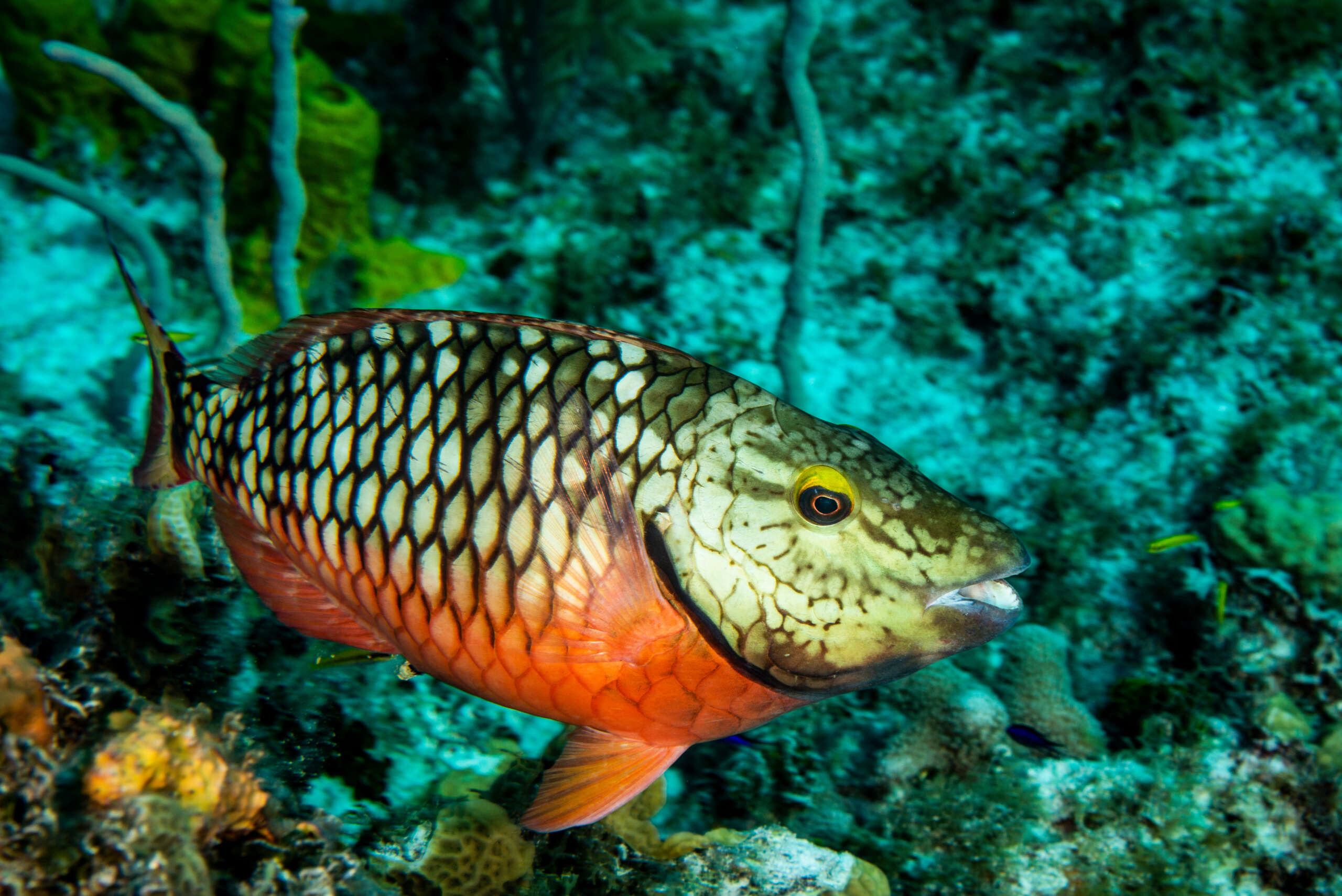
The number of herbivore parrotfish, which had been increasing since surveys began in 1999, showed a large jump in population from 2023 to 2024. Similarly, groupers, which are carnivores, showed the largest degree of change, with a steadily growing population between 1999 and 2023, and then a larger increase from 2023 to 2024.
With a lot more algae growing on the reef, as is usual following a bleaching event, this means there is more food for parrotfish.
Robyn Larkin, project manager at CCMI, told the Compass that the overgrowth of macroalgae is expected following any severe disturbance impacting reefs.
“It can be problematic because it typically colonises bleached or dying corals, and the algae can compete with corals for space on the reef,” she said.
But, she added, this is where Little Cayman’s healthy fish populations come into play.
“The substantial increase in herbivores (parrotfish) seen in 2024 surveys is likely to be in direct response to the increase in food availability in the form of macroalgae,” she said. “This is a recognised pattern in herbivore abundance sometimes seen after severe bleaching events in areas where fish populations are healthy.
“It is possible that this increase, which is also supported by the strict protections of fish in place in Little Cayman, will have helped to manage macroalgae levels in Little Cayman and prevent algae outcompeting corals which would ultimately impact overall reef composition.”
Nearly 75% of the water surrounding the island’s shoreline, out to 150-feet deep, is designated as a protected marine park under Cayman’s National Conservation Act.
‘Hope remains’
Despite the drop in coral cover and the deteriorating conditions in the health of the reef, CCMI said, even now, Little Cayman’s reefs remain “among the healthiest in the region”.
“It’s clear that the 2023 coral bleaching event had significant consequences for reefs across the globe, but hope remains, especially for Little Cayman’s reefs,” CCMI said.
“Little Cayman is still home to some of the healthiest reefs in the Caribbean, and on average, there is still double the amount of coral cover than reefs across the region.”
It noted that the high level of protection, the remote nature of Little Cayman and the healthy fish populations are positive signs that Little Cayman “will recover well after this event and remain a beacon of hope throughout the Caribbean”.
Checks to determine if the reefs are recovering this year will be done this summer. Larkin said CCMI’s next annual survey will be carried out in August, “after which we will be able to analyse the data and begin work on full assessment for next year’s report”.
She added, “Although surveys haven’t been completed yet this year, this response seen in herbivore populations in 2024 is a promising sign and gives us hope for the recovery of Little Cayman’s reefs.”
The report noted that the greatest long-term threat to the reef is “a phase shift, which is when coral reefs become dominated by macroalgae”.
“This makes recovery extremely difficult and reduces the reef’s ability to support fish, protect coastlines, and maintain biodiversity. Preventing this shift is essential to preserving the reef’s ecological function,” the report said.
It also outlined some of the measures that are necessary to protect the remaining corals and fish populations.
These include reducing local stressors, investing in conservation and restoration efforts, and supporting deeper reefs and offshore biodiversity hotspots as refuges.