


A dozen medals at CARIFTA 2025 made Lev Fahy one of the Cayman Islands’ most decorated athletes at a single championships.
But for this versatile 15-year-old (he was 14 as of 31 Dec. 2024, when ageing for CARIFTA is finalised), formerly of Stingray Swim Club and now a high school freshman at the prestigious Bolles School in Florida, that level of achievement was simply him meeting his own expectations.
“I think I did expect I might be able to do this,” Fahy admitted to the Compass on his return from an action-packed four days in Trinidad.
“Last year I didn’t do as great as I wanted to, but this year leading up to CARIFTA I was expecting a good number of medals just based on previous results and that I’ve been training pretty hard for this meet.”
Winning one medal in a single event against the Caribbean’s best is an applaudable achievement in itself.
To do so across the variety of strokes and distances that Fahy managed requires range – a quality he’d like to retain for as much of his career as possible – that few swimmers possess.
“It’s hard preparing with so many different focus events, especially from the 50(-metre) to the 400 freestyles,” he says. “They’re very different races, which means different speeds and paces to work on.
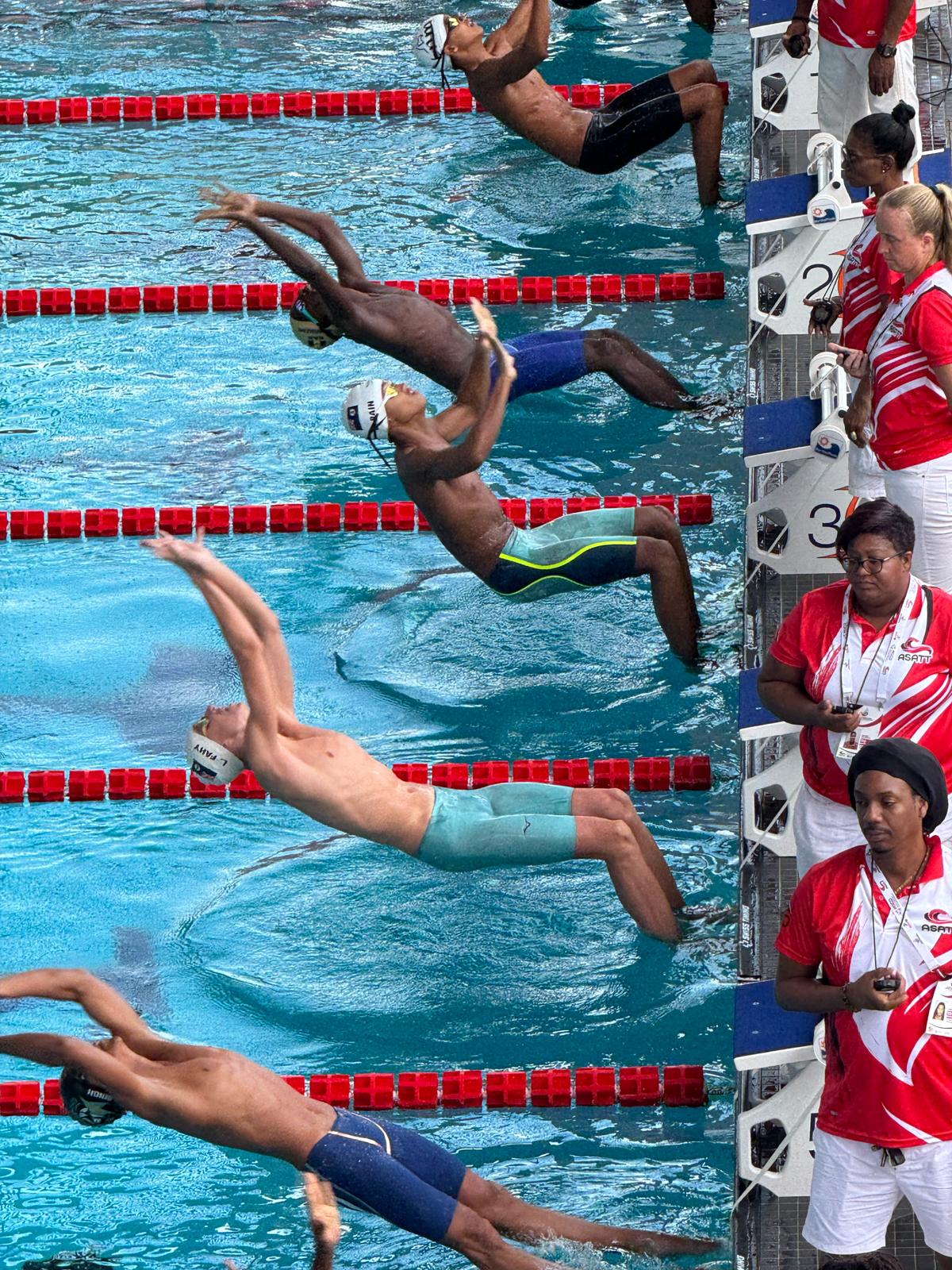
Indeed, Fahy reached the podium in the 50, 100, 200 and 400m freestyle events, earning two bronze and two silver medals, in the 13-14 age category.
Another medal of each colour was picked up in the 50m butterfly (bronze) and 200m individual medley (silver), notching two more Cayman Aquatics records to boot.
But it was the backstroke events – Fahy’s favourite discipline — that really gave one of Cayman’s most promising rising stars the chance to shine.
The first of his trio of golds, he says, “meant the most” for more reasons than one.
“I think the 50m backstroke meant the most to me, especially because in prelims I messed up my start and came fourth — but in the finals I got the start down, dropped a second from my time and managed to win gold.”
Stepping up to the 100m, Fahy again touched first to secure one of four total medals on day two in Trinidad, before rounding out his near-3,000 total metres of prelims and finals racing with a gold in the 200m on day four.
Across the first three days of competition, he also teamed up with fellow age groupers Eli Bain, Lennox Turnham-Wheatley – himself a seven-time medallist in Trinidad – and Gabriel Bispath to snag wins in the 4x100m medley and 4x200m freestyle relays, as well as a silver in the 400m freestyle relay.
On the final day, the group then finished less than two-tenths of a second shy of the podium in the 4x50m freestyle relay.
Lev Fahy’s CARIFTA 2025:
(5🥇, 4🥈, 3🥉)
50 back🥇 200IM🥈 50 free🥉 100 back🥇 100 free🥈 400 free🥉 200 back🥇 200 free🥈 50 fly🥉 400 medley relay🥇 400 free relay🥈 800 free relay🥇
Even with all that silverware racked up through individual and collective efforts, one of Fahy’s favourite parts of CARIFTA remains mingling with other up-and-comers from across the region.
“Meeting new people from different countries and seeing old friends who I sometimes only see once a year are some of the best moments,” he says. “But I guess winning the medals was pretty nice also!”
Fahy, formerly of Cayman International School, is in his first year of high school at Bolles, the Jacksonville-based school whose swim programme has produced more than 60 Olympians and sent several other current swimmers from around the Caribbean to Trinidad for CARIFTA over Easter weekend.
Among the Sharks’ alumni from years gone by is an instantly recognisable name: Shaune Fraser, Cayman’s three-time Olympian whose “perfect 10” showing as a 15-year-old at CARIFTA 2003 – where he won gold in each of his 10 events – is perhaps the only one-meet performance more successful than Fahy’s in the record books.
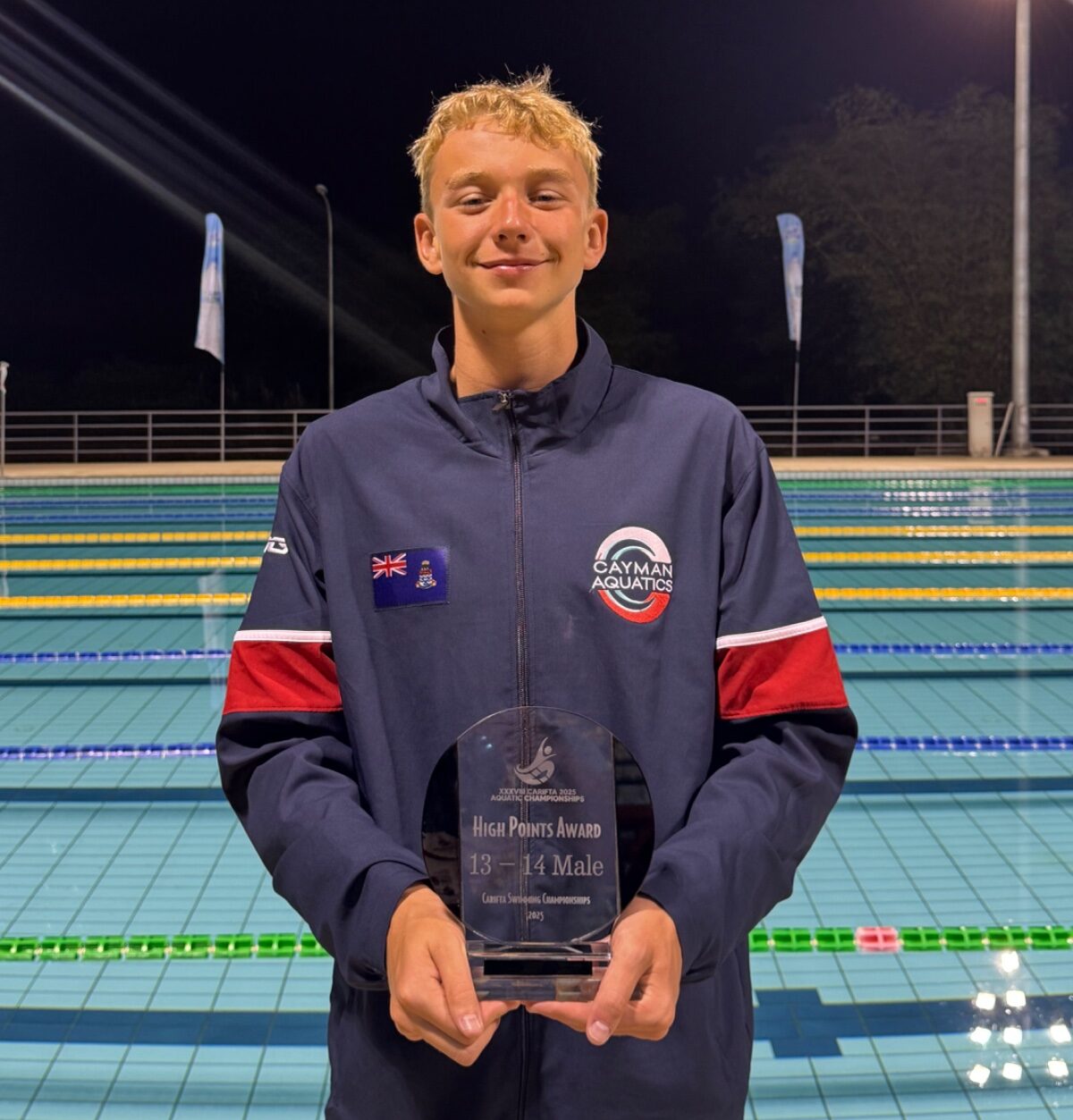
Other previous Bolles graduates who have gone on to achieve international success include Caribbean legends Anthony Nesty, Suriname’s two-time Olympic medallist and 1988 champion in the 100m butterfly; and George Bovell, Trinidad and Tobago’s 200 IM bronze medallist from 2004.
Bolles’ two most successful Sharks, meanwhile, are long-time American backstroke king Ryan Murphy, and Caeleb Dressel, the US star who won five golds at the Tokyo Olympics and has racked up 10 total medals on the sport’s biggest stage in addition to a plethora of world records.
“Dressel was definitely one of my idols, and him having trained in the programme at Bolles was definitely a factor of why I came here,” Fahy says, adding that he “looked up to” the American star when he began his own swimming career at Stingray, aged 9.
Fahy was “all in” with swimming even in those early days, having excelled at school meets before he started training competitively. Now, he has three more years at Bolles before graduation – but is already dreaming about what the future could hold.
“I definitely want to swim at college, especially an American college in NCAA Division I,” he says, “but that’s about as far ahead as I’ve got when thinking about that.”
First, though, it’s back to Bolles to finish this school year and prepare for a summer of fast swimming – British Summer Championships in Sheffield or Futures Championships in the US, both in late July, are two options currently under consideration for Fahy’s next big meet.
Whatever the future holds, and wherever it takes Fahy, Cayman Aquatics technical director Jacky Pellerin is certain of one thing: “Lev is undeniably an important part of the future of Caymanian swimming.”