


Government has approved $45 million in new welfare funding after it emerged it would be unable meet some of its financial obligations starting next month without a fresh cash injection.
The money will cover the healthcare costs of people who don’t have sufficient insurance and for financial assistance to those in need.
Finance Minister Rolston Anglin said that without the additional money, government would have been unable to pay rental assistance or fund other financial aid programs from next month.
There are currently 1,700 families that rely on those payments.
The funding bill, approved after an emergency Finance Committee session on Friday, includes:
- $14 million for financial assistance
- $8.25 million for medical care for ‘indigents’
- $20.54 million for tertiary medical care locally or overseas
While the top-up for financial assistance should carry the department through to the end of the year, Anglin acknowledged government would likely have to come back for more money for healthcare provision. He said the “increasing number of recipients” and the ballooning cost of tertiary care meant that significantly more funds would be needed.
Policy changes on financial assistance – including increased rental assistance allocations to reflect the rising cost of living in Cayman – are also driving the need for more funds.
Government passes a comprehensive budget bill every two years to plan how it will collect and spend around a billion dollars per year. As events and policies change, it is relatively common for MPs to increase or reduce spending in different areas through supplementary bills.
However, questions arose during Friday’s session about the integrity of the budget process.
An honest budget?
Several ministers on both sides of the parliamentary divide appeared to acknowledge they had deliberately under budgeted for welfare payments, among other areas, knowing they could come back to the house for more funds and would likely get approval.
Deputy Opposition Leader Kenneth Bryan questioned Premier André Ebanks – who was Minister for Social Development in the United People’s Movement coalition when the two-year budget was drafted – over why he had not adequately funded financial assistance in the first place. Ebanks and Bryan were in Cabinet together at the time but now sit on opposite sides with Bryan part of the Progressives’ opposition.
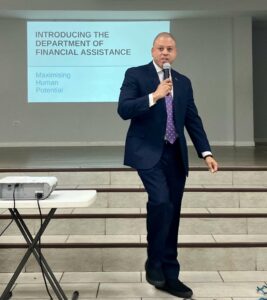
The premier suggested he had agreed to “take a significant cut” for his ministry in order to facilitate a “balanced budget” at the urging of other Cabinet members, including Bryan himself. He said the advice was to take a cut for financial assistance rather than other “non-essential items”, because MPs were unlikely to ever turn down subsequent supplementary funding requests for something like financial assistance or healthcare.
In an effort to be “team players”, he said successive social development and health ministers had agreed to budgets that they “know won’t last”.
Katherine Ebanks-Wilks, now minister for health and also a part of the former UPM cabinet, made similar remarks.
She accepted that government needed to be more realistic and honest in its budgeting to avoid having to constantly come back to ask MPs to vote for additional funds.
“This is not a today issue,” she said. “It has been going on for a number of years.”
Ironically, Bryan himself, who was tourism minister when the 2024-25 budget was passed in December 2023, was challenged over the same issue by former Premier Sir Alden McLaughlin, who accused him and his colleagues, at that time, of deliberately under budgeting for Cayman Airways.
McLaughlin, now retired as an MP but still the chairman of the PPM, said at the time that the UPM budget was “a stab in the dark” and warned that the country was likely heading for a deficit as a result.
Healthcare reform needed
Bodden Town West MP Chris Saunders said it was time for serious bipartisan discussions over healthcare reform to ensure government could fund the escalating costs of treating an ageing population.
Finance Minister Anglin, who introduced the bill and chaired discussions, said the additional funds were urgent and necessary for government to meet its obligations. But he acknowledged there would need to be savings found elsewhere to avoid government ending the year in deficit, as projected by a pre-election financial forecast.
He dismissed suggestions that government’s positive first quarter results had altered that trajectory. The vast majority of financial services fees are collected in the first quarter meaning government makes most of its income in the first three months and spends it the rest of the year.
He said the new government was taking “corrective action” to curtail expenditures and increase revenue in order to at least break even by the end of 2025.
Premier Ebanks thanked MPs for supporting the bill to “deliver essential services to our people”.
He acknowledged welfare and health payments would have to be scrutinised carefully to ensure they were appropriate.
“We are going to have to make harder decisions to make these budget items realistic and long lasting,” he added.