


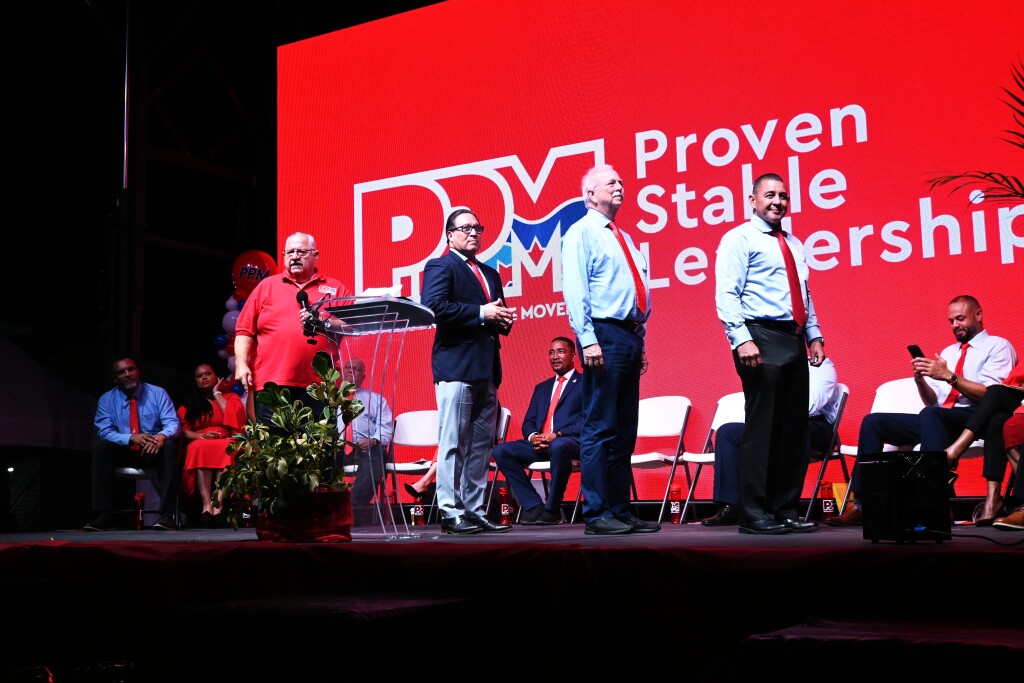
The People’s Progressive Movement party spent almost $700,000 on its election campaign – nearly $220,000 more than legally allowed, the Elections Office has reported.
The party spent $699,751 in the two-month period between Nomination Day on 3 March and Election Day on 30 April, rather than the maximum of $480,000 ($40,000 per candidate) stipulated by the Elections Act.
The information about the overspend “is being shared with the RCIPS”, Elections Supervisor Wesley Howell told the Compass Tuesday, 17 June. He said the information would ultimately be referred to the office of the Director of Public Prosecutions.
Under the Elections Act, each candidate is legally allowed to spend up to $40,000, meaning the dozen PPM candidates whose expenses were paid by the party spent $58,313 each – 45% more than allowed under the law.
Juliana O’Connor-Connolly, the former premier, who decided halfway through her campaign to run with the PPM, paid for her own expenses, which amounted to $13,819, and received no donations from third parties during the two months between being nominated and elected.
According to the summary of the candidate election expenses returns, released by the Elections Office on Monday, 16 June, the PPM received a total of $487,868 in donations from third parties in the run-up to the vote.
In response to the Elections Office report on the overspending, the PPM issued a statement Tuesday evening, outlining a number of reasons why its campaign spend overshot the maximum limit – including the late addition of four candidates to its roster and rising costs of advertising and events – and calling for reform of election financing.
$25,000 potential fine for overspending
In a press release accompanying its summary of the expense returns, the Elections Office said, “Submissions concerning the political party that exceeded the campaign finance expenditure limits are currently being prepared for referral to the appropriate authorities, in accordance with Section 67(5) of the Elections Act (2022 Revision).”
That section of the legislation states that a political party that spends more than the legal amount commits an offence and is liable on summary conviction to a fine of $25,000. Howell confirmed that the $25,000 amount is a flat rate for the party, rather than per candidate.
Under the Elections Act, all candidates and parties must file returns on donations and expenses they have received or accrued between Nomination Day and Election Day. Any monies received or spent in relation to the election before Nomination Day are not required to be reported to the Elections Office, an arrangement that has been criticised by elections observers over the years.
The Elections Office report revealed that the party that spent the next largest amount, after the PPM, was the Cayman Islands National Party, which spent $455,422, or $37,952 per each of its 12 candidates. The CINP received $34,942 in donations prior to the election, the report shows.
The Caymanian Community Party, which fielded 10 candidates, spent $394,749 on election expenses – or $39,475 per candidate. The party received donations totalling $211,118.
PPM: ‘We regret it sincerely’
In its statement Tuesday, the PPM said it acknowledged that its total campaign spending in the election exceeded the permitted limit, and called for a “meaningful review of the Cayman Islands’ outdated election rules”.
It noted that this was the first time the PPM had gone beyond the maximum spend limit in any election.
“This was never intentional, and we regret it sincerely,” said a spokesperson for the PPM in the statement. “But this experience has shown that the current rules do not reflect the realities of how modern campaigns actually work.”
Explaining how the overspend occurred, the PPM said four candidates had joined the party just days before Nomination Day, with some having already spent campaign funds independently, and that rebranding signs and brochures with the PPM logo and colours led to duplicated costs.
“With multiple candidates in many constituencies and a campaign that evolved quickly, tracking expenses in real time proved difficult,” the party added.
It also noted that the cost of advertising, outreach, logistics and events had increased sharply in recent years, but the maximum amount allowed under the Elections Act for campaign spending had not changed in over a decade.
In its statement, the PPM said that Cayman’s eight-week-long official campaign period is “much longer than countries like Canada or the UK, which manage national elections in just four weeks. A longer campaign means higher costs.”
The Elections Act does not prohibit candidates from paying in advance of Nomination Day for election-related products and services that can be used during the campaign period. The PPM said that while such pre-payment practices are “commonly done to reduce the amount of expenditure required to be reported”, in its campaign expenditure submission, it had “reported all expenses incurred during the entire election campaign”.
The party says it is calling for the government, during this parliamentary term, “to agree to comprehensive elections reform, including for campaign financing”.
It says it wants:
- A full review of the spending limit to reflect today’s economic realities;
- Clearer rules around what counts as campaign spending;
- The idea of limited public funding for campaigns to be explored;
- The official campaign period to be shortened.
“We are committed to working with all stakeholders to improve the fairness, transparency, and accountability of elections in the Cayman Islands,” the PPM said. “Caymanians deserve a system that is fit for today – not one stuck in the past.”
Nearly $2 million spent on campaigns
Overall, candidates, including those affiliated with parties and the independents, spent nearly $2 million on the 2025 general election, the Elections Office report showed. Combined, the three political parties spent more than $1.5 million.
Two of those parties, the CINP and TCCP, joined forces to form the National Coalition For Caymanians government.
While the 12 PPM candidates spent the most, independent hopeful Sterling Dwayne Ebanks, who ran for the West Bay South seat against now Premier André Ebanks, was the non-party-affiliated candidate who laid out the most cash in his campaign, at $39,742. He won 293 votes against his rival’s 979.
The candidate that spent the least on her campaign was Ruth Ann Bodden, who ran as an independent in Cayman Brac East against a slate of four other candidates. She spent a total of $390. Bodden garnered just 11 votes.
Five fail to file returns
Five candidates, none of whom won a seat, failed to file a return with the Elections Office – Jermaine Ebanks-Hurlston (West Bay North), Romellia Welcome (George Town North), Hunter Walton (George Town West), Phillip Ebanks (Red Bay) and Leon Gould (Red Bay).
Each candidate and party had a deadline of 35 days following the general election to file an expense and revenue report with the Elections Office.
There is no penalty under the Elections Act for the failure of an unsuccessful candidate to send a report to the Elections Office within that timeframe. However, winning candidates who fail to file a report are not allowed to sit or vote in Parliament until returns are filed. If they do so, they must forfeit $500 for each day they sit or vote.