


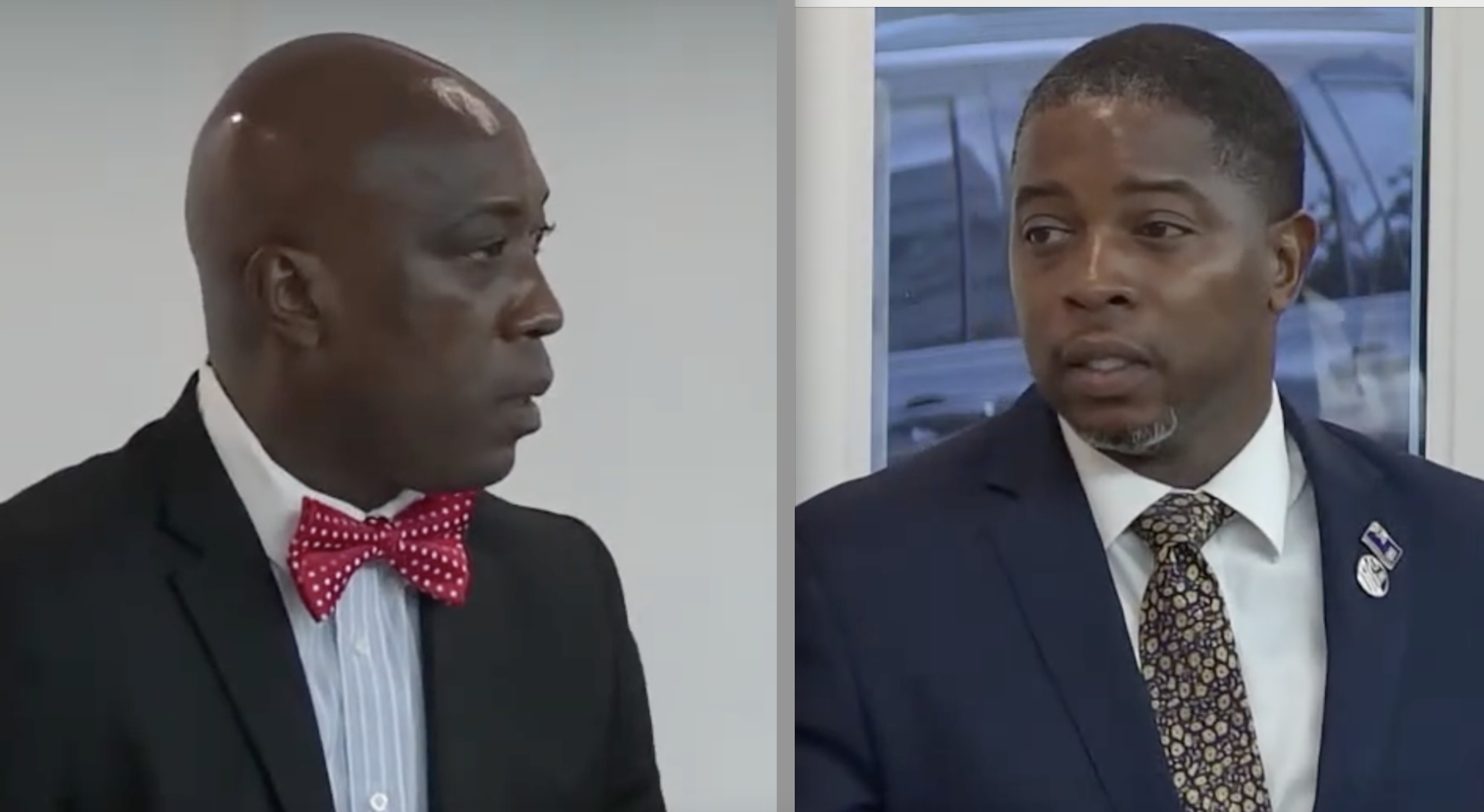
After a long-delayed bid to oust his government fizzled out on the floor of the House of Assembly last week, Premier Natalio “Sowande” Wheatley fired back at an opposition he said is divided.
The no-confidence motion was finally brought to the floor on the night of July 29 by Opposition Leader Myron Walwyn, who blasted the government for more than three hours before the House recessed.
But when the session resumed two days later, none of Mr. Walwyn’s four opposition colleagues joined him in pressing a case against Mr. Wheatley’s administration — and no members of government spoke either.
With no further contributions to the debate, Deputy Speaker Karl Dawson, who was presiding in the absence of the speaker, called for a vote on the no-confidence motion.
It was defeated, seven votes to two.
“It is interesting that the leader of the opposition could not find one person to debate in support of his motion,” Mr. Wheatley told the Beacon after the vote, adding, “There are five members of the opposition and only two voted in favour. That is not a vote of confidence in his motion.”
Vote breakdown
Besides Mr. Walwyn, the other vote in favour came from opposition member Mitch Turnbull (R-D2), who complained that he had missed his chance to contribute to the debate because the HOA meeting was delayed while members attended the funeral of entrepreneur Abdul Shabazz last Thursday morning.
Former opposition leader Ronnie Skelton (R-at large) — who had repeatedly tried to bring a similar no-confidence motion before he was ousted by Mr. Walwyn in March — abstained from the vote last week, and opposition members Stacy Mather (R-at large) and Marlon Penn (R-D8) were absent.
Mr. Dawson didn’t vote because he was presiding as speaker, but all seven remaining members of government voted against the no-confidence motion.
The government commands an eight-to-five majority in the 13-member House.
‘Other business’
Though no government members contributed to the no-confidence debate, some of them used the subsequent “other business” segment of the meeting to criticise Mr. Walwyn’s move and express support for the premier.
Financial Services and Economic Development Junior Minister Lorna Smith praised Mr. Wheatley’s handling of the Commission of Inquiry reforms and other matters, calling for unity in the face of external pressures.
“Should we be in this House debating a motion of no confidence?” she asked. “I say no. What message are we sending to investors? It is only one of instability.”
Ms. Smith — who was sacked as deputy premier last October and served on the opposition for about five months before returning to the government in March — also described divisions in the opposition.
“I sensed while I was on the opposition bench that there was a split in the opposition,” she said. “I did not create that split.”
Mr. Skelton eventually interrupted Ms. Smith to state that her remarks should have been made during the no-confidence debate. After that, she changed topics.
But later, other government members revived her earlier approach. Health and Social Development Minister Vincent Wheatley also backed the premier, suggesting that many of the problems facing the current government stretch back before its tenure.
“Yes, there are issues,” he said. “There will always be issues. But the premier has said one thing. He said to me; he said to others: ‘We’ve come to office and met these issues, but we don’t plan to leave the office and leave the issues there.’”
More criticism
Opposition members, meanwhile, used the “other business” segment to continue criticising the government, echoing Mr. Walwyn’s claims that Mr. Wheatley’s administration has failed to plan; has neglected infrastructure and social services; and has wasted taxpayer dollars.
Mr. Walwyn also defended his no-confidence motion, stating that such moves are key to holding governments to account.
“So when the opposition brings a vote of confidence, it must not be misconstrued as disunity,” he said. “It’s accountability, which is an important part of building a country and building a nation.”
He added a thinly veiled criticism of Ms. Smith, who previously supported Mr. Skelton’s move for a no-confidence vote during her five-month stint on the opposition.
“One person got up and spoke, but that same person who got up and spoke was one of them who publicly said [previously that] she had no confidence in the premier,” Mr. Walwyn said. “She said that, but now all of a sudden it’s a different ball game.”
Mr. Mather (R-at large) began his contribution by apologising for his absence during the no-confidence debate and vote, explaining that he had to attend to a “family matter and a personal matter.”
Mr. Walwyn did not respond to a request for comment.