


The Cayman Islands Airports Authority is inviting the pubic to give feedback on major projects involving all three of the islands’ airports, including expanding the Owen Roberts International Airport’s runway more than 2,000 feet into the North Sound.
The projects were included in an Airports Master Plan, released last year, which outlined the future development plans over the next two decades for the Owen Roberts International Airport on Grand Cayman, Edward Bodden Airfield on Little Cayman and Charles Kirkconnell International Airport on Cayman Brac.
Each of the long-term projects require an environmental impact assessment. The public is now being asked to review the draft terms of reference for those assessments.
The projects include the runway extension at Owen Roberts, the relocation of the Edward Bodden Airfield, and the widening of the runway strip at Charles Kirkconnell.
“These projects will shape the future of Cayman’s airports for generations to come,” said Cayman Islands Airports Authority CEO Albert Anderson in a statement.
“We are committed to sustainable development that balances environmental responsibility with service excellence, and community input is essential to developing solutions that best serve the Cayman Islands now and in the future.”
Owen Roberts runway expansion
The plan to extend the Owen Roberts runway stems from a desire to accommodate the increased landing distances required by wide-body aircraft flying new long-haul routes. Basically, a longer runway means larger planes bringing more stayover visitors to our shores.
The airport’s runway is currently 6,596 feet long. The Cayman Islands Airports Authority is proposing extending it by 2,100 feet eastward into the North Sound. This would include a 1,115 feet-long extension to the runway, a 197 feet-long runway strip, and a 787 feet-long long ‘runway end safety area’, known as a RESA.
The terms for reference document notes that “due to the environmental sensitivity of construction into the North Sound”, a westward extension was also considered, but discounted because it would require the relocation of a stretch of Crewe Road and the cricket oval.
The project is currently in the early stages of design, and once the design is finalised and the EIA process completed, “assuming that the project is approved”, it is anticipated the new runway will be operational by 2030.
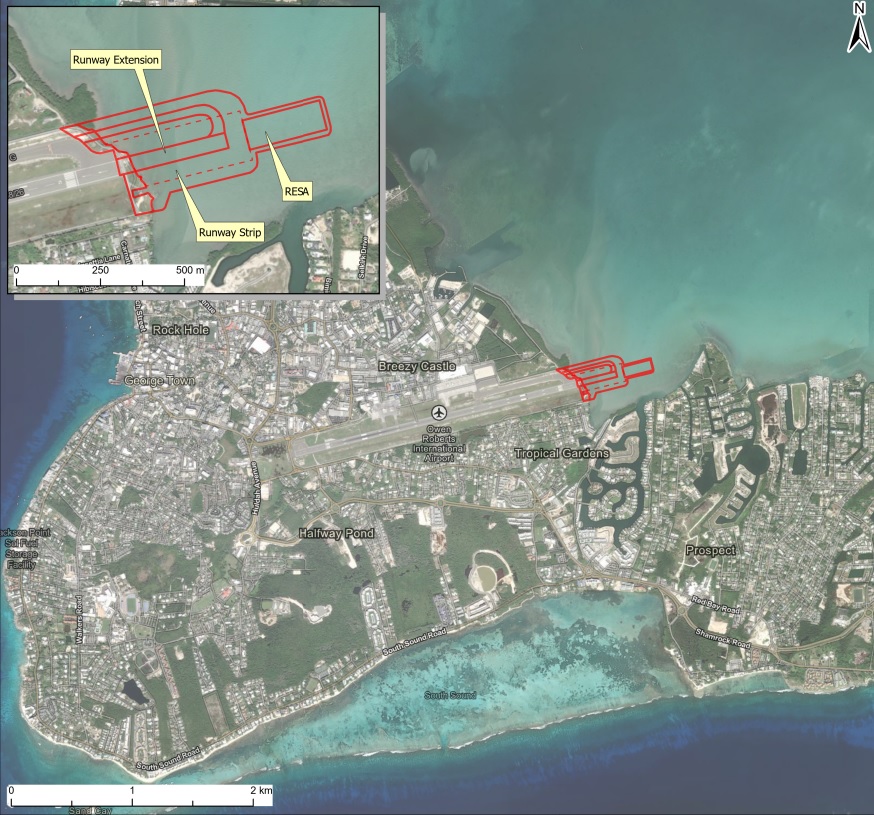
The terms of reference document states, “At this early stage in the process, outline or detailed design of the potential extension into North Sound is not yet known,” but it adds that “at a worst case”, the construction will require the reclamation of 22.4 acres of the North Sound.
“However, alternative designs of the extension and methods of construction will be included or proposed within the EIA to reduce the footprint of the scheme and mitigate/prevent the loss of habitat,” it notes.
It points out that, once operational, the runway extension will allow the airport to receive the larger widebody Boeing 787 and Airbus 350 aircraft, potentially from Europe and South America.
“The larger aircraft will … facilitate increased numbers of visitors to the Cayman Islands and the potential socioeconomic effects of this should be assessed within the Environmental Statement.”
The EIA will identify, assess and address the potential environmental impacts associated with expanding the runway. The National Conservation Council, in 2023, confirmed that the project necessitated an EIA, and it appointed an Environmental Advisory Board to advise on the process.
Last year, the airports authority hired Dutch consultancy company Royal HaskoningDHV to write the EIA’s terms of reference, which identify the scope of work required to inform the assessment.
The EIA will address the following topics:
• Water environment
• Marine ecology
• Terrestrial ecology
• Air quality
• Noise and vibration
• Visual and landscape effects
• Public amenity
• Climate change and hazard vulnerability
How to take part
The public consultation period, which began on 16 May will continue until Friday, 6 June.
Public outreach meetings will be held on all three islands at the end of this month, with representatives from the Cayman Islands Airports Authority, consultants Royal HaskoningDHV, and the Environmental Assessment Board on hand to answer questions.
The meetings will be held at the 2nd Floor Conference Room at Owen Roberts on Tuesday, 27 May; at the Alexander Hotel on Cayman Brac on Wednesday, 28 May; and at the Little Cayman Beach Resort on Thursday, 29 May. The meetings have been scheduled from 5:30pm until 7:30pm each night.
Copies of the draft terms of reference for each airport project can be found online at caymanairports.com and at conservation.ky/eia-reports.
Hard copies are also available for review at Department of Environment, Environmental Centre, 580 North Sound Road, George Town, Grand Cayman.
Feedback can be submitted to the Department of Environment in writing via email at [email protected], direct mail at P.O. Box 10202, Grand Cayman KY1-1002, or by hand delivery to Environmental Centre, 580 North Sound Road, George Town, Grand Cayman.
The CIAA noted that public feedback gathered during the consultation period will be used to refine the terms of reference for the projects, “ensuring that community concerns and environmental safeguards are properly integrated into the assessments”.
Once finalised, the EIAs will be conducted, leading to the development of an Environmental Statement for each project.
The Compass will be reporting on the EIA processes involved in the Sister Islands/ airports projects at a later date.