


Hundreds of commercial flights across the Caribbean were cancelled on 3 Jan. after the United States carried out overnight military strikes in Venezuela, prompting emergency airspace restrictions that disrupted travel in the region.
Shortly after the operation, the Federal Aviation Administration issued an emergency Notice barring all US-registered civilian aircraft from operating at any altitude in Venezuelan airspace, known as the Maiquetía Flight Information Region.
The order, issued just after 1am Eastern time, cited safety-of-flight risks linked to military activity, saying it would initially last through early Sunday, with the possibility of extensions.
Flight-tracking data showed that no commercial aircraft crossed Venezuelan airspace on Saturday, while airlines cancelled hundreds of flights across the eastern Caribbean.
The impacted area extended to Puerto Rico, where airspace restrictions led to widespread cancellations at Luis Muñoz Marín International Airport in San Juan. Airport officials said nearly 400 arrivals and departures were affected.
At Piarco International Airport in Trinidad and Tobago, at least a dozen outbound flights were grounded, including services operated by United Airlines, American Airlines, JetBlue and KLM, while several Caribbean Airlines flights were delayed.
Reshma Ragoonath, a Cayman Compass editor, was transiting Piarco International Airport on her return to the Cayman Islands when flight disruptions began to unfold, leaving passengers facing abrupt cancellations and limited information.
“There was a bit of confusion as American-based airlines were cancelling flights,” Ragoonath said. “I was worried not just for myself and getting on a flight. I was worried about leaving my family behind, not knowing what would happen next with Trinidad so close to the conflict.”
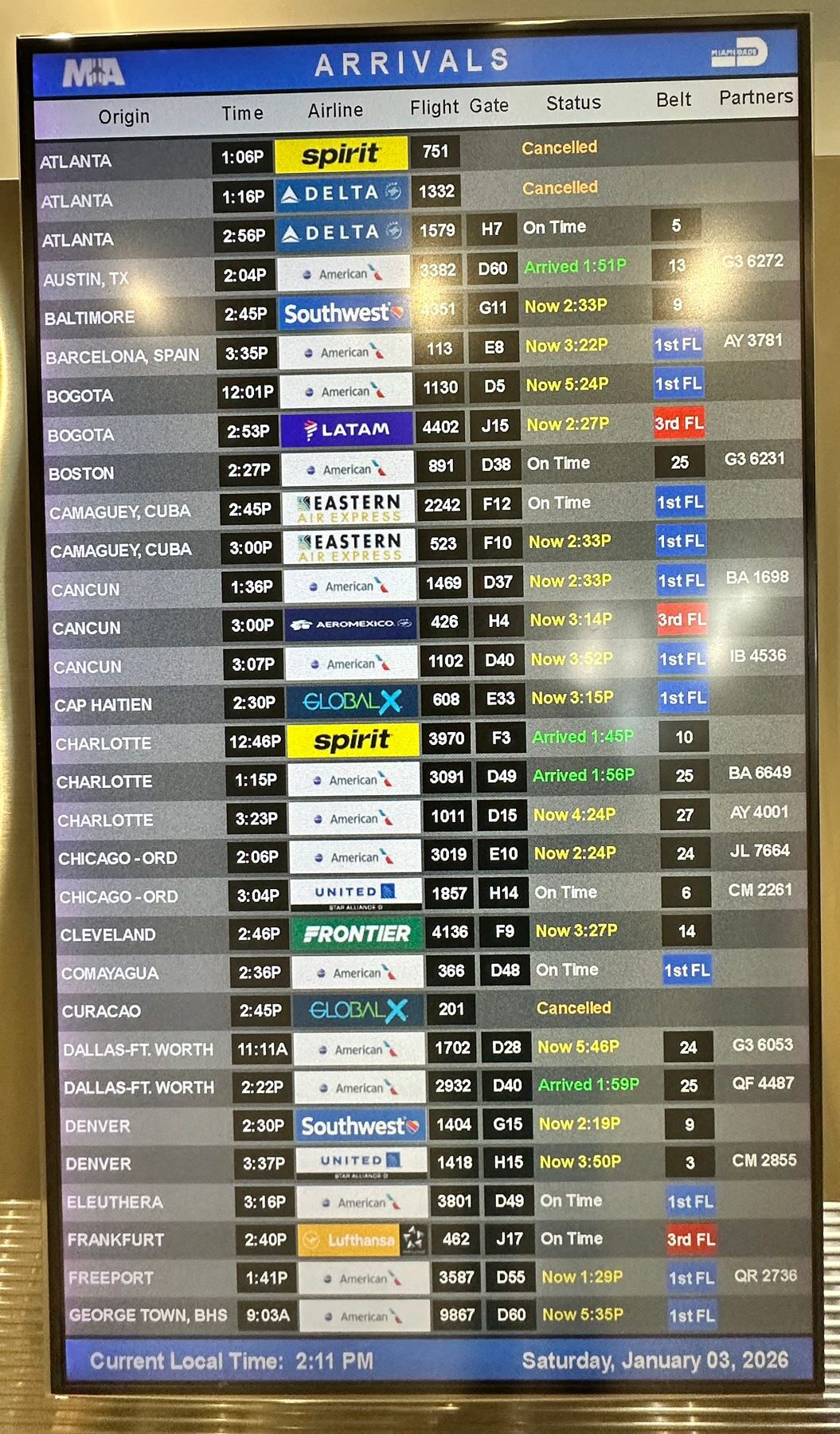
Later, she said, conditions at Miami International Airport appeared calmer, with terminals operating largely normal as passengers monitored departure boards for updates.
Impact on Cayman travellers
The Cayman Islands has not been directly affected by the disruptions, though travellers with Caribbean connections, such as Ragoonath, or those flying on carriers impacted by the cancellations may still experience knock-on delays or rerouting.
In a statement, Cayman Airways said its operations were not affected by the FAA restrictions and confirmed that all scheduled flights were operating normally. The airline advised customers to monitor communications in case of changes.
“Cayman Airways Limited confirms that its flight operations are not impacted by the current Notice To Airmen restrictions affecting parts of the Eastern Caribbean,” read the statement.
“All Cayman Airways flights are operating as scheduled at this time. If any changes become necessary, updates will be published and communicated directly to affected customers using the contact details they provided at the time of booking.”
Airlines respond
US carriers moved to mitigate the impact on passengers. JetBlue said it cancelled more than 200 flights and, along with United, American, Delta, Southwest, Spirit and Frontier rolled out travel waivers allowing customers to rebook or seek refunds.
Most carriers said passengers travelling in early January could change or cancel flights without the usual fees, with options to rebook into mid-January or receive refunds or travel credits.
The policies cover multiple destinations across the region, including Antigua, Aruba, Bridgetown, Bonaire, Curaçao, Grenada, San Juan, St. Maarten, St. Croix, St. Thomas, St. Kitts, St. Vincent and St. Lucia, as airlines continue to adjust operations in response to the security situation.