



– Advertisement –
Saint Lucia
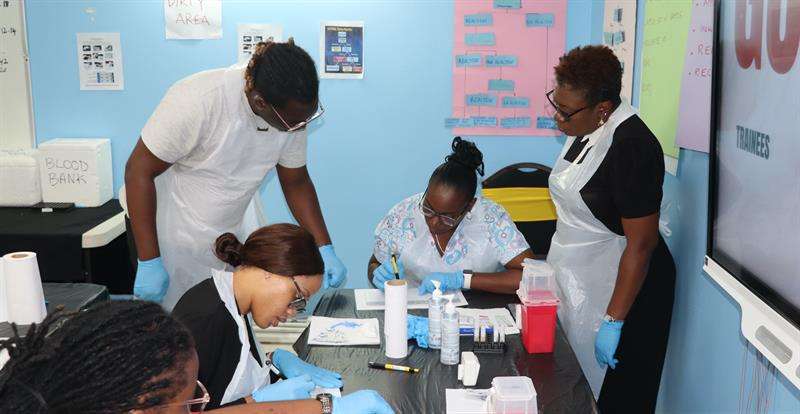
– The Ministry of Health, Wellness and Elderly Affairs has completed a Master Trainers Training Programme as part of the OECS Global Fund HIV/TB Project, aimed at strengthening national capacity in rapid HIV and syphilis testing and improving the quality of laboratory services across Saint Lucia. The programme was implemented through the engagement of the Caribbean Med Labs Foundation, contracted to provide technical support and build sustainable laboratory training capacity.

The Ministry nominated four healthcare professionals to undergo certification as Master Trainers. These candidates participated in structured training sessions that combined both theoretical and practical components to ensure a high standard of competency and consistency in testing procedures.
Linda Berthier, Coordinator of Prevention of Mother to Child Transmission in the Infectious Diseases Unit explained the intensity and importance of the certification process and the high standards required of participants.
“You have to read in advance, you have to study the work, because you are now going to be doing a mock training. But it’s an actual training, because CMLF, which is Caribbean Med Labs Foundation from Trinidad, their director and staff are here to invigilate the process. They’re supposed to pass to be able to be certified. So you’re supposed to teach the students accuracy and the importance of testing. Lab services are involved. So we got QC samples and live HIV and syphilis samples from the OKEO lab to be used in this lab setting for training. So it’s actual training, and they are really pushing for it to be done well, because you cannot pass with 90%. It’s 100% pass for the practical.”
Valerie Wilson, Director of the Caribbean Med Labs Foundation, outlined the critical role master trainers play in ensuring consistent, high-quality testing services throughout Saint Lucia.
“It’s really important for St Lucia to have your own trainers so that you are able to ensure that you keep the level of testing as constant as possible in terms of availability to the community, whether at clinical sites from the Ministry of Health or at NGO sites or in the hospital, for example, or at the maternity center at the clinic and at not just the clinics, but also when women present at maternity, because HIV and syphilis is really important in terms of preventing babies from being born with HIV or syphilis but in addition to that, it’s really important for populations who may in fact be exposed to HIV or syphilis to be able to find out if in fact they might be infected.”
Master Trainer, Yasmin Jules-Gabriel highlighted the significance of this responsibility to train, emphasizing the importance of ensuring preparedness in the first line of screening.
“To be nominated as a master trainer, it is a huge responsibility. It is a huge responsibility ensuring that people maintain standards, it’s a responsibility ensuring that people understand why they do what they do specifically and we have persons coming to us, we have to be that first line of screening and in that first line of screening be prepared. We have to have that confidence in the first line of screening when persons come to us that they know they can ask us a question and we can confidently let them know what is happening now and what is going to happen next. That’s important for people, it helps in their decision making.”
Beyond technical competence, Master Trainers are entrusted with a responsibility that extends into education, leadership, and patient engagement. They serve as the frontline point of contact, offering clarity, reassurance, and informed direction to those navigating the screening process.
– Advertisement –