


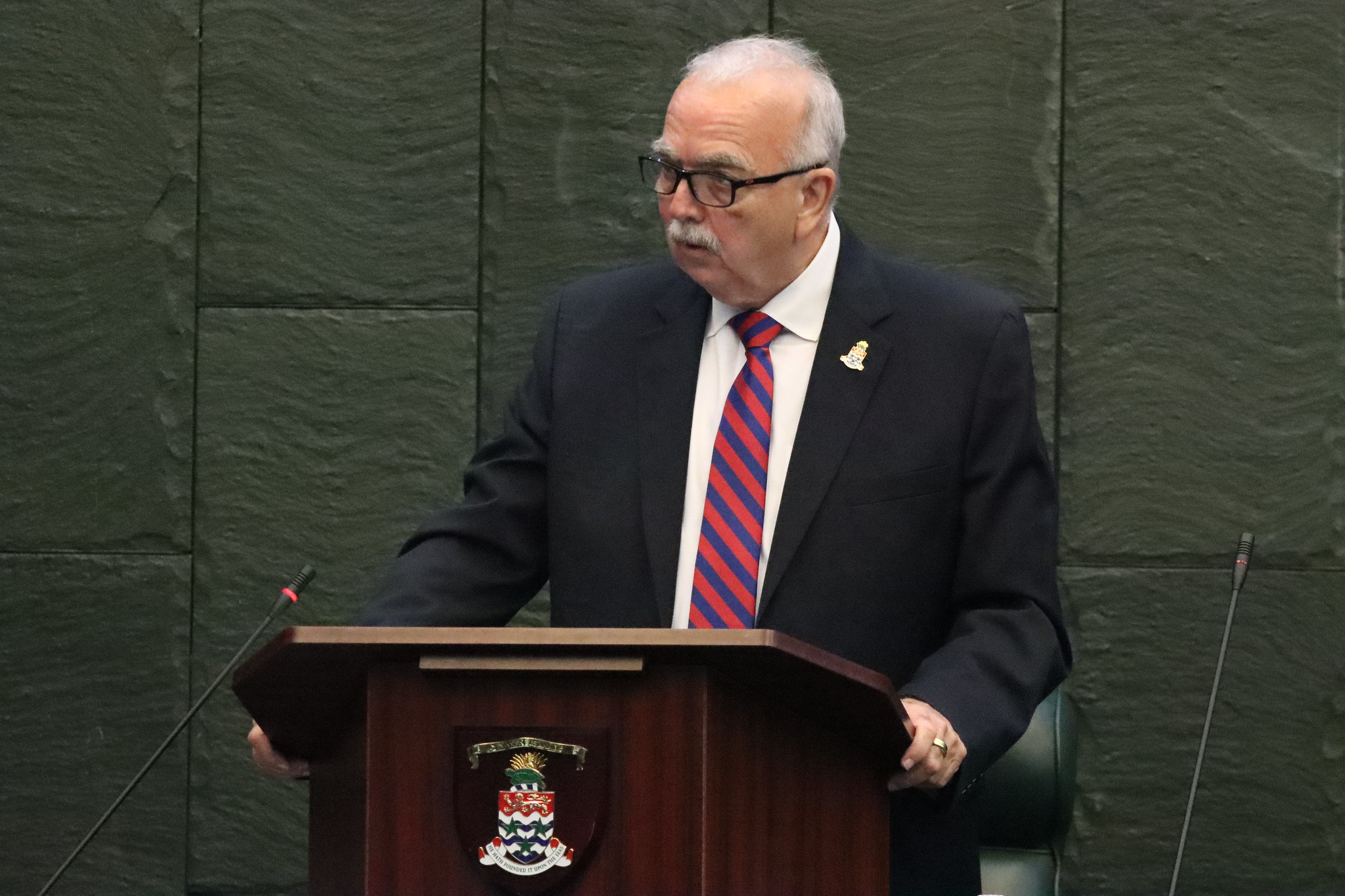
Shadow finance minister Roy McTaggart questioned plans to raise stamp duty on ‘high end’ properties and criticised government for declining to give details on its planned new fees during its budget presentations.
The government budget hinges on plans to raise an additional $172 million over the next two years across a variety of new revenue measures. But details of precisely where that money will come from have not yet been revealed.
McTaggart, speaking in parliament Tuesday, said the National Coalition for Caymanians had delivered a “tax, borrow and spend budget”.
He said the presentations so far were “woefully short on detail” about where the new revenue was coming from.
Both Premier André Ebanks and Finance Minister Rolston Anglin indicated there would be increases to various financial services fees, immigration fees and stamp duty on some properties but did not give specifics.
“The minister says immigration fees and stamp duty on high value real estate transfers will increase,” said McTaggart.
“He hasn’t told us what those increases will be, particularly the threshold for high-value real estate and the rate of duty to be applied on these transactions.”
Neither Anglin or Ebanks mentioned figures for the stamp duty increase and both men declined to give specifics when asked by the Compass.
A government press release on the budget differed slightly from his presentation, indicating that there would be a stamp duty increase for properties valued at more than $2 million. However, he did not say this number in Parliament and there was no detail of what the increase would be and to whom it would apply.
Currently, a one-time rate of 7.5% stamp duty is charged on all property transfers, with some exceptions, including concessions for first- and second-time Caymanian buyers.
McTaggart added, “I wonder if anyone on the government bench remembers that we tried something like this (increasing stamp duty on more expensive homes) about 25 years ago with disastrous results.”
He said government was clearly aware of its plans and had calculated the exact dollar amount it expected to yield over two years but has chosen not to share the information.
Because this is an appropriations bill, it only contains details of spending. Revenue measures aren’t outlined in the bill and some may require additional legislation.
But McTaggart urged government to be transparent about its plans.
“Without the details of the individual fee increases … the budget is incomplete. Parliament ought to have this information before it, even if the enabling legislation is to come at a later date … why the secrecy?”
Responding to the criticism in Parliament Tuesday, Anglin indicated government would give fuller details on its revenue measures “in the days ahead”.
He said, “We’re crafting legislation as we speak to underpin all the revenue measures.”
Anglin said he accepted the new measures might bring criticism, but were necessary to fund programmes and infrastructure that had been neglected by previous governments, including McTaggart’s PPM.
“Yes, we have increased fees,” he said, “but let us be clear, the fees that we have increased are not going to hit the average Caymanian.”
‘Historic levels of debt’
McTaggart also said government was stacking up “levels of debt never seen before in the history of this country”.
The budget includes $236 million in borrowing and estimates a total debt of $634 million by the end of 2027.
Presenting the figures last week, Finance Minister Anglin said Cayman still had an enviable debt to GDP ratio globally. He said the borrowing would be used for capital expenses only, primarily roads and schools’ development.
Anglin compared government’s borrowing strategy to a household mortgage, saying it was “prudent, affordable and tied to long-term assets”.
He repeated that defence in his budget response speech Tuesday, saying borrowing was being used to fund critical infrastructure. Both Anglin and Ebanks have characterised the budget as seeking to address long-neglected social issues.
McTaggart also took issue with the decision of most government ministers not to give speeches outlining their ministries’ spending plans, as is customary. He accused the coalition ministers of being “comfortable warming their seats” instead of outlining their plans.
Government has indicated it will outline its plans in detail during the line-by-line approvals process that takes place in Finance Committee, starting Thursday.
Anglin insisted there was nothing improper about government ministers not speaking in the budget debate. He said the ministers initially intended to contribute, but after hearing the formal opposition’s comments, they determined there was little that required a response and most chose not to speak.
He insisted full scrutiny will still occur in Finance Committee, where members can question ministers on every aspect of the budget.