


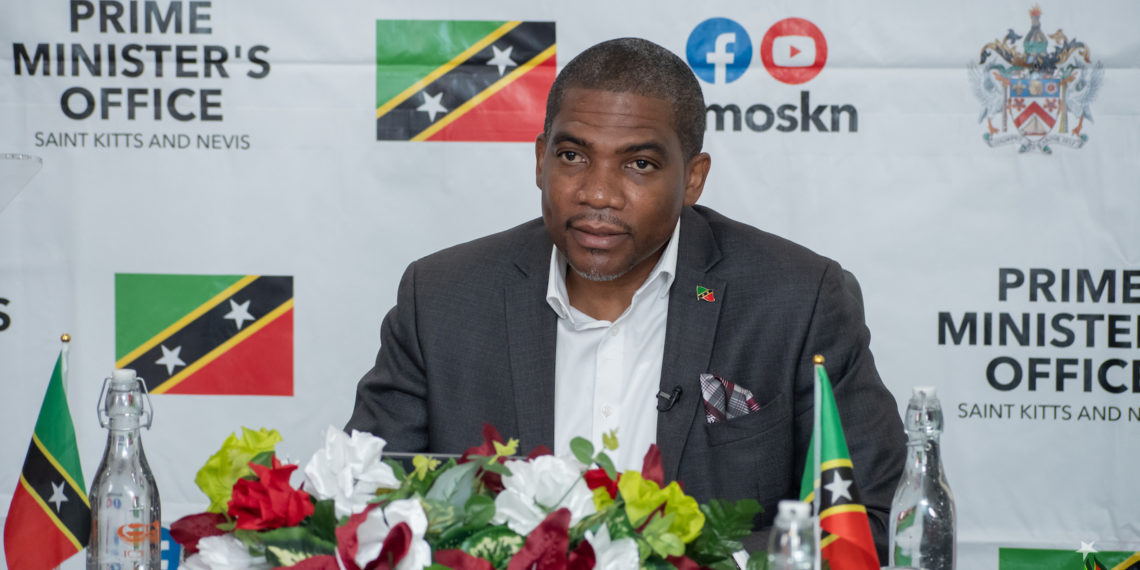
Saint Kitts and Nevis will accept deportees and refugees from the United States, joining a growing list of Caribbean countries that have confirmed they have signed a memorandum of understanding (MOU) of a similar nature.
Prime Minister of the twin-island federation, Terrance Drew, confirmed the agreement to reporters during a “roundtable” on Thursday, January 8.
“St Kitts and Nevis has negotiated and entered into an MOU with the United States of America for the potential transfer of certain third-country nationals. And I want us to listen carefully; this applies only to citizens or nationals of the Caribbean Community (CARICOM),” Drew stated, noting that Haitians would be included as an exception and that only individuals without a violent or sexual criminal past would be accepted.
Drew’s confirmation follows earlier news that Antigua and Barbuda, as well as Dominica, had both signed similar MOUs with the United States.
Dominica’s Prime Minister, Roosevelt Skerrit, told reporters at a conference earlier in the week that an agreement had been reached with the United States “to facilitate third-country refugees”.
With Dominica’s population at about 60,000, Skerrit emphasised that while no specific number of refugees had yet been confirmed, the United States was aware of the island’s small size and limited resources. He also said concerns had been raised about receiving individuals who could compromise national security, which he noted were acknowledged by the United States.
In a statement posted on his social media earlier this week, Prime Minister of Antigua and Barbuda Gaston Browne said: “Antigua and Barbuda has not entered into any binding agreement with the United States to accept deportees or refugees. What exists is a non-binding MOU proposed by the United States, as part of its global efforts to share responsibility for refugees already present in its territory.”
According to Browne, Antigua and Barbuda has the right to reject any individual proposed by the United States; individuals with a criminal past would not be considered, and no more than 10 deportees would be accepted per year.
Both Dominica and Antigua and Barbuda have had visa bans and travel restrictions imposed on them by the United States, effective January 1, 2026.
Browne said the move to receive deportees was “not a concession, nor an attempt to trade people or curry favour”. Instead, he says “it was a measured diplomatic gesture, taken alongside many other responsible states, while preserving Antigua and Barbuda’s full discretion and control.”
In his online statement, Browne said Antigua and Barbuda was approached alongside more than 100 other governments, including additional members of CARICOM, to consider the arrangement.
Earlier reports indicated that Guyana was also nearing a pact to receive third-country deportees from the United States.
Queries sent to Saint Lucia’s Ministry of External Affairs regarding whether similar discussions are underway with local officials had not received a response by publication time.