


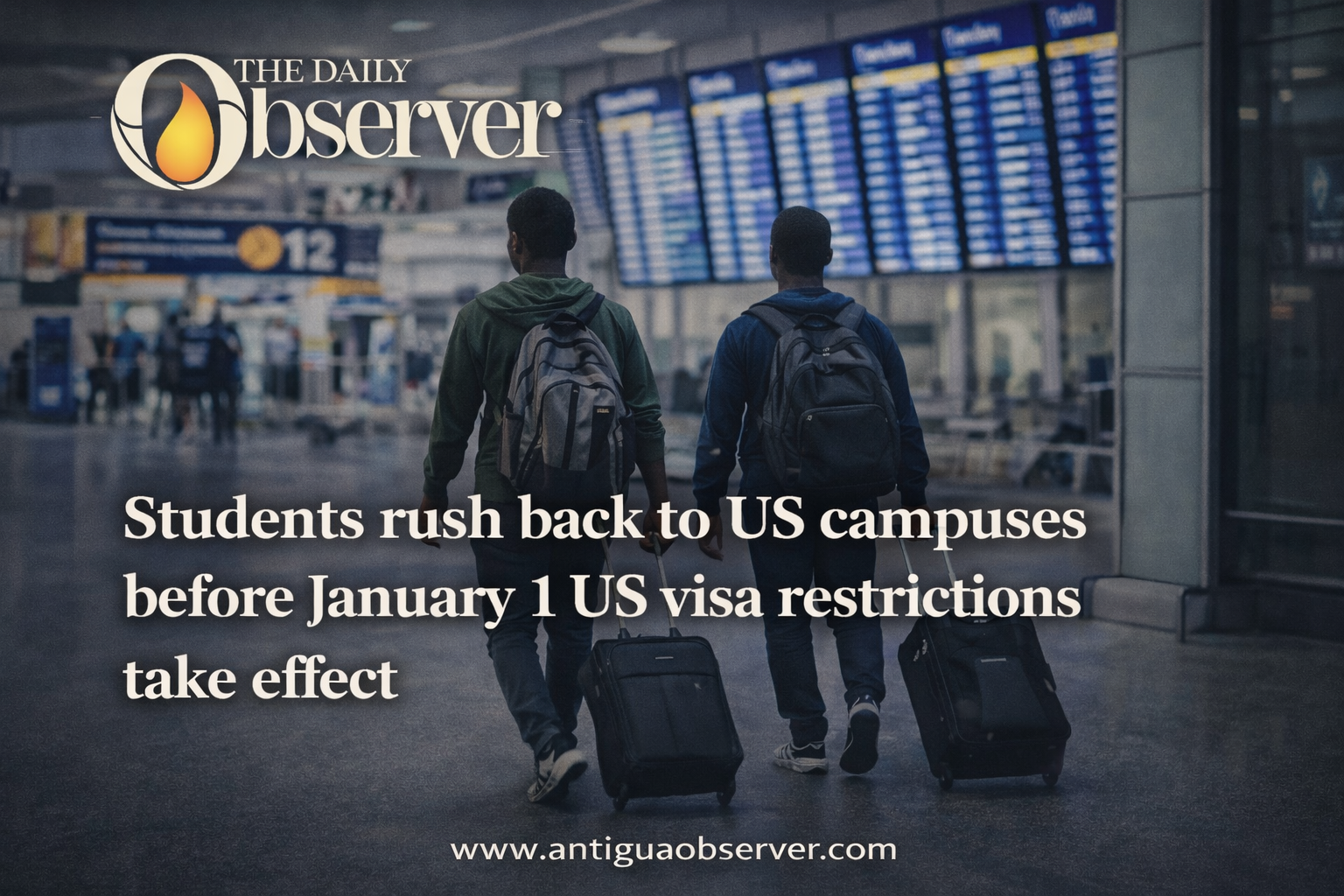
A quiet but urgent exodus is underway as students from Antigua and Barbuda studying in the United States scramble to return to their campuses ahead of a looming January 1, 2026 deadline tied to new U.S. visa restrictions.
Many students were home for the Christmas break when news broke of a U.S. proclamation imposing a partial suspension on certain visa categories for Antigua and Barbuda nationals. Since then, Observer understands that a significant number of students have either already departed or are making last-minute travel arrangements in an effort to be physically back in the United States before the new measures take effect.
With tuition already paid, housing secured, and academic calendars set to resume in early January, the potential risk of a student facing complications at a port of entry — or delays linked to evolving visa rules — is being treated as too great. As a result, holiday plans have been cut short, work schedules rearranged, and costly airline tickets secured during one of the busiest travel periods of the year.
The U.S. proclamation outlines a partial suspension affecting several visa categories used by Antiguans and Barbudans, including tourist and business travel, as well as specific student and exchange-related classes. While the announcement did not amount to a blanket ban, its timing and wording created immediate uncertainty for students attempting to determine whether their existing visas would be sufficient for re-entry after January 1.
Following high-level discussions with U.S. officials, Antigua and Barbuda’s Ambassador to the United States, Sir Ronald Sanders, sought to reassure the public that valid, previously issued visas would continue to be honored and that no existing visas would be revoked before December 31, 2025. He also confirmed that new visa applications submitted after that date would fall under revised arrangements, including enhanced biometric requirements intended to align with U.S. systems.
Despite those assurances, the pressure has not eased.
In practical terms, a valid visa does not guarantee entry at a U.S. port of entry, and students — particularly those returning after a prolonged holiday absence — are weighing worst-case scenarios. Any delay could mean missed classes, disrupted academic schedules, lost access to campus housing, and complications for students enrolled in clinical placements, labs, or time-sensitive programmes.
The situation has been further compounded by peak-season travel conditions. Flights are heavily booked, prices are elevated, and availability is limited, forcing families to absorb additional costs simply to ensure their children return with enough buffer time before the deadline.
Beyond individual households, the rush has also reignited wider national debate around Antigua and Barbuda’s international standing and the scrutiny being applied to its citizenship-by-investment programme. While the U.S. action is rooted in its own national security framework, it has added to ongoing discussions with international partners about biometric compatibility, due diligence standards, and whether recent reforms will be enough to maintain confidence and preserve mobility.
Observer will continue to monitor developments in the days ahead.