


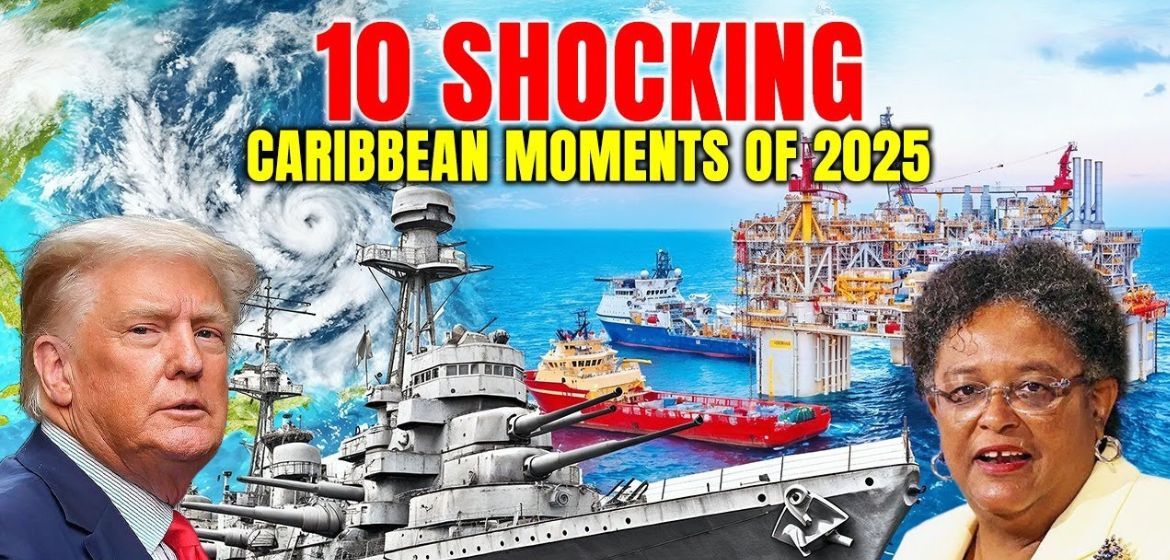
2025 was not an ordinary year for the Caribbean—it was a turning point. From catastrophic hurricanes and explosive economic growth to political upheavals, cultural breakthroughs, and historic global recognition, the region experienced a year of extremes that reshaped its future. This was a year that tested resilience, challenged sovereignty, and proved that the Caribbean is no longer just reacting to global forces—it is shaping them. Here are the 10 moments that shook the Caribbean to its core in 2025, counting down from number ten.
In 2025, the Caribbean endured a year of extremes, with political, economic, and environmental upheavals reshaping the region. Donald Trump’s return to power strained U.S.-Caribbean relations through tightened restrictions and deportations. Mia Mottley earned global recognition, while Caribbean tourism surged to record highs. Haiti’s crisis deepened, and Guyana’s oil boom fueled unprecedented economic growth. The region also witnessed historic elections and a breakthrough in fashion with the Caribbean Fashion Collective. Amidst all, Hurricane Melissa devastated Jamaica, underscoring the Caribbean’s vulnerability to climate change, but also its unbreakable resilience and global influence.
10. Donald Trump’s Turbulent Relationship With the Caribbean

In 2025, Caribbean–U.S. relations entered one of their most strained periods in decades following Donald Trump’s return to power.
Key developments included:
- Expanded U.S. travel restrictions and heightened visa scrutiny are affecting several Caribbean nations
- Disruptions to tourism, student travel, and seasonal labor mobility
- Mass deportations of Caribbean nationals under renewed zero-tolerance immigration enforcement
- Jamaica, Haiti, and the Dominican Republic are struggling to absorb thousands of forced returnees
Tensions intensified as Trump repeatedly linked Caribbean migration to crime and security threats, prompting strong pushback from regional leaders who condemned the policies as unilateral and damaging to Caribbean sovereignty.
By the end of 2025, the fallout reshaped Caribbean–U.S. relations, strengthening calls for regional unity, diplomatic independence, and reduced reliance on shifting U.S. political agendas.
9. Mia Mottley Named To Forbes’ 100 Most Powerful Women

In a historic moment for Caribbean leadership, Barbados Prime Minister Mia Mottley was named No. 99 on Forbes’ 2025 World’s 100 Most Powerful Women list.
Recognized for:
- Global climate advocacy
- Diplomatic leadership
- Guiding Barbados’ transition from monarchy to republic
Mottley became the Caribbean’s most influential voice on climate justice. Her “1.5 to Stay Alive” campaign resonated worldwide, forcing global powers to confront their responsibility to vulnerable island states.
8. Caribbean Tourism Rebounds To 34.2 Million Arrivals

The Caribbean tourism industry roared back with extraordinary force.
- 34.2 million international arrivals in 2024
- Some destinations recorded up to 18% year-over-year growth
- Momentum continued strongly into 2025
Major destinations like The Bahamas, Jamaica, the Dominican Republic, and Aruba led the charge, while smaller islands also saw record-breaking visitor numbers. This wasn’t just recovery—it was a tourism explosion that reshaped regional economies.
7. Haiti Became The Central Political Crisis Of The Region
Haiti dominated regional politics as the state’s authority remained severely weakened and armed groups expanded control, pulling CARICOM and global powers into nonstop debate over intervention versus sovereignty.
Key developments included:
- Gangs are tightening their grip, including control of about 85% of Port-au-Prince.
- Violence surging—UN reporting 1,617 killed in the first quarter of 2025.
- Nearly 1.3 million Haitians were internally displaced by mid-2025.
- CARICOM condemns any attempt to overthrow Haiti’s transitional arrangements by force.
- The UN Security Council is authorizing a shift from the MSS toward a Gang Suppression Force framework.
Haiti forced the Caribbean to confront the hard limits of regional influence, international assistance, and post-colonial governance when a state begins to collapse.
6. Five Caribbean Nations Receive Credit Rating Upgrades
In a stunning endorsement of economic management, five Caribbean nations received sovereign credit rating upgrades in 2025:
- Anguilla
- Barbados
- Belize
- Jamaica
- Suriname
For decades, the region battled high debt, stagnation, and the stigma of being a risky investment. These upgrades reflected improved fiscal discipline, sustained growth, and restored investor confidence, marking a major turning point for Caribbean economies.
5. A Caribbean Electoral Wave Across Multiple Nations

2025 became one of the busiest election years in Caribbean history.
General elections were held in:
- Trinidad and Tobago
- Suriname
- Belize
- Anguilla
- Curaçao
- Turks and Caicos
- Bermuda
- Cayman Islands
- St. Lucia
- St. Vincent and the Grenadines
Nearly one-third of Caribbean nations went to the polls in the same year, creating a region-wide moment of democratic reckoning. Voter turnout surged as citizens passionately debated corruption, economic direction, and regional sovereignty—signaling renewed political engagement across the Caribbean.
4. Caribbean Fashion Collective Reshapes Global Fashion

On September 13, 2025, Caribbean fashion made history.
The Caribbean Fashion Collective (CFC) debuted on the official CFDA Fashion Calendar at New York Fashion Week, marking a defining moment for Caribbean creatives.
Founded by Xavier Walker, with co-founders Norka Vasquez and Stewella Daville, CFC was created to elevate Caribbean and emerging designers on the world’s biggest stages.
Six standout brands showcased their artistry, blending heritage with innovation:
- Aesthete Artwear – bold crochet craftsmanship
- Kudos Designs – Caribbean heritage meets modern tailoring
- MAK GIOUS – luxury bespoke elegance
- Atelier Sanel – avant-garde sophistication
This was more than a runway show—it was a declaration that Caribbean designers had earned their place at fashion’s most exclusive table.
3. Guyana’s Oil Boom Continues

Guyana’s economic transformation reached jaw-dropping levels in 2025.
- 43.5% GDP growth in 2024
- 10.3% projected growth in 2025
- Potential 23% expansion forecast for 2026
No other country on Earth was growing at this pace. Georgetown was transformed almost overnight—glass towers replaced colonial buildings, luxury vehicles filled once-quiet streets, and global banks rushed to establish Caribbean headquarters.
Each new exploration well revealed billions more barrels than expected, turning a nation of just 800,000 people into one of the world’s most sought-after energy frontiers.
2. U.S. Naval Deployment And Operation Southern Spear

In 2025, the Caribbean Sea transformed into a geopolitical flashpoint.
The United States launched its most aggressive naval buildup in the region since the Cold War under Operation Southern Spear, including:
- The USS Gerald R. Ford carrier strike group
- Over 10 warships
- Approximately 15,000 U.S. military personnel
Caribbean leaders were stunned. The move appeared to undermine the region’s long-standing designation as a “Zone of Peace.” Smaller island nations watched uneasily as foreign warships patrolled their waters.
Public backlash followed quickly. Protests erupted across several islands as citizens questioned sovereignty, neocolonialism, and whether the drug war justification masked deeper geopolitical ambitions.
1. Hurricane Melissa Devastates Jamaica
On October 28, 2025, the Caribbean watched in horror as Hurricane Melissa made landfall near New Hope, Westmoreland, Jamaica, unleashing unprecedented destruction.
- Sustained winds: 185 mph
- Central pressure: 892 mb
- Status: Third-most intense Atlantic hurricane ever recorded
- Strongest tropical cyclone to ever strike Jamaica
The storm claimed 102 lives across the Caribbean, primarily in Jamaica and Haiti, and caused an estimated $10 billion in damages—nearly one-third of Jamaica’s GDP.
Entire farming regions were wiped out, livestock decimated, and 156,000 homes destroyed, crippling food security and national infrastructure. Hurricane Melissa forced a sobering national reckoning with climate change and triggered the largest reconstruction effort in Jamaica’s history.
Conclusion
2025 tested the Caribbean with fire, wind, ambition, and change—but it also revealed something unbreakable.
In crisis and celebration alike, the region rose with resilience, creativity, and global influence. From rebuilding stronger to commanding international respect, the Caribbean proved it is no longer just responding to history—it is shaping it.
As the tides of the future rise, one truth is clear: The Caribbean’s greatest chapter is still being written.
Join the Conversation
- Which moment from 2025 do you think will have the biggest long-term impact on the Caribbean’s future—and why?
- Are you feeling more hopeful or more concerned about where the region is headed?
Share your thoughts in the comments, and help spread these stories by sharing with someone who needs to see them. See you at the next one.