




As we move on to Chapter V, the 1982 Anguilla Constitution Order enshrined powers to “make laws” beginning with Section 47, “Subject to the provisions of this Constitution, the Governor, with the advice and consent of the Assembly, may make laws for the peace, order and good government of Anguilla.” [1] So, only an appointee can “make laws” – limiting elected members to advise, agree or disagree?
Royal Instructions
Section 48 links back to the monarchy, saying, “Subject to the provisions of this Constitution, the Governor and the Assembly shall, in the transaction of business and the making of laws, conform as nearly as maybe to the directions contained in any Instructions under Her Majesty’s Sign Manual and Signet that may from time to time be addressed to the Governor in that behalf.”[1]
Rules of procedure
Section 49 gives latitude for House rules, then retracts it: “Subject to the provisions of this Constitution and of any Instructions under Her Majesty’s Sign Manual and Signet, the Assembly may … make, amend and revoke rules of procedure …and the despatch of business, and for the passing, intituling and numbering of Bills for the presentation thereof to the Governor for assent; but no such rules … shall have effect until the Governor, acting in his discretion… approves them.”[1]
Presiding in Assembly
Section 50 requires, “(1) When the Assembly first meets after a general election, or after the office of Speaker has fallen vacant for any [other] reason… and before…any other business, the Assembly shall elect a… Speaker… from among persons who are qualified for election…” but not from Executive Council.[2] Electing a Deputy Speaker was later included, as would be another member’s election for a single sitting if both are absent.[2,3] Conditions that “vacate” their offices include: dissolution of Assembly; resignation; two-thirds vote; ceasing to be a member (Section 39); joining Executive Council; or if not a member, if the Speaker becomes disqualified for election under Section 37. [3]
Assembly may transact business not-withstanding vacancies
Section 51 is ironic: “The Assembly shall not be disqualified for the transaction of business by reason of any vacancy… and any proceedings therein shall be valid notwithstanding that some person who was not entitled to do so sat or voted in the Assembly or otherwise took part in those proceedings.”[1] Ironic? See Section 56. Laws can be made without any Assembly at all!
Quorum
However, Section 52 allows “any member of the Assembly who is present” to object to “the transaction of business” without a quorum (two-thirds) and for “the person presiding” to “adjourn the Assembly” once the rules for confirming quorum status are followed.[1] Sounds good but see Section 56.
Voting
Section 53 has another pesky key left in the lock, saying, “Save as otherwise provided in this Constitution,[!!] all questions proposed for decision… shall be determined by a majority of votes of the members present and voting.” And the presiding member, “shall not vote unless… the votes are equally divided, in which case he shall have and exercise a casting vote.”[1] Most expect Speakers to vote down fraught legislation. Nonetheless, they are clearly empowered to single-handedly impose it.
Summoning of persons to assist Assembly
Section 54 simply allows, “The Speaker or other person presiding” to “summon any person to a meeting of the Assembly notwithstanding that that person is not a member” and that such individual(s) can participate in the proceedings relevant to their summons, except they can’t vote.[1]
Introduction of Bills
Section 55 states, “…any member may introduce any Bill or propose any motion for debate in, or may present any petition to, the Assembly… according to the rules of procedure.” However, it reserves powers of taxation whereby “Except on the recommendation of the Governor, the Assembly shall not—proceed upon any Bill [or motion – or receive any petition or amendment…] which in the opinion of the person presiding…makes provision for imposing or increasing any tax, for imposing or increasing any charge on the revenues or other funds of Anguilla or for altering any such charge otherwise than by reducing it or for compounding or remitting any debt due to Anguilla.”[1] Okay to reduce them? Hmm.
Section 56: Governor’s legislative reserved power
Section 56 turns an important key: “If the Governor considers that it is expedient in the interests of public order or public faith (which …include the responsibility of Anguilla…and all matters pertaining to the creation or abolition of any public office …) that any Bill introduced or motion proposed, in the Assembly should have effect, then, if the Assembly fail to pass the Bill or to carry the motion within such time and in such form as the Governor thinks reasonable and expedient, the Governor, acting in his discretion, may, at any time that he thinks fit, and notwithstanding any provision of this Constitution or of any other law in force in Anguilla or of any rules of procedure… declare that the Bill or motion shall have effect as if it had been passed or carried by the Assembly either in the form in which it was introduced or proposed or with such amendments as the Governor thinks fit which have been moved or proposed in the Assembly or any Committee thereof; and the Bill or the motion shall be deemed thereupon to have been so passed or carried, and the provisions of this Constitution, and in particular the provisions relating to assent to Bills and disallowance of laws, shall have effect accordingly.” [1,2]
This notably requires instructions from the Secretary of State, unless he judges it too urgent for such instructions. Reports and objections may follow, giving final discretion to the Secretary of State.[1,2]
Assent to Bills
Section 57 underscores the clarity of 56, saying, “A Bill shall not become a law until—the Governor has assented to it in Her Majesty’s name …or Her Majesty has given Her assent to it through a Secretary of State and the Governor has signified Her assent by Proclamation.” It continues, saying the Governor shall declare his assent, or that “he reserves the Bill” for [His Majesty’s] pleasure for “any Bill which appears to him to be in any way repugnant to, or inconsistent with, the provisions of this Constitution; and…any Bill which determines or regulates the privileges, immunities or powers of the Assembly or of its members…unless he has been authorised by a Secretary of State to assent to it.”[1] One wonders if either governor read the Constitution before assenting to GST or its offspring? [4,5]
And the General Services Tax (GST)…
Remember July 29, 2021, when the DG and AG nullified elected Ministers’ votes? ’Seems no one read Section 56, which empowered the Governor to enact GST without any votes, once the Speaker allowed the first reading. And would Section 55 permit replacing General Services Tax with Accommodation Tax while “reducing it” to zero for other services, now that AI is funding the government anyway?
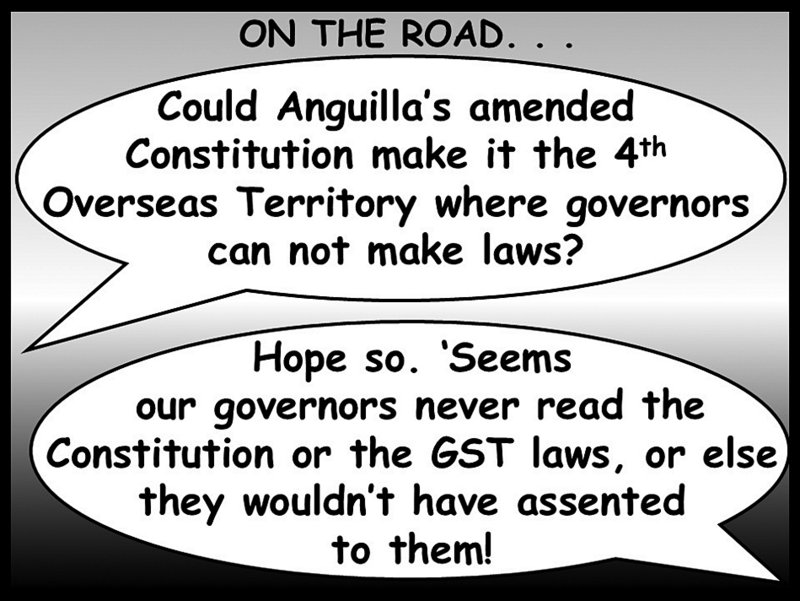
Notably, the “UK retains the right to make law for all the Territories” – yet three such constitutions do not allow the Governor to make laws.[6] Will our amended Constitution will be the fourth? And will this Government put the People First by sharing AI revenue for more relief and restore the People’s rights by repealing that outside child of a fraught, repugnant law?
Repeal General Services Tax – and pass a balanced budget bill. Now.
This article reflects issues raised on July 5, 2021, at the House Select Committee on GST Public Hearing.
[1] The Anguilla Constitution Order 1982; [2] The Anguilla Constitution (Amendment) Order 1990; [3] Anguilla Constitution (Amendment) Order 2020; [4] Goods and Services Tax Act, 2021; [5] General Services Tax Act, 2025; [6] https://commonslibrary.parliament.uk/research-briefings/cbp-9583/