


By Kisean Joseph
A community environmental initiative that began at a landfill during the COVID-19 pandemic has evolved into a skills-training and sustainable-livelihood program and is now taking root in the Fitches Creek community.
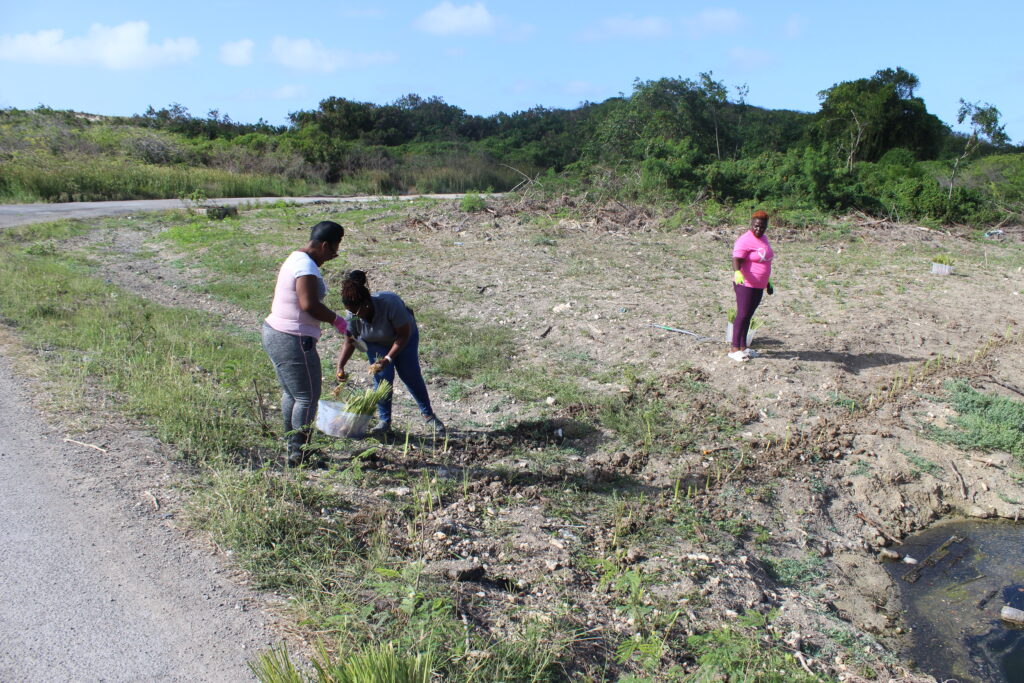
The Gard Center, in collaboration with the Fitches Creek community, is leading a new phase of the initiative focused on Vetiver grass — a plant that was once common in Antigua before becoming extinct.
The Center’s Director, June Jackson, said the project began around 2020 as part of a collaboration with the Inter-American Institute for Cooperation on Agriculture (IICA). Vetiver — brought in from Dominica — was first planted along hedgerows at the Cooks Landfill to create a barrier that would prevent leachate from reaching the nearby mango swamp, thereby protecting the livelihoods of those who depend on it.
“This project that is happening here started … during COVID, with a collaboration between IICA,” Jackson said. “We were doing this eco-friendly EBA adaptation initiative.”

Out of that pilot project grew a green business, with participants learning to produce soaps, body mist, infused sauces, and other products from the plant’s roots, which carry a distinctive natural fragrance and have applications in skincare, including facial powder and exfoliant.
The initiative has since secured funding from the Caribbean Catastrophe Risk Insurance Facility to expand community outreach and training. Jackson says that support has allowed the project to work with women in handicrafts, farmers interested in soil stabilization, and now — for the first time — teachers.
“We are now here doing with a group of teachers what we call training the trainers,” she said. “These teachers now are going to be going back into the schools and actually opening up an opportunity for the students to see what can be done with a form of agriculture, a form of environmentally friendly biodiversity conservation.”
Jackson noted that the Vetiver plant’s roots can grow to depths of 30 feet, making it highly effective for soil stabilization — a benefit for farmers as well as environmental conservation. The leaves, which grow tall, can be used in handicrafts, while the roots serve as the basis for a range of value-added products.
The Fitches Creek community represents the project’s latest pilot site, with plans to establish a hedgerow around a local pond. Jackson says the aim is to demonstrate the plant’s value to residents, visibly.
She pointed to a recent exhibition where participants showcased products developed from Vetiver, with one entrant creating a full spa-themed product line using the plant — earning first place in the competition.
Jackson is encouraging residents to support the initiative. Members of the public are urged to visit to the organization’s website, www.gardc.org, for more information.