


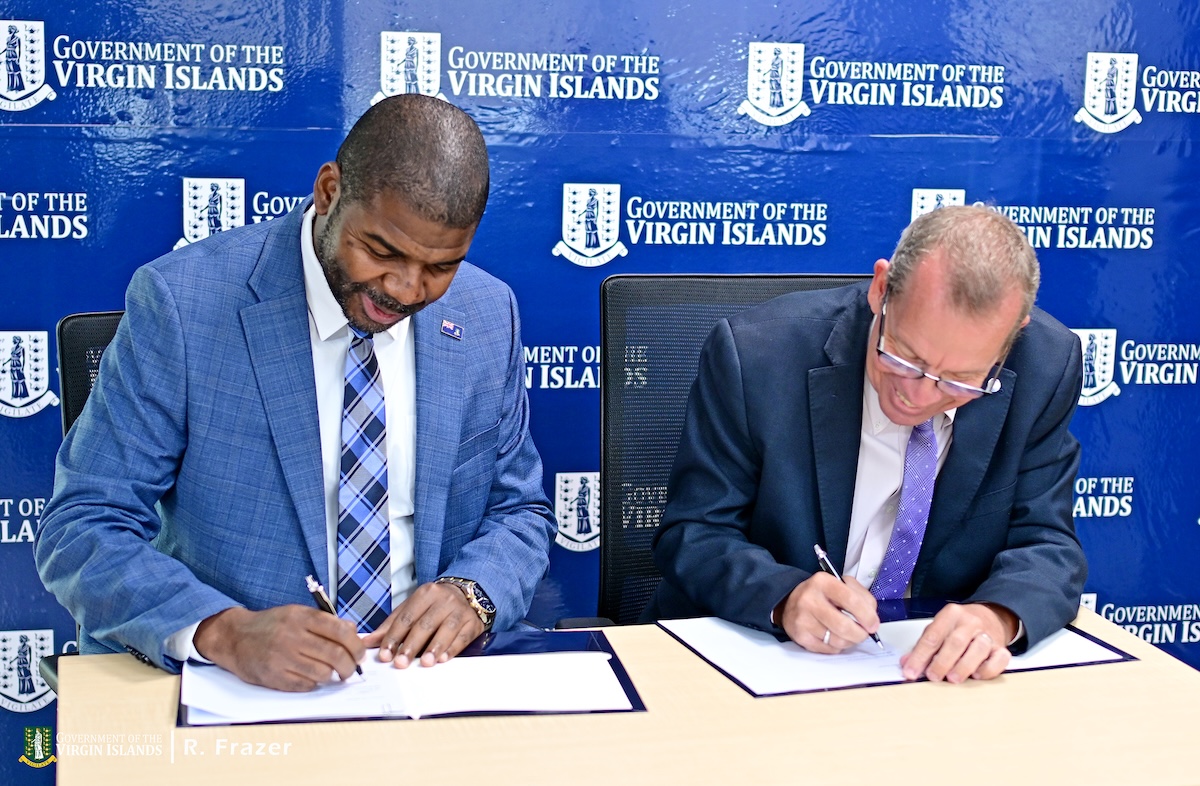
Government and United Nations officials met last week to hammer out the next phase of their sustainable-development partnership, with leaders saying the latest talks are meant to ensure a 2026 implementation plan signed Tuesday reflects the Virgin Islands’ own priorities rather than a one-size-fits-all regional agenda.
The high-level dialogue was held Tuesday during the second day of a two-day Sustainable Development Forum.
The same day, Premier Natalio “Sowande” Wheatley and UN Resident Coordinator for Barbados and the Eastern Caribbean Simon Springett signed the territory’s 2026 Country Implementation Plan — the latest agreement detailing how the UN will provide technical assistance toward achieving targets under the UN’s Sustainable Development Goals for 2030.
The SDGs — which all UN member states adopted in 2015 — include eliminating hunger and poverty, reducing inequality, and ensuring access to health care, quality education, clean water, and reasonable employment, among others.
High-level talks
The discussions this week brought together senior public officers, UN representatives and members of the VI National Sustainable Development Coordinating Committee at a time when the territory continues to face climate risks, external shocks and socioeconomic disparities despite its high-income status, according to government.
Mr. Wheatley said the talks were intended in part to align the 2026 Country Implementation Plan with the work of ministries and departments as government continues rolling out the National Sustainable Development Plan Vision 2036, which was launched in 2023.
That broader push has been years in the making.
The territory’s first Country Implementation Plan was signed with the UN in August 2021, and Mr. Wheatley said Tuesday that the VI-UN partnership has also “strengthened considerably” since 2022, when the territory began engaging “more systematically” with the UN through the Multi-Country Sustainable Development Cooperation Framework for the Caribbean.
“Today’s high-level dialogue provides an important opportunity for us to review our collaboration under the [multi-country framework], to reflect on the progress that has been made over the past several years, and to shape the priorities that will guide our engagement in the next cycle of cooperation,” Mr. Wheatley said during his opening remarks on Tuesday.
Joseph Smith-Abbott, the permanent secretary in the Ministry of Tourism, Culture and Sustainable Development, explained that the Country Implementation Plan is designed to translate the broader multi-country framework into a set of coordinated, country-specific activities and outputs.
‘Proud to partner’
Mr. Springett also spoke during the Tuesday event, according to government.
“The United Nations are proud to partner with you,” he said, adding, “The world continues to face many interconnected challenges, and only by working together across politics and geography can we together ensure economic and social progress.”
He added that the new implementation plan will guide the UN’s cooperation with the territory throughout this year.
“It will also provide a foundation for the new Caribbean Cooperation Framework that the United Nations is developing with your government and many other [Caribbean Community] member states,” he said. “I look forward to this constructive dialogue.”
Financing constraints
The meeting comes as the VI and other eastern Caribbean overseas territories continue pressing for better access to development finance — a longstanding sore point in regional and local discussions about climate resilience and sustainable development.
Overseas territories often face obstacles in qualifying for international climate support despite their vulnerability, and the government said this week that the UN-VI forum builds on ongoing work to tackle such financing constraints through a regional roadmap running from 2025 to 2027.
The Country Implementation Plan has not been released to the public, and the government did not immediately respond to a request for it yesterday.