


–President Ali says, highlights massive investments, wide-ranging strategy to modernise local defence capabilities
–announces plan to establish dedicated technology, AI branch to boost defence operations
SIGNALLING a decisive shift from maintenance to full-scale transformation, investments in the Guyana Defence Force (GDF) has accelerated dramatically over the past five years, with capital investment rising tenfold, Commander-in-Chief of the Armed Forces, President Dr. Irfaan Ali said on Thursday.
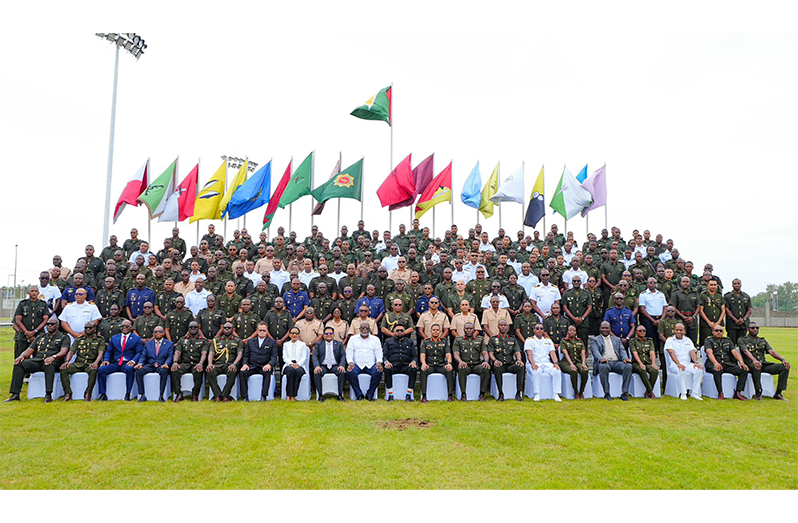
Speaking at this year’s GDF Annual Officers’ Conference being held under the theme: ‘Transforming the Force to better confront the nation’s present and future challenges by enhancing its awareness, adaptability and agility capabilities,’ President Ali said the government in recent years has embarked on a deliberate and sustained process of modernising the local military.
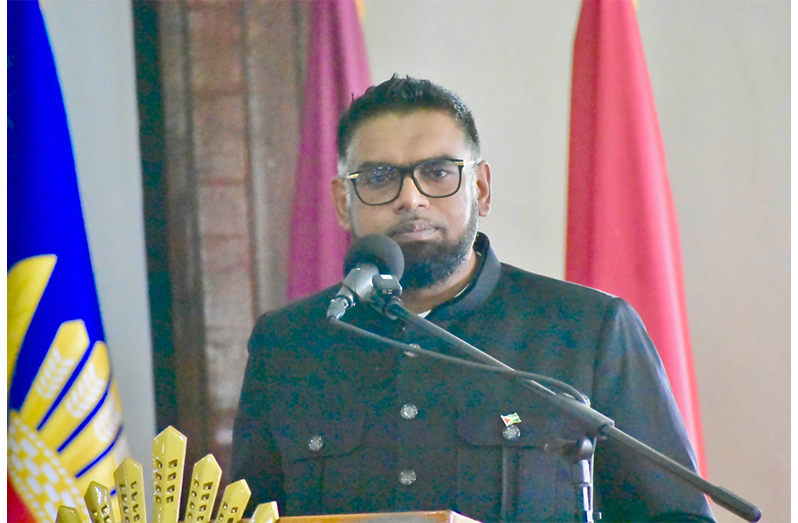
“This is reflected clearly and unmistakable in the resources committed to the Guyana Defence Force on both the capital and recurrent size of the budget,” he said noting that in 2019, the GDF’s actual total expenditure stood at approximately $13.9 billion made up overwhelmingly of recurrent expenditure.
He noted that there was very little capital expenditure with current expenditure standing at $12.8 billion out of the $13.9 billion, which left $1 billion for capital expenditure to cover modernisation, restructuring and retooling efforts.
“At a time when we face immense threats…In structural terms, the force in 2019 was largely being maintained rather than transformed. Capital outlays were modest, signalling limited investment in new assets, infrastructure, or upgrades,” he said, adding that by 2025, the picture had changed dramatically.
“Actually, total expenditure rose approximately $36.2 billion, more than two and a half times the 2019 level. Recurrent expenditure showed a correlation with capital expenditure. The current expenditure was focused on the growth of personal costs, operations training, and expanded responsibility,” he said.
Most notable and striking was a shift in capital spending in 2025 with total capital expenditure reaching roughly $10.35 billion representing a tenfold increase from 2019.
This according to the President contrasts and highlights a decisive policy shift.
“While recurrent spending continued to grow in line with a larger and more active force, capital expenditure moved from the margins to become a central feature of defence spending. The expansion of GDF expenditure from 2020 onward has been progressive and strategic.”
Total actual expenditure increased from about $15.9 billion in 2020 to $16 billion in 2021, and $23 billion in 2022, total actual spending rose sharply to $42.1 billion, driven primarily by an unprecedented surge in capital investment of $20.1 billion.
“Although total expenditure moderated in 2025, it remained well above historical levels. The average annual growth rate of actual GDF expenditure from 2020 to 2025, is approximately closer to 19 per cent per annum,” he explained.
These investments, he said indicates that increase in spending was not a one-off spike, but a sustained and compounding expansion over several years.
“It tells a story of a plan being implemented…in 2026 capital expenditures projected at $15 billion. And we expect that, because it’s a bell we’ve been acquiring, acquiring, acquiring, then you sustain, sustain, sustain, because you meet that threshold of optimisation until the phase of redevelopment and recapitalising come back. It’s a model.”
He added: “Today, we are better off than we were yesterday, and we have positioned ourselves to be the best of tomorrow.”
CAPACITY, PARTNERSHIP AND ECOLOGY
Meanwhile, to further advance the GDF beyond traditional military functions and align it more closely with Guyana’s economic growth, environmental stewardship and evolving security threats, the President outlined a comprehensive strategy aimed at supporting a holistic transformation.
At the core of the strategy is a direct link between people, capability and capacity. The President explained that a 15- to 20-year gap analysis will be conducted to identify the skills and resources the force will require in the future, ensuring that recruitment, training, and development are deliberately structured to build those capabilities over time.
“Where do we want our people to position? Is our Coast Guard appropriately positioned or headquartered in this modern era of defence and what is needed in the future? These are the questions we must confront now and adapt to what is necessary in a new environment,” he said.
Partnership, priority, policy, and positioning form another pillar of the approach, with the government seeking to use strategic partnerships to guide investment decisions and operational planning. President Ali said assets such as the Coast Guard, infrastructure and specialised units will be aligned with national policies and emerging challenges, allowing the GDF to adapt more effectively to Guyana’s changing security environment.
The framework also places strong emphasis on protecting the economy, ecology, energy sector, and environment. According to the President, the GDF must be capable of safeguarding critical infrastructure including oil and gas operations, telecommunications networks, and subsea cables, while ensuring defence planning complements Guyana’s global leadership in biodiversity conservation and environmental protection.
READINESS, TECHNOLOGY AND LEADERSHIP
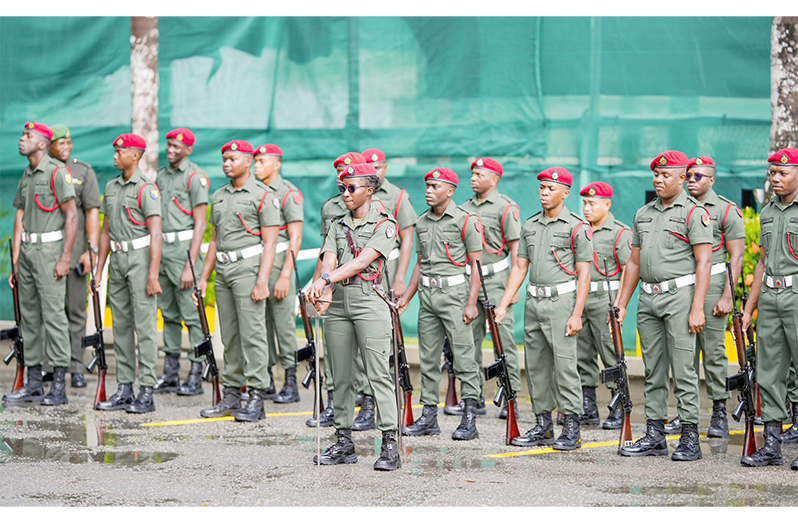
Responsibility, reliability, and readiness were highlighted as essential to building a force that understands its mission and can be depended upon to defend democracy, the rule of law and national sovereignty.
President Ali said this includes strengthening the GDF’s role in combating transnational crime and ensuring that accountability and professionalism are embedded at every level of the organisation.
Recognising the changing security threats, the President announced plans to adapt the force to new operational domains, including artificial intelligence and modern technologies.
A dedicated technology and Artificial Intelligent (AI) branch is to be established with direct command authority, focused on continuous learning, innovation, and the integration of advanced systems into defence operations.
He added that the defence of democracy and the practice of diplomacy must now be closely linked to infrastructure protection and emerging security risks.
“We have to develop our in-house AI and train our in-house AI with the right data, with the right information to be the right tool for our defence system. We can’t tiptoe around this issue,” he said.
President Ali said programmes aimed at strengthening patriotism and national responsibility among young people will be expanded, including Friday afternoon civic and physical education initiatives and structured youth engagement programmes designed to instil discipline, service and civic pride.
GREATER INTEGRATION, TRAINING
Integration, intelligence, and interoperability are to become central to national security planning.
The President outlined plans to deepen coordination across the GDF, the Guyana Police Force, the Fire Service, and the Prison Service, ensuring that intelligence sharing, joint operations and interconnected systems allow for faster, more effective responses to threats.
He further acknowledged that training and orientation methods within the force have remained largely unchanged for decades, despite rapid global transformation.
As part of the new strategy, recruitment orientation and operational structures will be modernised to reflect present and future security realities, ensuring officers and ranks are prepared for contemporary challenges.
President Ali said too that specialised skills such as officers trained in environmental science, biology and technology will be strategically positioned to support both national security objectives and Guyana’s international environmental commitments.