


Date: Tuesday, 1 April 2025
Candidates
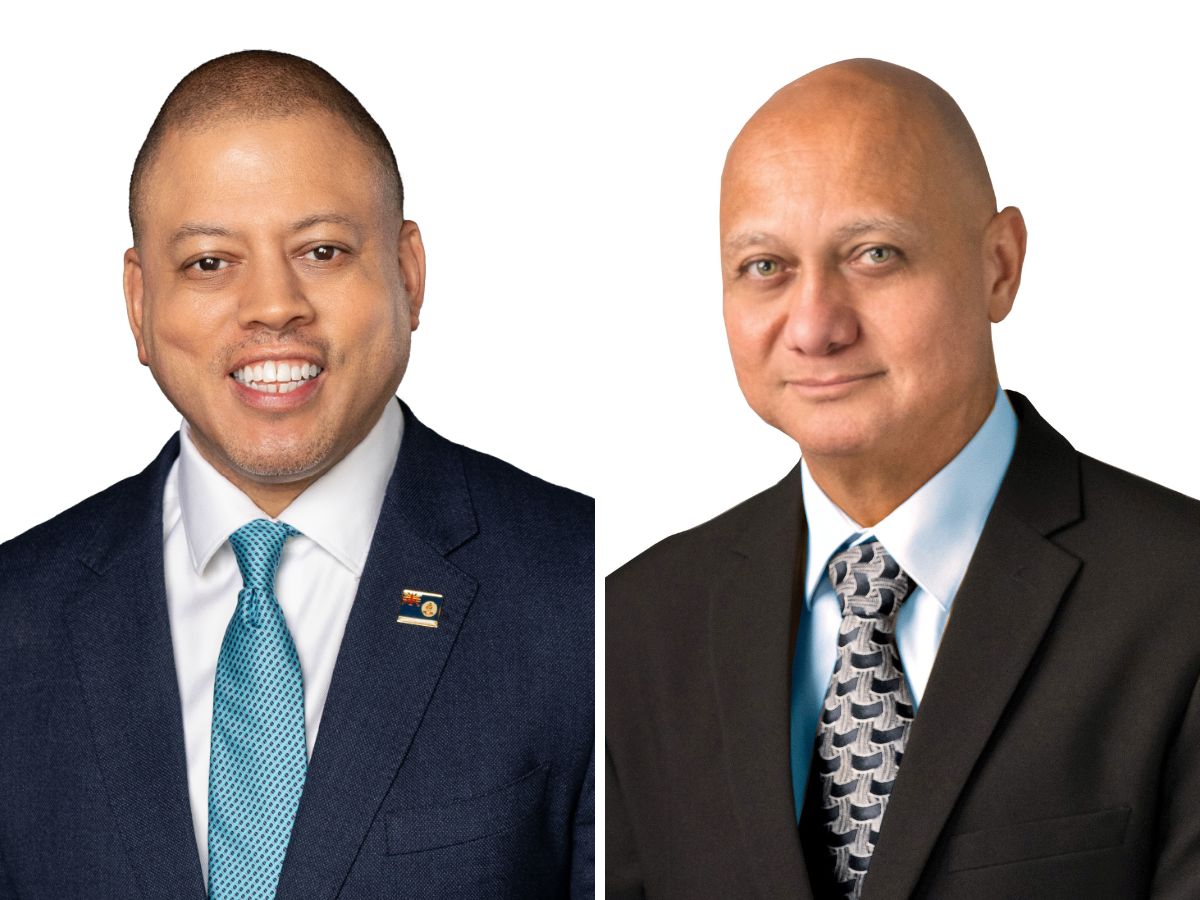
- André Ebanks* (TCCP)
- Sterling Dwayne Ebanks (IND)
*incumbent
The forum
The 14th forum in the Cayman Islands Chamber of Commerce’s candidates’ series took place on Tuesday night, spotlighting the West Bay South constituency, for which there are only two candidates vying to represent what, as of today, is the second largest constituency with 1,772 registered voters (Bodden Town West has two more at 1,774).
Incumbent André Ebanks, the former deputy premier who resigned from government in October last year, along with three other MPs, is part of newly formed The Caymanian Community Party. Independent challenger Sterling Dwayne Ebanks is the long-time host of Radio Cayman’s ‘Talk Today’ show.
Key Issues
What are the top three national issues you would prioritise if elected, and why?
André Ebanks said his top three priorities would be “cost of living, access to housing and — all wrapped into one because they’re connected — education [and] workforce development, for which immigration reform forms a part of”.
He added that those issues are to be “solved as a means to an end”, explaining that the goal was to narrow the socioeconomic divide in Cayman.
“We need to have a country that gets back to a community where all Caymanians are participating in and/or benefiting from the success of the country,” he said, stressing the need to create “a modern and inclusive Cayman”.
He said Caymanians of all income levels should have access to housing, alongside a “ready- to-work force, with proper immigration reform”.
He suggested reducing the cost of living “by manipulating our tax code, which is the stamp duty, off goods that are healthy for you, and then increase it on junk food”.
Sterling Ebanks named education, quality of life and the landfill as the most pressing concerns, saying the “dump [is] the most immediate issue that needs to be addressed”, adding “we need to immediately suspend all operations at the dump and find a suitable facility”, and suggested looking east for a solution.
“There must be properties up there that we can identify as a new facility for the dump,” he said, calling for a modern waste management facility owned and managed by the government. “It doesn’t matter who builds it, but we need to understand the cost.”
As for education, he said there were many things that could be done “but it all encompasses … quality of life, from housing to healthcare, from the cost of living to employment, the opportunities for entrepreneurship”.
What can be done to make healthcare more affordable for residents, including retirees, particularly in light of the rising cost of insurance?
Noting Cayman’s ageing population, Sterling Ebanks said, “We need to find a way to ensure there’s free healthcare, not just to the elderly, but perhaps to our very young.”
Regarding the cost of healthcare, he said, “If our elderly in their retirement has less and less money to pay for everyday life, and now has to find more money to pay for that increased healthcare cost, what are we telling people? You work all your life for nothing at the end of the day?”
Adding that many people look at health insurance as something that can only be afforded if you have the money, he said, “It needs to be accessible” and that government could contribute to that as “a public good”.
André Ebanks said people need to think about the purpose of health insurance, which is “to ensure that you as an individual do not become medically bankrupt”.
Calling healthcare a human right, he said the ultimate goal is “to ensure that there’s universal access to healthcare”.
He called for the Cayman Islands National Insurance Company to be “realigned” and to look at the rising cost for indigent coverage, “because that is a cost driver”.
He pointed to a proposal to amend the Health Insurance Act that was “left on the table” when he resigned from the government, to include a definition of “medically indigent” and investigate how to bring down costs.
Noting that there is “very little financial reporting data” from private healthcare providers, he said, “I know the country is tired of reports, but this is one instance where you do need data to understand why the premiums are so high, to then be able to investigate how you can bring them down and have funding models that could cover categories such as children and older persons in the future.”
What is your vision for Barkers? Would you protect Barkers as a natural park or develop it as part of our tourism offering?
Calling Barkers a “political football that needs to be resolved”, André Ebanks said there was a way to do both. “Anyone in the public right now can look at the lands registry, you will see that the area of Barkers is a hodgepodge of land ownership, some government, some private.”
He said there needs to be an agreement to preserve the area fully, and then assess the value of the property, “and see where you can align the pieces of land together to create, one, a national park and two, an area that can be utilised for a public tourism offering”.
He added that Seven Mile Beach comprises most of the tourism offering, “which is not working at all”.
“We need to be able to expand our tourism product and then also have a national park, because the ecological value of Barkers is something that Cayman should be deeply proud of and protect, and we can no longer afford for this to be an issue that continues on into the next administration,” he said, calling for “innovative, creative solutions, negotiations with property owners to be able to align the vision and get the job done”.
Sterling Ebanks pointed out that Barkers is not only enjoyed by West Bayers, but by people from every district, and proposed the drafting of national parks legislation “to ensure that its management, use and entry” are protected and “enjoyed in perpetuity”.
Referring to Barkers as a place “where many families would go quietly”, he said it has now become almost public, “but its use and abuse is almost passively encouraged by some because it’s out of sight and out of mind”.
He said his proposed legislation would ensure that “Barkers is enjoyed in its entirety, [and] as much as possible, retained in its present state. Whatever development that private land owners may have, we are convinced, with proper negotiation and discussion, we can incentivise them to utilise the land, not just in an environmentally or ecologically sensible way, but give them a return.”
Notable exchange
The candidates were asked about immigration policy and how to balance reform with the labour needs of businesses that can’t find qualified Caymanians.
André Ebanks started by saying, “I believe that every well-intended person can say that the immigration system right now isn’t working for anyone,” noting that there was not a way for Caymanians to challenge a work permit that should not have been issued.
But he also noted that for employers, the process takes a long time. He said a programme should be developed where Caymanians have greater protections, but at the same time, incentivise firms to bring back jobs that are overseas “to plant those jobs here in Cayman so the Caymanian who is ready can take that job”.
He also suggested realigning the permanent residency point system “so instead of just purchasing land to get PR, increase the fees that you can have for PR for independent means, and tuck that into a social development fund” which could be used for additional training for Caymanians to get them ready for the jobs being held by work-permit holders.
In addition, he called for the rollover policy to apply to the civil service on a phased basis.
Sterling Ebanks said that moratoriums and quotas, which many call for, tend to be arbitrary and “change with the changing political cycle”.
He proposed a national jobs programme for ages 16-26, “from that high school student who is on the eve of graduation to the returning college grad”.
Noting that technical vocation training can be disrespected, he said every job is valuable.
Referring to work-permit holders who “graduate” to permanent residency or status, he said it has to be “merit based as a team of partners with government, as it has in the past. Under our administration, we’ll invite that participation. We welcome it, but the partnership has to extend initially and immediately to every single school child who’s entering the education system to develop them.”
Standout moment
When asked about reducing waste and improving efficiency in government spending, André Ebanks suggested a move toward outcome-based budgeting.
“What happens now is that the pie is the pie. Everybody chucks in their requests into caucus, are used to their historical slices, and that’s how the pie is divided up. And you don’t really get a chance to drill down to see what’s being spent,” he said.
Outcome-based budgeting can show “where can we make money … and that’s where the budget should be applied”.
Sterling Ebanks called for a “rethink of governance”, adding, “we need to look at attaining more efficiencies, be more agile”.
“Parliamentarians seem to believe there’s a licence to spend the money, because there’s a printing press somewhere. That’s going to cost us now in terms of what we got to pay for it. But more importantly, you are going to hamstring our children’s ability for education, for healthcare, for infrastructure.”
The next forum will be held on Wednesday, 2 April at 7:15pm with George Town North candidates Joey Hew and Romellia Welcome.