


In today’s fast-moving digital world, false stories can gain traction quickly. This is especially true during sensitive moments such as elections, emergencies, and transitions in government.
While the term ‘misinformation’ may seem like a modern buzzword, it reflects a real and growing concern in the Cayman Islands and across the Caribbean.
Misinformation refers to false or inaccurate information shared without the intent to deceive. Even well-meaning individuals can unknowingly spread content that fuels rumours, confusion, or misinformed decisions.
In close-knit communities like ours, where word-of-mouth remains powerful, false information can travel quickly when shared without verification.
Social media is a primary news source for many Caymanians, and high WhatsApp usage across the islands means unverified claims can easily circulate in private groups. With our devices constantly delivering news and updates, it’s easy to engage with fake news without pausing to check the facts.
The risk has grown with the rise of widely accessible AI tools, which allow anyone to create realistic images, videos or stories that appear credible. This makes it even more important to question what we see and share.
A lack of regulation and accountability locally also make it easy for false content to spread unchecked, often appearing on platforms and pages that mimic trusted sources. In some cases, false news is knowingly shared to manipulate public opinion.
Over the past few years, the Cayman Islands has seen a steady rise in misinformation, particularly across digital platforms and private messaging channels.
A recurring example involves phishing scams that use fabricated news stories featuring real images of elected officials, often appearing to make official statements or give media interviews.
These scams are published on fake websites that mimic the design of trusted local news outlets. The stories typically link to suspicious investment schemes or limited-time offers, aiming to steal personal or financial information.
The spread of these deceptive tactics can have serious consequences.
They can damage the reputations of public figures and institutions, mislead the public, and put individuals at risk of financial loss or privacy breaches. Over time, this erodes public trust and weakens confidence in legitimate sources of information.
These risks can be especially heightened after elections, when rumours and speculation can spread quickly.
This may include false claims about who will form the next government, changes in ministries, or statements falsely attributed to public officials.
When shared widely, this type of content can create confusion, fuel mistrust, and make it harder for the public to access accurate information during a period of transition.
Taking action on misinformation
To address the growing spread of false information in the Cayman Islands, CIG has launched a new Misinformation Campaign. The initiative promotes digital literacy and encourages the public to take personal responsibility in identifying fake content, verifying it with trusted sources, and sharing only what is accurate to support a better-informed community.
As part of the campaign, CIG has also published recent government-related misinformation cases for which it has issued official alerts. Learn more at https://www.gov.ky/misinformation/alerts.
Why false information spreads
Several factors contribute to the spread of misleading content:
- Viral social sharing: Emotionally charged or sensational content often spreads quickly, even when the information is false.
- Echo chambers and confirmation bias: People tend to engage with content that aligns with their views, creating information bubbles where inaccuracies go unchallenged.
- Manipulated media: Deepfakes, edited visuals, and misleading captions can deceive even cautious readers.
- Scams masquerading as news: Some fabricated stories are designed to manipulate the public, whether for political gain or financial fraud.
The impact of misinformation locally
Misinformation can have real-world consequences, as seen in recent local incidents.
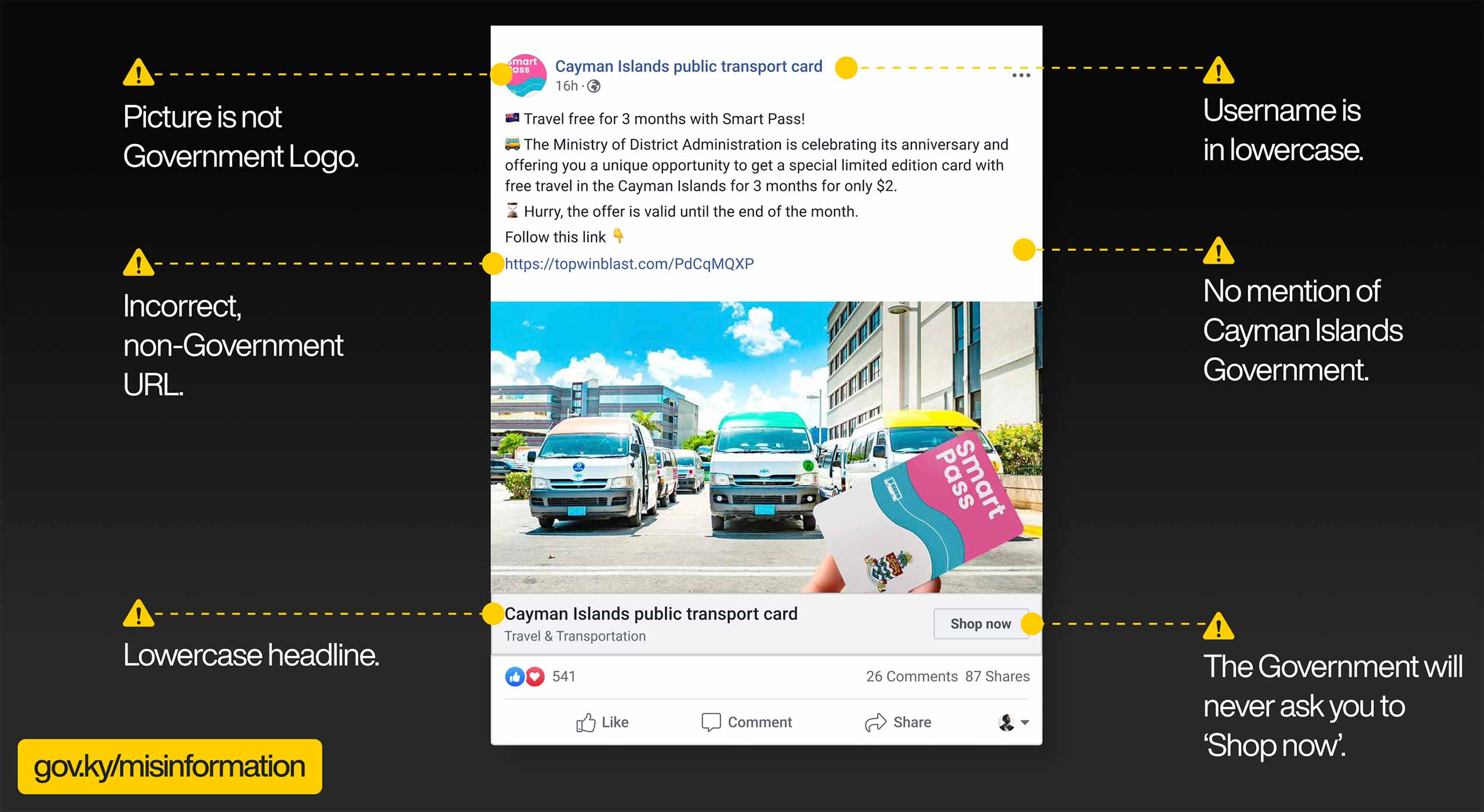
One example involved a fabricated social media ad falsely claiming the launch of a ‘Smart pass’ from the Public Transport Unit. The post included a suspicious link advertising a limited-edition card offering three months of public transport for $2. This was, in fact, a phishing scam designed to steal personal information and compromise users’ cybersecurity.
Another case surfaced at the start of the 2024 hurricane season, when digitally altered images of severe flooding were widely circulated on social media. Hazard Management Cayman Islands quickly confirmed the visuals were fake, but their spread risked causing public alarm and could have misdirected emergency resources.
How you can help promote accuracy
Here are some practical steps to take before sharing information online:
- Pause before you share: Just because something is trending doesn’t mean it’s true. False stories often spread because they’re emotional, alarming or sensational. Take a moment to think about the intent of the content, its source, and whether it’s something that should be shared at all.
- Verify the information: Before sharing anything, check that it comes from a reputable source. Look for evidence, official statements, or confirmation by trusted sources or media outlets. Use the CIG Misinformation Alerts page to check if a claim involving government has been flagged as false. For international content, visit fact-checking sites like Snopes or FactCheck.org.
- Report suspicious activity: The public plays a key role in protecting the community from scams and disinformation. Report suspicious content or scams to the Royal Cayman Islands Police Service (RCIPS) and the Financial Crime Investigation Unit at [email protected], particularly if you have been affected.
- Stay safe online: Visit ky/cybersafe for tips on recognising phishing attempts and improving your online safety habits.
A shared responsibility
While individuals play a vital role in how information spreads, institutions also have a responsibility to lead by example. Government agencies, media outlets, and community organisations can support a more informed public by providing timely, transparent updates and addressing false claims as they arise. This is especially important during elections, emergencies, and major policy developments.
The circulation of inaccurate information is a growing challenge in the Cayman Islands, but it is one we can face together. By staying alert, thinking critically, and pausing before sharing, we all contribute to a safer and more informed community. Choosing to verify or report suspicious content is an act of responsible citizenship.
By fostering a culture rooted in truth, trust and awareness, we can help protect our society from the harms of false information.
Visit gov.ky/misinformation to learn more and access tools to help you recognise and respond to false information.