


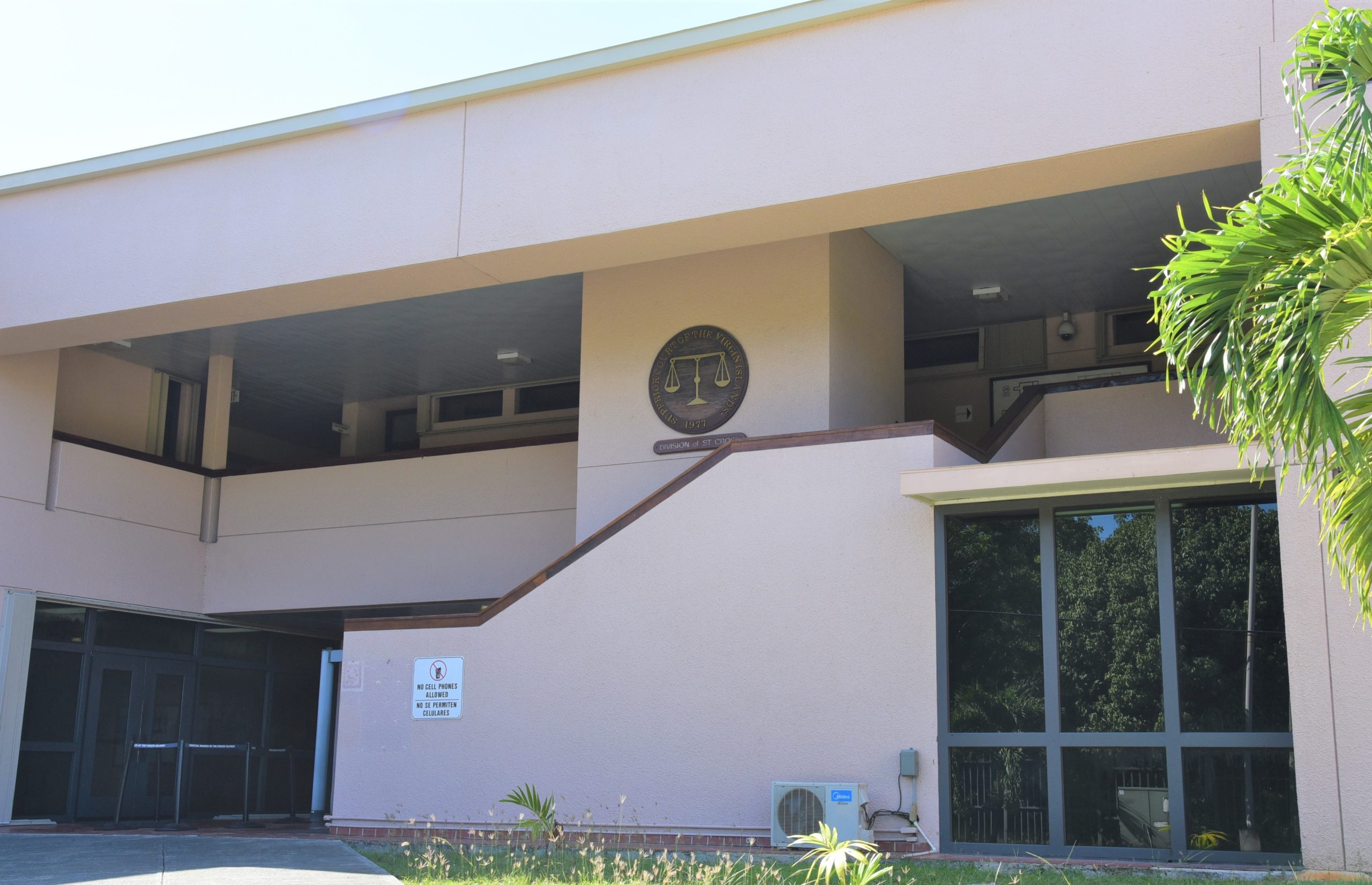
A Virgin Islands judge Tuesday said she lacked the authority to mandate involuntary medical and behavioral health treatment for 18-year-old Kyjauni Joseph, who was already found incompetent to stand trial in a separate matter two months ago.
According to documents filed in V.I. Superior Court, St. Croix district, Joseph has been diagnosed with developmental delay, autism spectrum disorder, and catatonia due to a traumatic brain injury and has been in a catatonic state since his arrest for carrying a firearm last month. Magistrate Judge Yolan Brow Ross told Assistant Attorney General Chad Mitchell and Assistant Territorial Public Defender Leslie Davis that she was very concerned about Joseph’s health but couldn’t violate the law to care for him.
The Justice Department asked the court to approve involuntary treatment or medication last week after Brow Ross ordered the V.I. Corrections Bureau to transport Joseph to Schneider Regional Medical Center for neurological, medical, psychiatric and psychological evaluations in mid-April. On Tuesday, Mitchell noted the urgency of the motion, saying at one point that Joseph was not eating or drinking, and argued that the Behavioral Health Act authorized the court to determine whether involuntary treatment was necessary after committing a person to the custody of the Health Department for hospitalization.
“There’s the problem: I did not,” Brow Ross said, clarifying that she only ordered Joseph moved to SRMC. “I did not commit him.”

Joseph was arrested on April 9 after a Lorraine Village woman called 911 to report “that a mentally ill male was sitting on the couch outside of her apartment and that he was refusing to move, and she was afraid to leave her home,” according to an arrest report filed in V.I. Superior Court, St. Croix district. That call came one day after Joseph’s father called 911 to report that Joseph pulled a gun on him during an argument before running off. When police arrived to question Joseph, they noticed a Glock 9mm handgun loaded with seven rounds of live ammunition in the spot where he’d been sitting.
Police then took Joseph to Juan F. Luis Hospital for treatment.
“It appears, however, the hospital refused to admit the Defendant, claiming treatment was unnecessary and recommending instead the Defendant be incarcerated,” Brow Ross wrote after an advice of rights hearing on April 10.
A spokesperson for JFL did not respond to questions sent by the Source Tuesday, but according to an April 11 court order, the hospital “averred to investigate and correct its noncompliance” with V.I. Code title 19, section 1023, part of which states:
“When a law enforcement officer or crisis intervention personnel has probable cause to believe that a person may be suffering from behavioral health challenge, mental health disorder, or substance use disorder and that due to that condition the person presents a threat of harm to himself or herself, other persons or property, the law enforcement officer or crisis intervention personnel shall take the person into protective custody immediately and deliver the person immediately for examination by a medical practitioner to a hospital or appropriate behavioral health treatment facility.”
“Despite telephonic communication with the Department of Justice regarding the need for a mental health intervention, hospital staff determined that nothing was wrong with him psychologically and that the hospital would not admit him,” Police Officer Ivory Carter wrote in the April 9 arrest report.
Soon after Joseph’s incarceration, the V.I. Bureau of Corrections told the court that it was unable to provide Joseph with the care he needed and recommended that he be moved to Schneider. The V.I. Health Department began searching for an appropriate long-term care facility for Joseph shortly after he was arrested, according to court documents.
Law enforcement and the Justice Department and the court were familiar with Joseph’s circumstances because two weeks earlier, on March 26, the court granted the prosecutor’s motion to dismiss a separate third-degree assault charge against Joseph after a psychological and psychiatric evaluation found him incompetent to stand trial. Mitchell wrote in the motion that the territory instead decided to file a guardianship case in family court because of Joseph’s diagnoses.
On Tuesday, Brow Ross suggested that an involuntary commitment action could be pursued through the guardianship case and ordered the Justice Department to update the court on the matter within the next few days. The case, she said at one point, highlighted that there are certain cases that should never be brought in criminal court.
The territory has long lacked sufficient behavioral health infrastructure, despite two states of emergency declared by two governors and two substantial pieces of legislation mandating the expansion of mental health services. The Behavioral Health Act, which Gov. Albert Bryan Jr. signed into law in January 2023, calls for the establishment of “the first comprehensive public Behavioral Health Facility to treat individuals voluntarily and involuntarily who face behavioral health challenges.”
The government has been eying the shuttered Sea View Nursing Home and Rehabilitation Facility on St. Thomas as a possible home for a long-term care facility for several years, and the 35th Legislature earmarked $4.2 million in Jeffrey Epstein-related settlement funds for Sea View in September. It’s not clear how many of those initial carveouts remain in place since the 36th Legislature voted last month to redirect settlement funds to cover retroactive wages and vendor payments and to shore up the territory’s struggling hospitals.
Last week, Bryan told the Source that the government is still assessing the facility, which closed in 2020.
“We are about to purchase Sea View, where we have money set aside,” he said. “We’re looking at an engineering report to see exactly what exactly that’s going to take before we purchase it, because we don’t want another rotting facility on the government’s hands.”
In the meantime, Virgin Islanders who are caught up in the justice system and in need of specialized care continue to be housed in expensive stateside facilities.
Health Commissioner Justa Encarnacion told the Source Tuesday that the cost of placing someone in those facilities, which include service providers in California, Florida and Puerto Rico, ranges from $250 to $1,000 per day, depending on their needs. The higher cost, she said, “would more lean on those that are needing ‘forensic care,’” such as people who have been found not guilty by reason of insanity.
Encarnacion said the total cost of housing people abroad has been increasing annually.
“So let’s say in 2022 it was like $9 million, close to $10 million. Then, of course, it went up,” she said. “So now it’s actually close to $14 million per year as a result of everything I just spoke about.”
The rising costs underscored the need for local options, Encarnacion said, like a portion of the V.I. Corrections Bureau dedicated to treating mentally unwell incarcerated people.
“It wouldn’t be that we would be placing individuals in BOC. It would mean that we would be negotiating a portion of BOC, separating it completely from BOC,” she said. “But they have the space that would allow us to offer forensic medicine outside of BOC.”
