


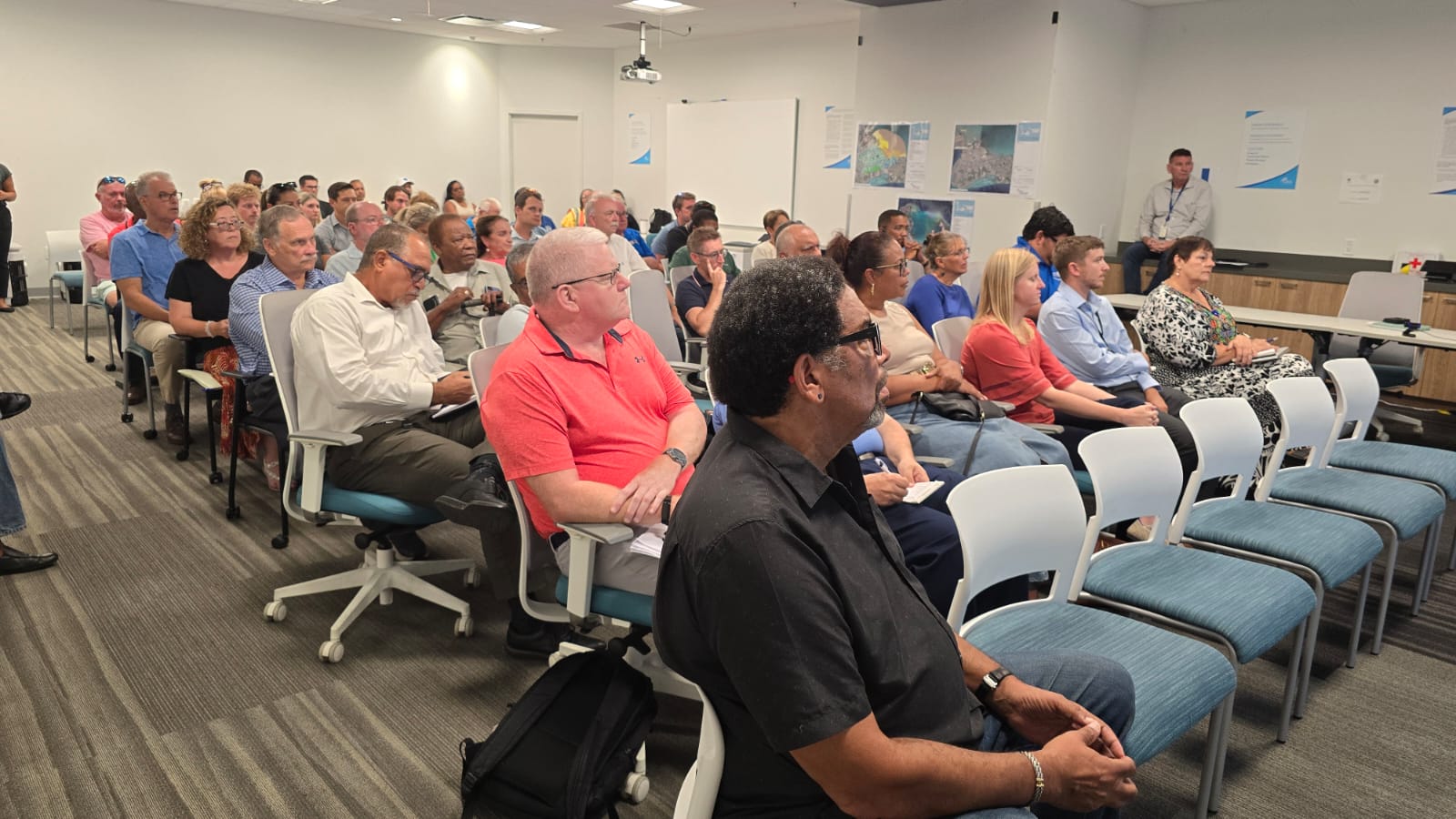
A public meeting about a proposal to extend the runway of Grand Cayman’s Owen Roberts International Airport addressed questions and concerns surrounding the $28 million project.
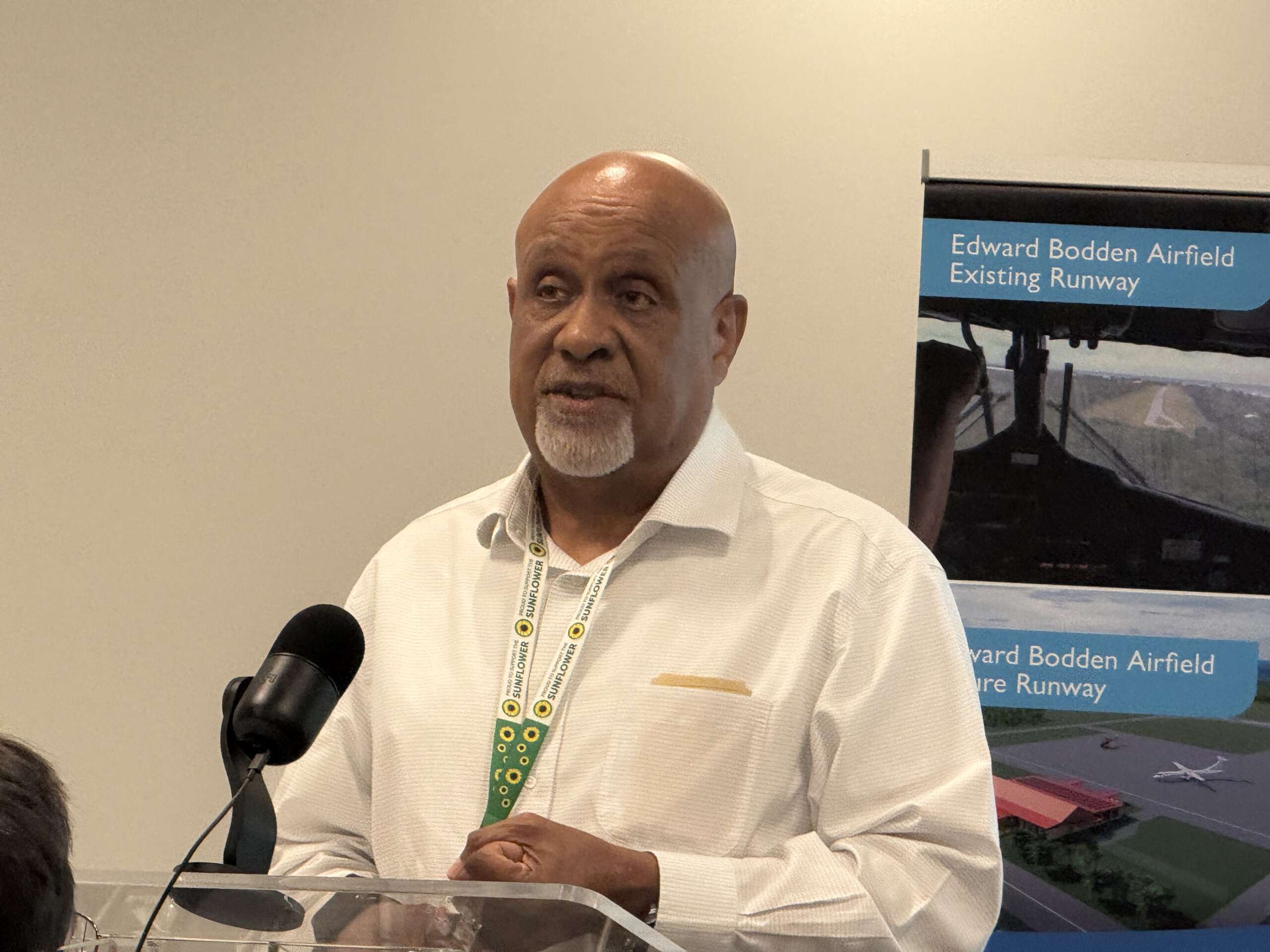
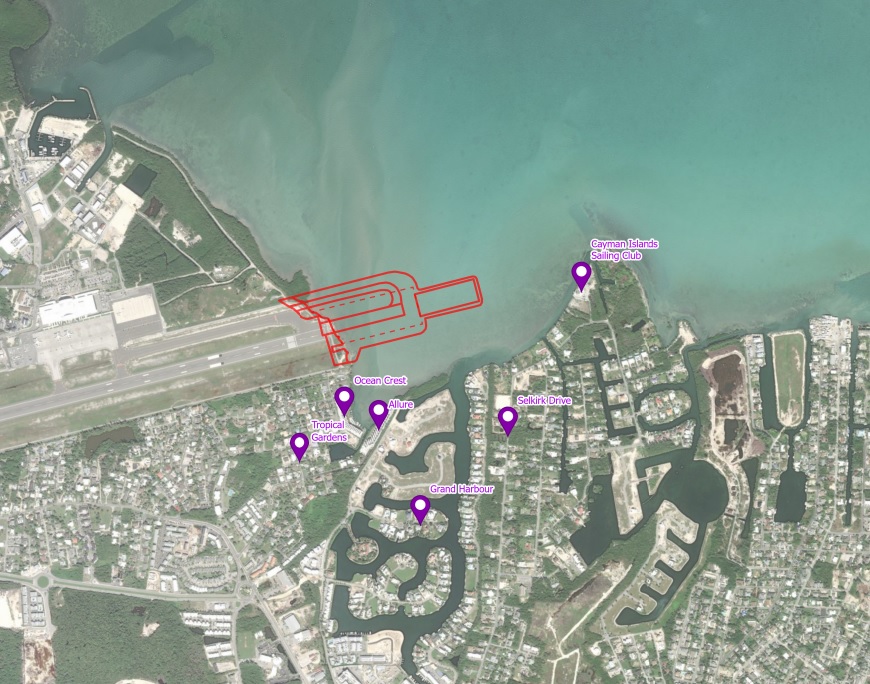
Cayman Islands Airports Authority CEO Albert Anderson explained at Tuesday evening’s meeting, held at the airport, that the idea for the proposed 2,000-foot extension of the runway into the North Sound had originated following discussions with UK airlines British Airways and Virgin Atlantic, which had stated they needed a runway that’s at least 8,000 feet long to bring their larger aircraft to Cayman.
The meeting was held as part of a public consultation into the terms of reference for an environmental impact assessment of the extension plan. Making the runway longer to accommodate larger BA and Virgin Atlantic planes is one of several proposed developments at all three of Cayman’s airports laid out in a master plan that was released in 2023.
Accommodating long-haul routes
Project manager Roy Williams said for Owen Roberts International Airport to accommodate the wide-body Boeing 787 or Airbus 350 planes, a longer runway is necessary. He noted that the Department of Tourism had indicated, “There’s a lot of interest in long-range aircraft coming here from Europe, possibly South America, maybe even the Middle East, so that’s what’s driving this.”
Extending the opposite end of the runway to the west was not a preferred option as it would entail moving a section of Crewe Road and the cricket pitch, he explained.
Former Cayman Islands Airports Authority CEO Kerith McCoy, at the meeting, raised a number of concerns about the project, chief among them being what he described as the seeming ‘if we build it, they will come’ approach, when no agreements were in place to guarantee that long-haul flights would come to Cayman.
He said during his decades-long tenure at the airports authority, British Airways and Virgin Atlantic had come to the table for discussions a number of times about flights from Europe.
“As far as the lengthening of the runway for long-haul flights, it always comes down to two items,” McCoy said. “Marketing in Europe, or lack thereof [as the Department of Tourism] had no marketing structure in Europe or for the European market. The second impediment was [rescue and fire-fighting services] support,” he said.
McCoy added, “I think the country needs to balance the cost that we know such a project will entail against the benefits, if they are there.”
Department of Tourism chief officer, Stran Bodden, and former tourism minister Kenneth Bryan, now in the opposition, were in attendance at the public meeting.
Opening up a secondary market
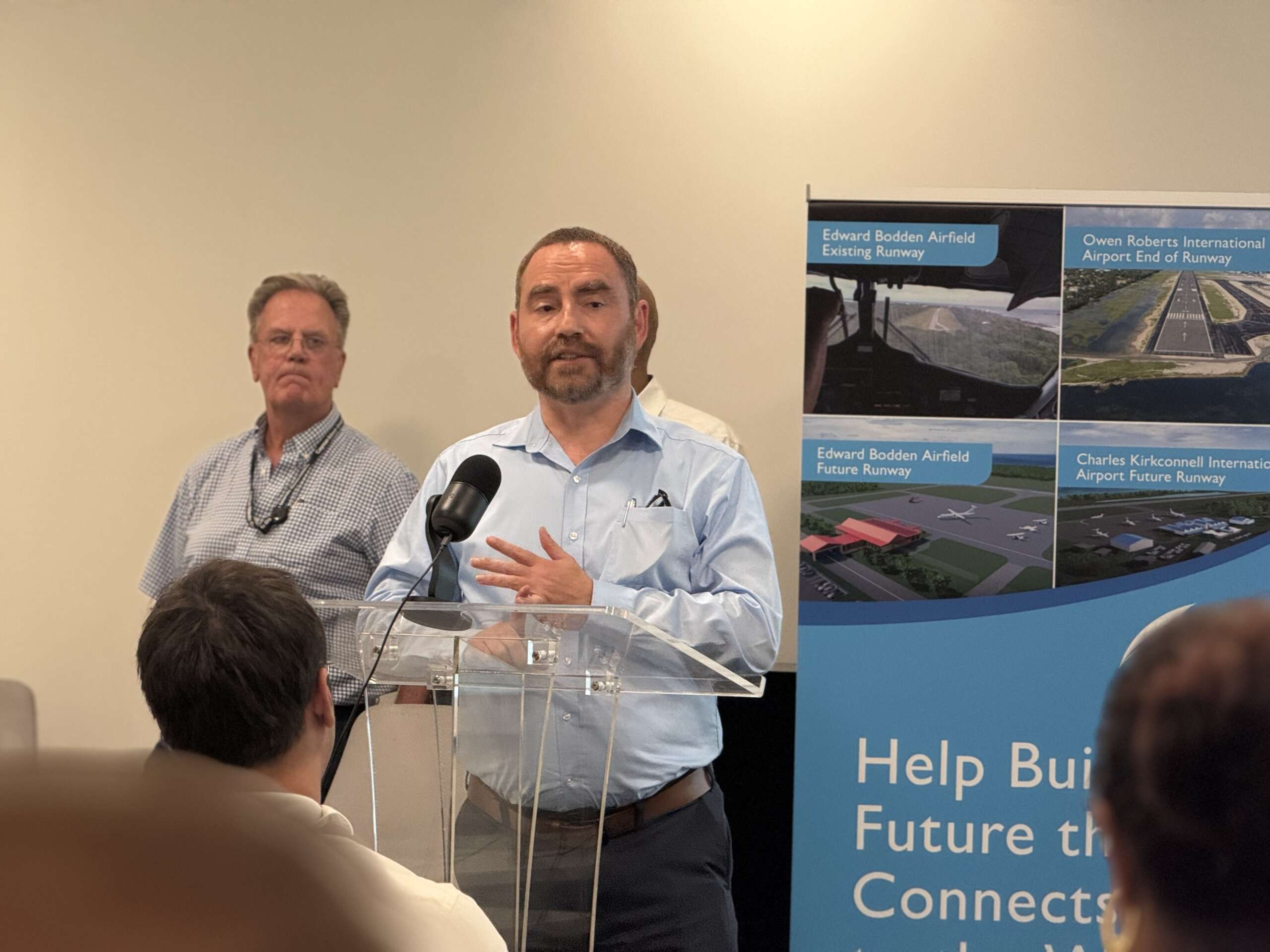
Responding to the question of marketing in Europe, the DoT’s Bodden acknowledged that the UK and European market is a secondary one for Cayman, with the US being the primary tourism market. He said Cayman recently appointed an agency in Germany to help build the European market and has an office in the UK which promotes the Cayman Islands in Britain and continental Europe.
He added, “I will say it is a secondary market, but in terms of diversification, that’s what we’re looking to do.”
Former minister Bryan briefly took to the stage to note that 80% of Cayman’s tourists come from the US, saying the islands should diversify its market, and added, “If, God forbid, geopolitically, something happens in the United States, you don’t want to have all your eggs in one basket.”
In response to the question of rescue and fire-fighting service support, Anderson said the fire service had been “in lockstep with us through the planning process. They have new equipment now and they are aware of what this runway would require.”
Other audience members asked if a business case had been drawn up to justify the cost of the runway. Anderson stated that the process “would not be completed without a business case that is done by a professional entity and sent to Cabinet to be approved”.
He noted that an environmental impact assessment would first have to be carried out before a financial analysis was done.
An outline business case for this project, and the other proposals for the three airports, which are slated to cost $660 million, are included in the master plan.
Some residents who live in Ocean Crest, Tropical Manor and other properties beside the North Sound whose sea views, recreational use of the water and property values would likely be impacted by an elongated runway also raised questions and concerns about the proposal at the meeting.
Another attendee queried what problem the runway extension was trying to fix, noting that tourism numbers appeared to be continuing to rise, with each recent year, outside of the period impacted by COVID-19, setting record figures. He noted that the Bahamas has the longest runway in the Caribbean, “but still 97% of its tourists come from the US”. He questioned why Cayman wasn’t concentrating on catering to the US, since the American market “is our bread and butter”.
Asked about the funding of the proposed runway project and the other developments contained in the master plan, Anderson said it would be driven by airport revenue, noting that passenger fees had been increased in 2023 for this purpose.
A public consultation is currently under way on the terms of reference for environmental impact assessments of the Owen Roberts runway expansion plan, the proposed relocation of Little Cayman’s Edward Bodden Airfield, and the inclusion of runway end safety areas at Cayman Brac’s Charles Kirkconnell International Airport. The deadline for feedback from the public is 6 June.
For more information on the public consultation, click here.