


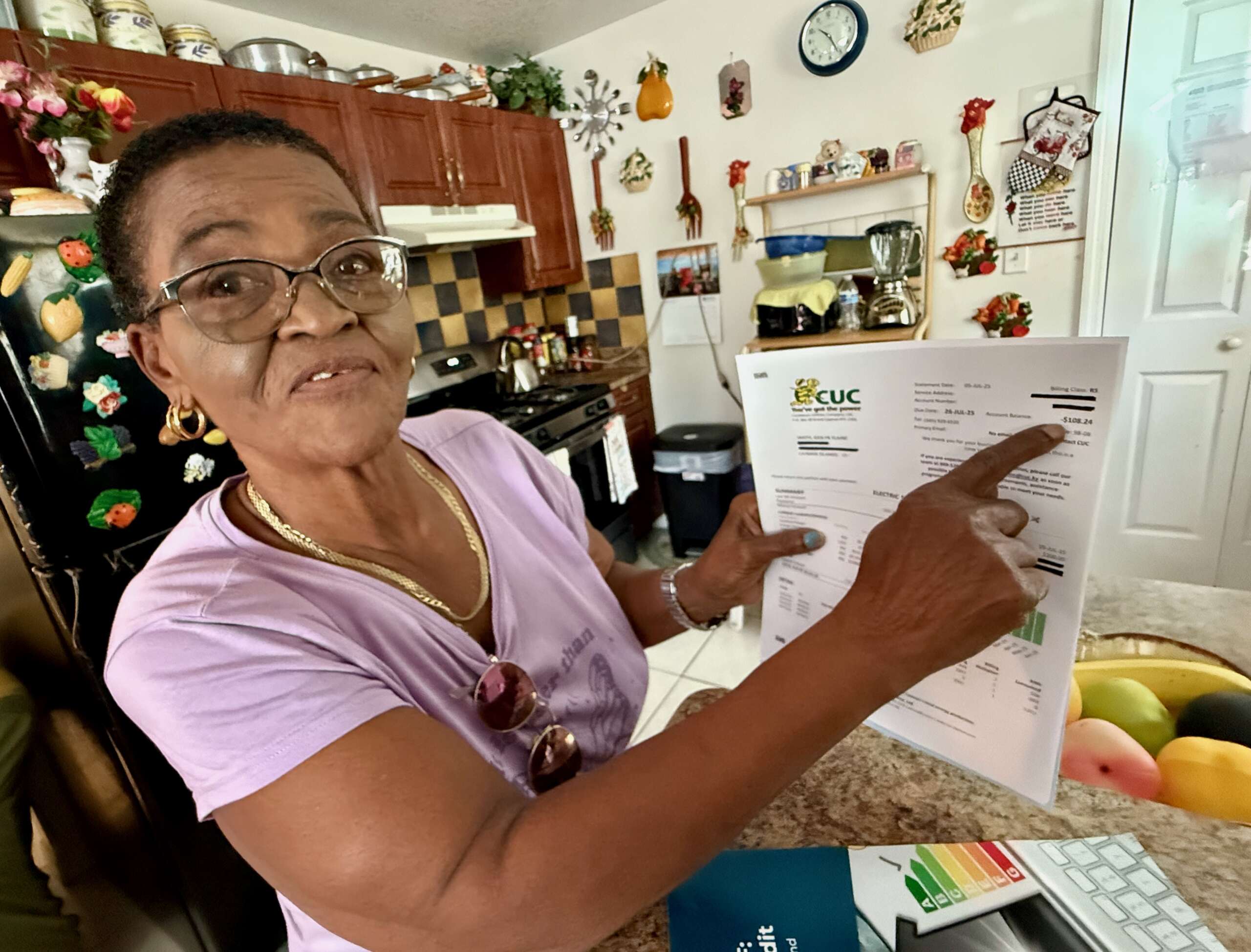
Idolyn Smith used to dread the arrival of her electricity bills.
The number in the envelope determined what kind of month she was going to have. How much she could spend on food, whether she could run the air conditioner at night or a fan for her husband, who was laid up in bed with a broken hip.
“Sometimes I didn’t want to open it,” she said.
“I would sit and think, ‘Lord don’t tell me it is high again’.”
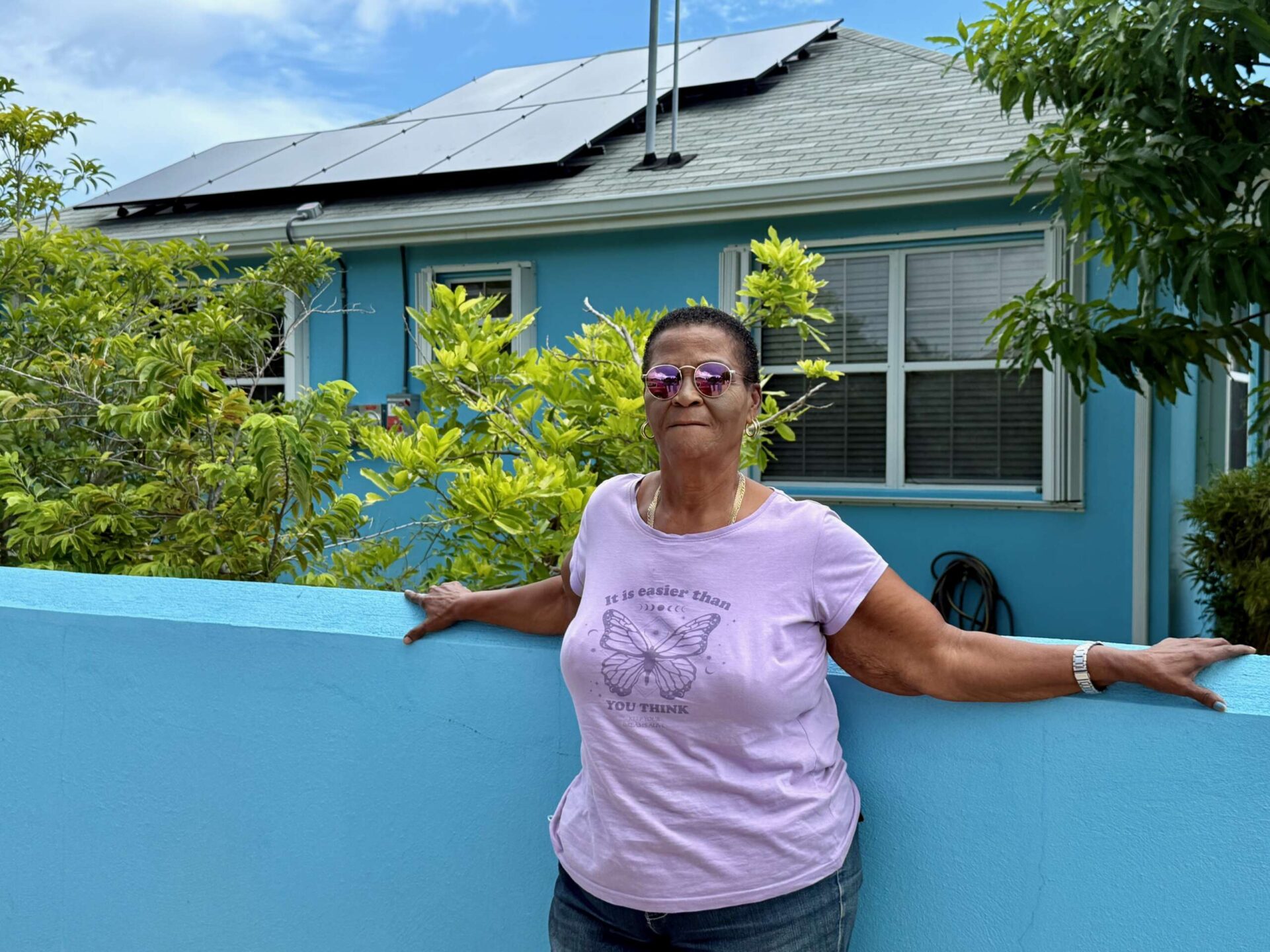
Now, she proudly displays her July bill, showing a credit of $108.24.
As the summer heat reaches its sizzling peak, many in Cayman are seeing their electricity usage surge.
But Smith’s energy use – and, critically, her bills – are lower than they have ever been.
Only two years ago, she was seeing monthly bills of more than $500 for her tiny National Housing Development Trust home in West Bay.
Now, after spray foam insulation, a new air conditioning unit and solar panels were installed, she is effectively turning a monthly profit on her power supply.
Smith was one of 10 ‘guinea pigs’ in a European Union-funded project focusing on energy efficiency.
The project has transformed her life and her finances.
“I can’t explain the difference it has made,” she said. “I feel so good. The house is cooler, I sleep more comfortably, and now I have a couple of dollars left over for myself.”
Proof of concept
Beyond the personal impact on people like Smith, the project has also provided proof of concept for a quietly powerful national blueprint to fight a growing energy challenge in the Cayman Islands.
Earlier this year, utilities regulator, the Utility Regulation and Competition Office – known as OfReg or, more recently, URCO – issued a certificate of need for 90MW of new diesel power generation to help meet Grand Cayman’s growing energy needs. The regulator warned that, without that investment in fossil fuels, the island would be facing the prospect of ‘rolling blackouts’.
It has since walked back on that announcement and Caribbean Utilities Company (CUC) issued a press release Wednesday indicating that it was working with the regulator on a process to ensure a better mix of renewable energy is included.
Meanwhile, a bid process for Cayman’s largest ever solar farm and battery storage project – intended to be the first of multiple similar clean power projects – is under way.
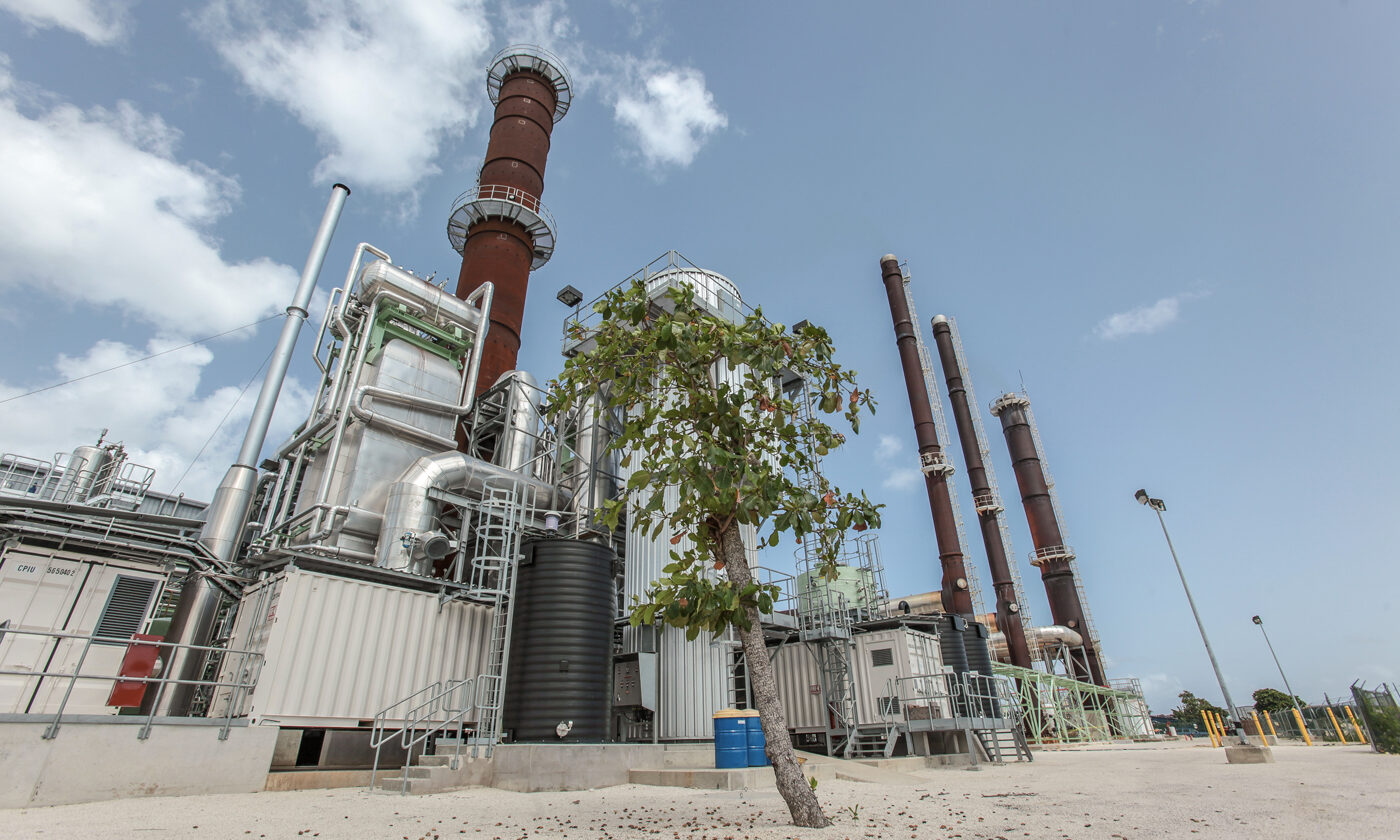
URCO and CUC differ on the appropriate blend of renewables and fossil fuels. But both agree that Cayman must quickly add significant new capacity to its power grid.
At peak demand, Cayman homeowners and businesses are already using up to 80% of the island’s current power supply. That’s outside the recommended safety net and leaves the island vulnerable in case of spikes in demand – for instance, during a hot spell – or dips in supply, such as when generators are in need of repair.
The goal over the next few years is to add 100MW to the grid – increasing Cayman’s power supply by 50%.
Ramping up output to meet the demands of a growing population and a thriving business community and tourism sector is considered a national security imperative.
Away from the limelight, energy officials are developing an equally powerful strategy to reduce demand – not by shrinking the economy, but by adapting homes and ways of building to minimise electricity use. A small-scale case study involving fewer than 50 homes has already had a seismic impact.
Insulating against high energy use
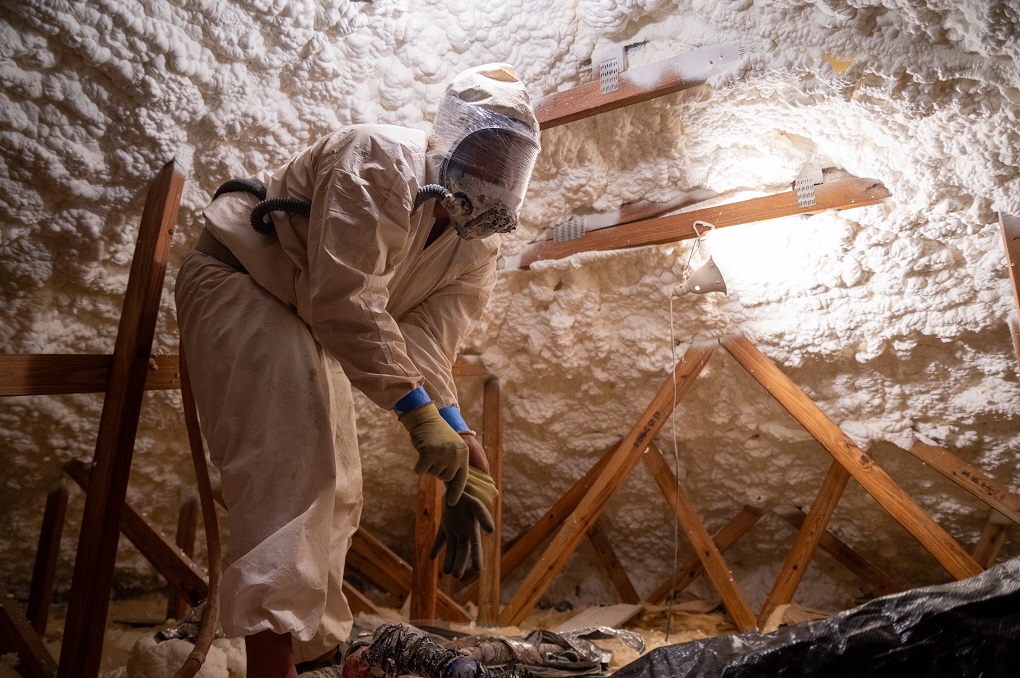
In cramped attics in the roof space of homes across Cayman, engineers in masks and hazmat suits spray foam insulation between the timber beams.
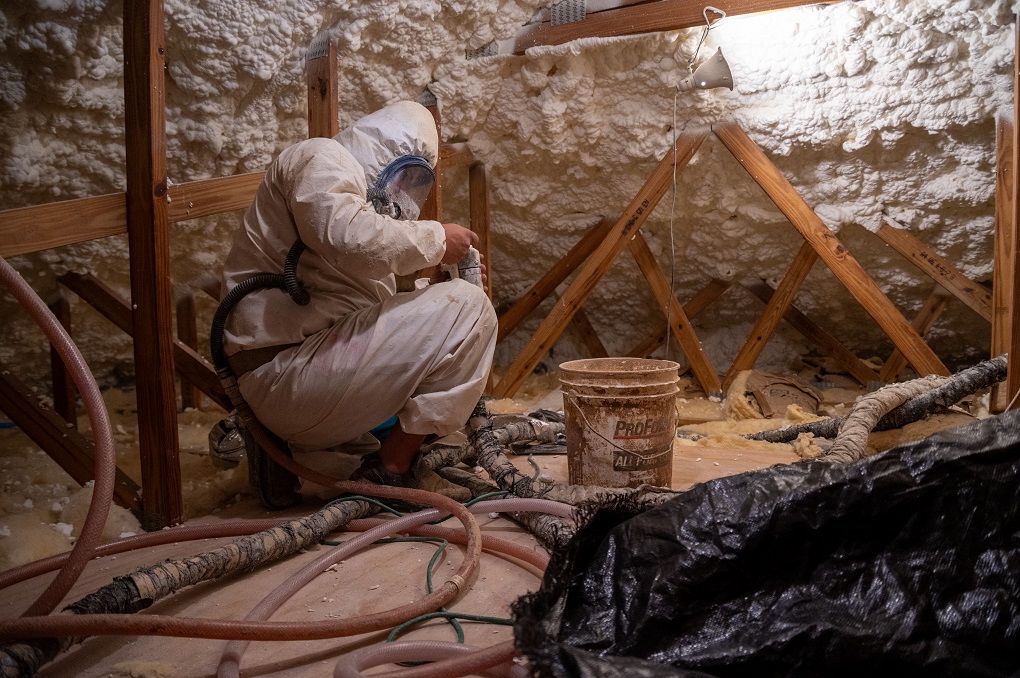
The method is a critical step in ensuring the cool air being pumped out by newly fitted air conditioners doesn’t escape.
It is perhaps the most critical ingredient in a government-sponsored effort to retrofit homes for energy efficiency.
Across two projects – one funded through the European Union’s RESEMBID grant programme, the other from Cayman’s Ministry of Sustainability – a total of 36 houses have been renovated. The results so far have been astounding.
In the EU programme, energy auditors worked with 10 homeowners, selected based on need through the National Housing Development Trust, to upgrade their air conditioning units, add spray foam insulation to their homes, and install solar panels to their roofs.
Details from all 10 homes show massive reductions in electricity bills.
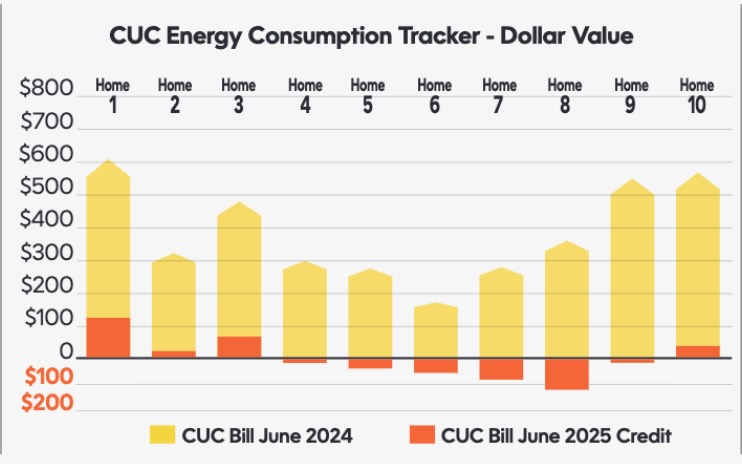
One resident went from a monthly bill of $544.49 last June to a credit of $10.25 for the same month this year.
Six of the 10 participants were showing a credit in their June bills this year through a mix of efficiency savings and solar production. The highest bill anyone had to pay was $122.22 compared with more than $600 for the same month in 2024.
The social and financial impact of the project for those involved has been profound.
But for Kristen Smith, Cayman’s National Energy Plan coordinator, the critical data is not purely measured in dollars and cents.
The reductions in energy usage from the retrofits are equally important.
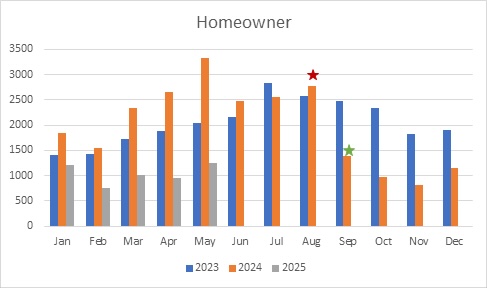
One resident cut their energy usage in half and most showed some reductions.
Hard choices
There are some anomalies. In fact, some of the residents used more electricity – though this was offset on their bills by the energy produced through new solar arrays.
In general, the project has driven positive changes in behaviour.
But, for some, the previous impact of power bills was so great that they were restricting their use at the expense of their own comfort levels.
Joy Ebanks had days where she had to choose between lights and air conditioning. When she went out to work at the hospital, she flicked the switches in the fuse box so that only the fridge was operating.

Now retired, she can afford the relative luxury of keeping her home cool throughout the day and running the lights and the television at night.
“Before, if I pay the light bill, I had to be scraping to eat. Now, I am smiling from ear to ear,” said the West Bay resident.
“I used to have to scrimp and save, but now I can just sit and rock back in my chair and it is easy like a Sunday morning. The last few months, I haven’t paid a thing.”
While there is no denying the impact of solar on those 10 homes, such installations are typically more expensive and require admittance to the CUC Consumer Owned Renewable Energy programme, known as CORE, which is periodically limited depending on demand.
A separate Cayman Home Energy Efficiency Retrofit (CHEER) programme, operated through the Ministry of Sustainability across 28 homes, focuses purely on energy use, insulation and air conditioning. It also had a transformative impact for those involved.
One homeowner saw his bill go from $1,100 a month to just over $300.
“That was actually the biggest energy and cost saving that we saw, and it didn’t involve any solar installation at all,” said Smith.
Jan Gupta, of Resilience Cayman, which partnered with the ministry on the CHEER programme, said homeowners were reporting an average of 35% to 40% drop in their bills. The project involved changing habits and using smart thermostats, as well as energy retrofits.
“This is a dramatic saving for these low-income families, for whom an extra $300 in their pocket every month makes a huge difference in their quality of life.”
Scaling up
For Smith, who has spearheaded both projects for the ministry, the results have been better than she could have hoped.
The projects showed that people could cut their energy use almost in half with a few simple modifications to their homes and habits. With the addition of solar, they could eliminate their use of fossil fuels totally and get credit on their bills.
For those selected, it has been life changing. But are they the lucky few?
“My neighbours are all jealous,” said Ebanks.
“They want to know how they can get it, too, but I think they have to pay because we were the guinea pigs.”
Unfortunately, it is not practical or affordable for the EU or the government to fund retrofits or solar panels for everyone, said Smith.
The idea of the project was a visible case study in public education. And the ability to make savings provides a powerful financial motive to others to follow suit.
Details of how to do it are on the ministry’s website, and banks are now making green loans available to help people fund the renovations and pay back over time. In most cases, a monthly repayment schedule is covered by the cost savings from the new technology.
Smith says government is continuing to do its part by providing information and making materials for retrofits duty free.
The bigger picture
But when she looks at the results from this small project, she imagines what an impact this could have on a national scale. If every home had the right air conditioning unit and the right insulation – that alone could cut the islands’ energy usage in half.
That’s not just cost savings, but also diesel fumes that don’t need to be pumped into the atmosphere, and land that does not need to be cleared for solar farms.
She agrees that Cayman is growing and more energy production is needed, but the National Energy Plan also involves limiting emissions by cutting the use of fossil fuels.
The analysis of the results continues, but she recognises that government can’t just leave it to the goodwill of developers and homeowners.
Discussions are now taking place on how to embed guidelines around insulation and air conditioning into planning codes for new buildings and to incentivise families to invest in adapting their homes to make savings in the long term.
Even without expensive retrofits, Smith said small changes – from turning up the thermostat when out of the house, to sealing leaky doors and windows – can make reasonable impacts.
“People just assumed that CUC was the issue,” she said. “They didn’t realise that by making changes to their own home and their own behaviour, they could reduce their bills by so much.”
How to do it
- To make the biggest energy savings, use an air conditioning unit with a SEER (Seasonal Energy Efficiency Rating) of at least 20.
- This should be combined with insulation to seal the airflow and ensure the home stays cool. The project used spray foam insulation.
- Adding solar panels and connecting them to the grid through the CUC Core programme allows homeowners to produce renewable energy and sell it back to the utility company in return for credit on their bills.
What does it cost?
The RESEMBID programme was funded through a 1.2 million Euro ($1.15 million) grant from the European Union. The CHEER project was funded through $500,000 from the Ministry of Sustainability.
For small homes, around 1,000 square feet, the total cost of installing new centralised AC units, insulation and solar panels ranged from $20,000 to $30,000.
How can I cut my bill?
Check the government’s energy site for advice on how to do an energy audit on your home and plan a retrofit.